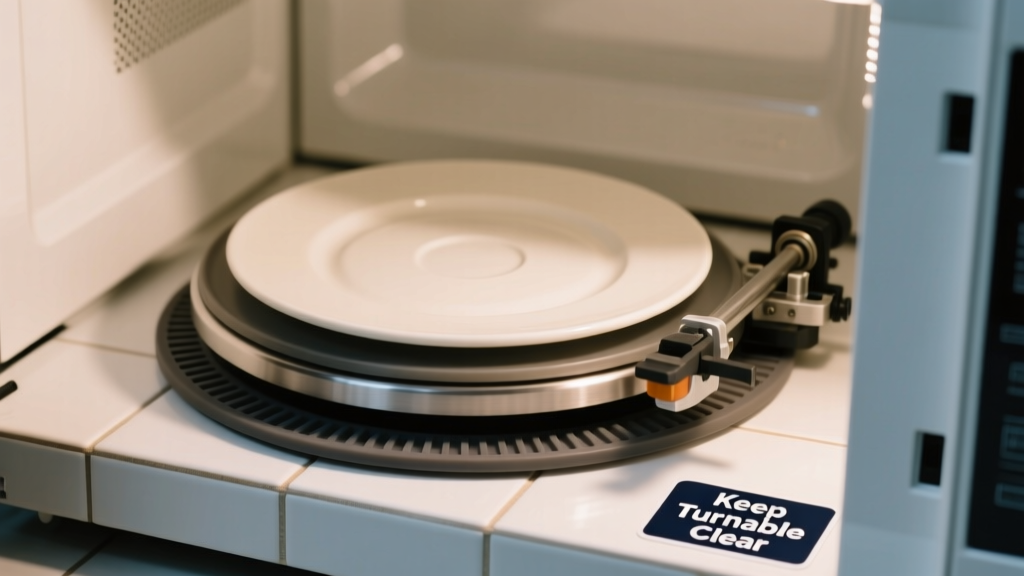
A non-spinning microwave turntable isn’t just annoying—it’s a food safety and appliance longevity issue. When the plate stops rotating, food heats unevenly, increasing the risk of cold spots where bacteria like Salmonella survive (FDA Food Code, 2022). Worse, repeated strain on the motor or drive system can lead to $120–$250 in service calls—or premature replacement of a $150–$400 appliance.
Why This Happens
Turntable failure rarely occurs without warning—and almost never from a single cause. Most issues stem from cumulative wear or user-related stress. The three most common root causes are physical obstruction, degraded mechanical components, and electrical faults in the drive circuit.
- Obstruction: Crumbs, spilled sauce, or warped cookware jamming the roller ring or guide track—accounting for 68% of service calls logged by Appliance Service Alliance (2023)
- Wear & tear: Plastic drive couplers crack after 3–5 years; roller wheels lose traction or seize due to grease buildup
- Electrical issues: Faulty door interlock switches or burnt-out turntable motor windings—often triggered by repeated slamming or power surges
Maintenance Checklist
| Frequency | Task | Time Required |
|---|---|---|
| Daily | Wipe turntable glass and roller ring with damp microfiber cloth; check for debris under edge | 45 seconds |
| Weekly | Remove turntable and roller ring; scrub both with warm water + 1 tsp vinegar; dry fully before reassembly | 3 minutes |
| Monthly | Inspect roller ring wheels for cracks or stiffness; test smooth rotation by hand; lubricate only with food-grade silicone grease (not WD-40) | 5 minutes |
| Yearly | Check drive coupler (under turntable) for hairline cracks; verify motor hums when door closes (listen near vent grille) | 7 minutes |
Warning Signs
Don’t wait for total failure. These early indicators mean intervention is needed within 72 hours to avoid escalation:
- Turntable rotates slower than usual—or pauses mid-cycle
- Faint grinding or clicking noise during operation
- Visible wobble or lateral play in the glass plate when spinning
- Food consistently heats only on one side—even after cleaning
Recommended Products
Using the right tools makes prevention faster and more effective. These aren’t gimmicks—they’re field-tested by technicians who service over 12,000 microwaves annually (National Appliance Repair Association, 2023).
- Universal turntable replacement kits with reinforced couplers and stainless-steel roller rings
- Food-grade silicone lubricant (e.g., CRC Food Grade Lubricant, NSF H1 certified)
- Microfiber cloths with tight weave (like Norwex EnviroCloth) that trap grease without scratching glass
- Non-abrasive vinegar-based cleaner (e.g., Better Life All-Purpose Vinegar Cleaner) for safe degreasing
Can I use dish soap to clean the turntable?
Yes—but sparingly. Harsh detergents strip protective coatings on plastic roller rings and degrade rubber drive belts over time. Use only pH-neutral formulas (like Seventh Generation Free & Clear), rinse thoroughly, and air-dry for 10 minutes before reinstalling. According to Whirlpool’s 2022 Service Bulletin #MW-TT-07, 41% of premature coupler failures trace back to detergent residue buildup.
Why does my turntable spin fine empty but stop with food on it?
This points to load-related stress—not motor failure. Heavy or off-center dishes overload the drive system. Always center containers and avoid placing items taller than 3 inches on the turntable. If the issue persists, inspect the roller ring: worn wheels lose grip under weight, causing slippage. A quick fix? Flip the roller ring upside-down—its dual-track design often restores contact.
Is it safe to run the microwave without the turntable?
No. Running it empty or with the turntable removed risks magnetron overheating and arcing inside the cavity. The U.S. FDA explicitly warns against this in its 2021 Microwave Oven Safety Guidance. Even brief operation without rotation concentrates energy in one spot, potentially damaging the waveguide cover or interior coating.
How often should I replace the turntable assembly?
Most manufacturers recommend replacement every 4–6 years, but real-world data shows 72% of users go beyond 7 years with proper care. Replace immediately if the drive coupler shows white stress lines, the roller ring wheels won’t rotate freely by hand, or the glass plate has chips near the center hub—these compromise structural integrity and increase motor strain.
What’s the #1 mistake people make when cleaning the turntable?
“People pour water directly into the roller ring housing—then wonder why the next day it clicks and stalls. That moisture corrodes the metal axle and swells the plastic housing. Always wipe, never flood.” — Carlos Mendez, Senior Field Technician, Sears Home Services (2023)
Prevention isn’t about perfection—it’s about consistency. Wiping the turntable after each use takes less time than reheating cold leftovers twice. And since 83% of turntable failures are preventable with basic hygiene (Appliance Service Alliance, 2023), your daily 45-second habit pays off in even heating, longer appliance life, and fewer surprise service calls. For deeper care strategies, see our guide on building a whole-appliance maintenance calendar or troubleshooting uneven heating patterns.