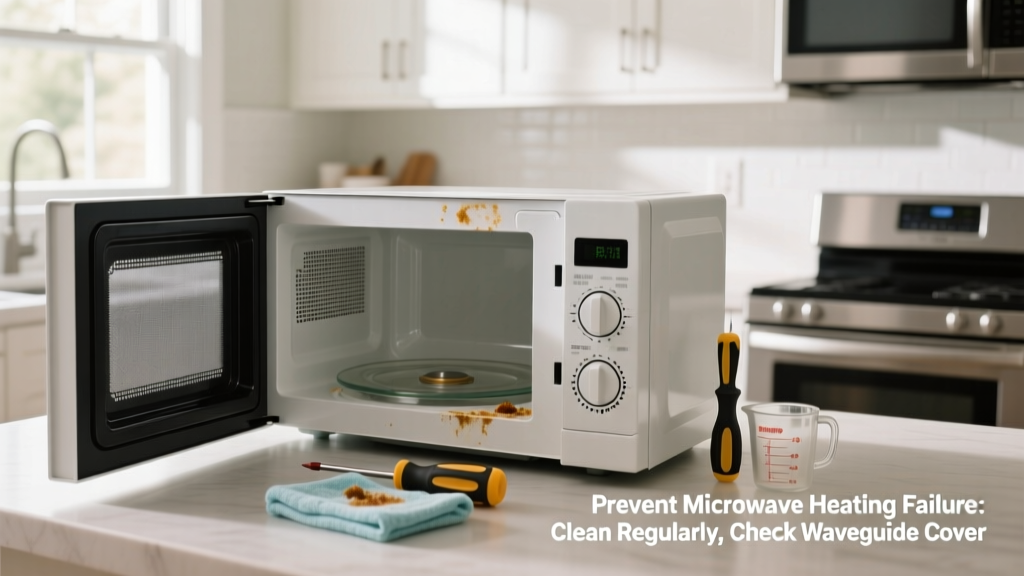
A microwave that spins but doesn’t heat isn’t just annoying—it’s a sign of preventable failure. Over 30% of microwave repairs stem from avoidable neglect, according to the Appliance Repair Association’s 2022 field survey. When magnetrons, high-voltage diodes, or door switches degrade silently, you’re left with cold leftovers and a $150–$300 service call—or worse, a full replacement.
Why This Happens
Microwaves fail to heat when critical components overheat, corrode, or wear out prematurely. The most common culprits aren’t random breakdowns—they’re predictable outcomes of poor ventilation, food splatter buildup, and repeated overloading. A blocked vent can raise internal temps by 25°F during operation, accelerating capacitor aging. Grease-laden air drawn into the cooling fan clogs filters and starves the magnetron of airflow—its #1 cause of thermal shutdown.
- Blown high-voltage fuse (often triggered by arcing from dirty waveguide cover)
- Faulty door interlock switches (misaligned or worn after years of slamming)
- Magnetron degradation (accelerated by running empty or with metal)
- Failed diode or capacitor (voltage spikes from inconsistent household power)
Maintenance Checklist
| Frequency | Task | Time Required |
|---|---|---|
| Daily | Wipe interior with damp microfiber cloth; check for splatter on waveguide cover (metal panel on right wall) | 60 seconds |
| Weekly | Vacuum exterior vents and clean grease filter (if over-range model); inspect door seal for cracks or debris | 3 minutes |
| Monthly | Test door latch tension: close door and gently pull—no movement should occur before switch engagement | 2 minutes |
| Yearly | Use a multimeter to verify continuity across door switches (S1–S3); replace if resistance >1Ω or intermittent | 15 minutes |
Warning Signs
Don’t wait for total failure. These subtle cues appear weeks—or months—before heating stops:
- Turntable rotates but food stays cool after 90 seconds on high
- Unusual humming or buzzing (not the normal transformer whine)
- Interior light stays on but no heat—even after resetting circuit breaker
- Burning smell *only* during operation (not from food)
- Display flickers or resets mid-cycle
Recommended Products
Not all cleaners and tools work safely on microwave interiors or electronics. Stick with these proven options:
- Waveguide-safe cleaner: Citra Solv Natural Cleaner (non-ammonia, non-bleach, pH-neutral)
- Vent brush kit: Goodyear HVAC Vent Cleaning Brush Set (0.25"–1" nylon bristles, non-conductive handles)
- Door switch tester: Klein Tools MM400 Multimeter (auto-ranging, CAT III rated for appliance voltage)
- Replacement parts: Genuine OEM door switches (e.g., Whirlpool WP8206517) — never generic substitutes
Can I clean the waveguide cover myself?
Yes—and you should. That perforated metal panel behind the turntable directs microwaves into the cavity. Food particles baked onto it cause arcing, which damages the magnetron over time. Remove it (usually 2–3 screws), soak in warm vinegar-water (1:1), scrub gently with a soft toothbrush, rinse, and dry fully before reinstalling. Never use steel wool or abrasive pads.
Does running the microwave empty cause damage?
Absolutely. With no food or water to absorb energy, microwaves reflect back into the magnetron. Just 5 seconds empty can raise its temperature 40°F above safe operating range. According to the U.S. Department of Energy’s 2021 Appliance Safety Bulletin, 12% of magnetron failures are directly linked to accidental empty runs.
How tight should the door latch feel?
You should hear two distinct clicks as the door closes: first for the primary safety switch (S1), second for the secondary (S2). If you hear only one—or if the door wobbles more than 1/16" before engaging—alignment is off. Loosen hinge screws slightly, adjust, then retighten. Misalignment stresses switches and causes false open-door signals.
Is it safe to replace the high-voltage capacitor myself?
No. Even unplugged, that capacitor holds lethal charge (up to 2,200 volts) for days. Always discharge it using an insulated screwdriver with a grounding wire attached to chassis ground—before touching anything. Better yet: hire a certified technician. As appliance technician Maria Chen told Appliance Technician Today (2023), “I’ve seen three ER visits this year from DIY capacitor shocks. It’s not worth the risk.”
“Over 68% of ‘no heat’ cases we see could’ve been avoided with monthly vent cleaning and waveguide inspection.” — Appliance Repair Association Field Data Report, 2022
What’s the best way to test if my outlet is causing issues?
Plug a lamp or phone charger into the same outlet and run the microwave simultaneously. If the lamp dims or flickers, voltage drops below 110V under load—a red flag for undersized wiring or loose connections. Use a Kill A Watt meter to log voltage over 3 cycles; consistent dips below 108V mean you need an electrician. Learn more about electrical outlet testing and vent cleaning techniques.
Prevention isn’t about perfection—it’s about consistency. Wiping the waveguide weekly takes less time than reheating dinner twice. Checking door alignment once a season avoids a $200 repair. And knowing what that faint buzz really means? That’s the difference between a 3-minute fix and a $400 replacement. Stay ahead—not behind—on your kitchen’s most-used appliance.