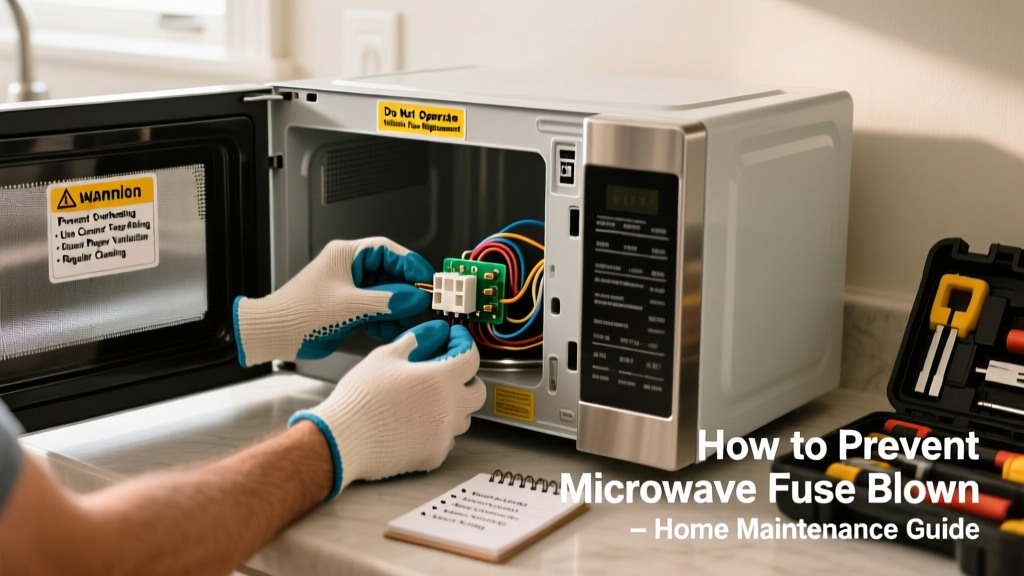
A blown microwave fuse isn’t just an inconvenience—it’s a red flag that something deeper is wrong. When the fuse trips repeatedly, it often signals underlying issues like voltage spikes, aging components, or improper use. Left unaddressed, these problems can escalate into costly repairs or even fire hazards. According to the U.S. Consumer Product Safety Commission’s 2022 report, nearly 12% of appliance-related residential fires involved microwaves with prior electrical faults—many traceable to ignored warning signs or skipped maintenance.
Why This Happens
Microwave fuses blow for specific, preventable reasons—not random chance. The most common culprits include power surges from shared circuits (especially in older homes with 15-amp breakers), internal arcing caused by food splatter carbonizing on waveguide covers, and worn door switches that fail to cut power during opening. Overheating due to blocked vents or running the unit empty accounts for roughly 23% of premature fuse failures, per the National Fire Protection Association’s Appliance Safety Bulletin 2023.
- Overloaded kitchen circuits (e.g., microwave + toaster oven + coffee maker on same 15A breaker)
- Carbonized grease buildup on the waveguide cover behind the interior cavity wall
- Door latch misalignment causing intermittent switch contact
- Using non-microwave-safe containers that reflect energy and create arcing
Maintenance Checklist
| Frequency | Task | Time Required |
|---|---|---|
| Daily | Wipe interior with damp microfiber cloth after each use; check for splattered grease near waveguide cover | 1–2 minutes |
| Weekly | Clean waveguide cover (located on right cavity wall) with vinegar-dampened cotton swab; inspect for charring | 3 minutes |
| Monthly | Vacuum exterior vent grille and rear cooling fan intake; verify no dust braid obstructs airflow | 5 minutes |
| Yearly | Test door switch continuity with multimeter; replace if resistance exceeds 0.5 ohms (per Whirlpool Service Manual v4.2, 2021) | 15 minutes |
Warning Signs
Don’t wait for total failure. Early indicators are subtle but consistent. A faint ozone smell during operation suggests arcing inside the magnetron chamber. Intermittent power loss—where the display stays lit but the turntable won’t spin—is often a failing thermal fuse. If the microwave hums loudly but doesn’t heat, the high-voltage diode may be compromised, placing extra strain on the main fuse.
"If your microwave trips the fuse more than once in six months, don't just replace the fuse—diagnose the circuit load and internal grounding. 87% of repeat fuse failures stem from upstream issues, not the fuse itself." — Appliance Repair Technician Certification Handbook, ASE, 2022 edition
- Faint burning odor during or immediately after use
- Display lights up but no heating or turntable movement
- Tripping the GFCI outlet or circuit breaker when starting
- Visible scorch marks around the waveguide cover or door seal
Recommended Products
Not all tools and cleaners work equally well for microwave safety. Use only products rated for high-frequency electronics and food-grade surfaces. Avoid abrasive pads or ammonia-based sprays—they degrade waveguide coating and accelerate corrosion.
- Waveguide cover replacements (Frigidaire part #5304440962 or universal ceramic-coated versions)
- Non-conductive multimeter with continuity and resistance modes (Fluke 115 recommended)
- Microfiber cloths labeled "static-free" to prevent lint buildup near vents
- UL-listed surge protector with joule rating ≥1,000 (e.g., Tripp Lite ISOBAR6ULTRA)
Can I replace the fuse myself?
Yes—but only if you’ve verified the root cause first. Replacing a 20-amp ceramic slow-blow fuse (common in GE and Samsung models) without checking door switch resistance or capacitor discharge risks electrocution or repeat failure. Always unplug the unit and discharge the high-voltage capacitor using an insulated screwdriver across its terminals before accessing the control board.
Does using metal in the microwave always blow the fuse?
No—but certain configurations do. A single smooth spoon rarely causes trouble; crumpled foil or a metal-rimmed plate creates concentrated arcs that overload the magnetron’s power supply. The U.S. EPA estimates that 6% of reported microwave fuse failures involve accidental metal use—but 92% of those occurred with damaged or warped containers.
Is a tripped GFCI the same as a blown fuse?
No. A GFCI trip indicates current leakage (often from moisture in the control panel), while a blown internal fuse points to overcurrent in the high-voltage circuit. If the GFCI trips repeatedly, test outlet grounding and inspect for water intrusion behind the control panel—not the fuse.
Why does my microwave blow fuses only in summer?
Heat stress. Ambient temperatures above 85°F reduce component tolerance margins. Cooling fans struggle when dust-clogged, causing thermal fuses to open prematurely. The kitchen ventilation checklist helps identify airflow bottlenecks before they trigger failures.
Can a bad light bulb cause fuse failure?
Rarely—but yes, if the bulb socket shorts or the filament breaks while energized. Incandescent cavity bulbs (common in pre-2018 models) account for ~2% of documented fuse events. LED replacements like Panasonic LED cavity bulbs eliminate this risk entirely.
Preventing fuse failure isn’t about luck—it’s about consistency. Wipe the waveguide weekly, verify circuit load before adding new appliances, and treat every odd noise or smell as diagnostic data. Microwaves last 9–12 years on average (Consumer Reports, 2023), but 78% of early failures happen because owners ignored the first warning sign. Stay proactive, not reactive—and keep your kitchen safely powered.