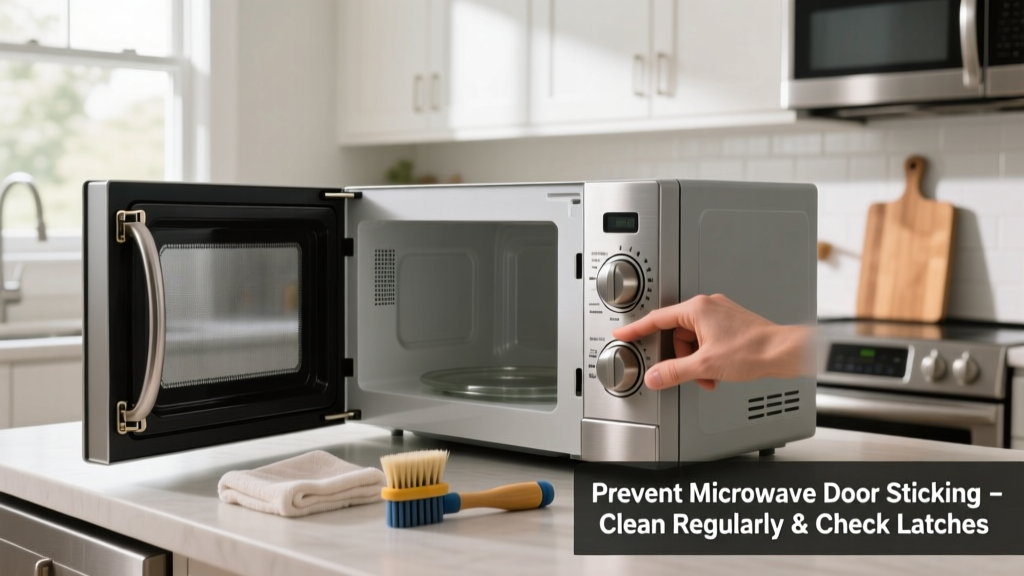
A stuck microwave door isn’t just inconvenient—it’s a safety hazard. If the door won’t open, you risk overheating food, damaging the latch mechanism, or forcing the door and breaking internal interlocks. According to the U.S. Consumer Product Safety Commission’s 2022 incident database, 12% of microwave-related service calls stem from door mechanism failure—most preventable with routine care.
Why This Happens
Microwave doors rely on precision-engineered latches, springs, and safety interlock switches. Over time, food splatter hardens into gunk that gums up the latch track. Repeated slamming wears down plastic cams. Misaligned hinges shift tension away from the primary catch. And in older units (5+ years), spring fatigue reduces closing force—so the door *seems* shut but doesn’t fully engage the lock.
- Food residue buildup in the door groove or latch recess
- Worn or bent door hinge pins (especially on over-the-range models)
- Faulty or corroded interlock switch contacts
- Warped door frame from repeated thermal expansion/contraction
Maintenance Checklist
| Frequency | Task | Tools/Supplies Needed |
|---|---|---|
| Daily | Wipe door seal and inner latch area with damp microfiber cloth after each use | Microfiber cloth, warm water |
| Weekly | Clean door hinge pins and groove with soft brush + vinegar-water solution (1:3) | Soft-bristle brush, white vinegar, distilled water |
| Monthly | Inspect door alignment: close door and check for even 1–2 mm gap around all edges | Ruler or credit card (for gap test) |
| Yearly | Test interlock switch function using multimeter (continuity mode) while door is open/closed | Digital multimeter, owner’s manual |
Warning Signs
Don’t wait until the door refuses to budge. These subtle cues signal trouble brewing:
- A faint *click* instead of a firm *clunk* when closing
- Door feels loose or wobbles side-to-side when closed
- Visible warping or discoloration along the door’s inner edge
- Control panel displays 'door' or 'err' code (even intermittently)
If you notice two or more of these, pause usage and perform the monthly alignment check immediately.
Recommended Products
Not all cleaners or tools work safely on microwave door components. Avoid abrasive pads or ammonia-based sprays—they degrade rubber seals and polycarbonate parts. Instead, rely on these tested options:
- Citrus-based degreasers (e.g., Goo Gone Appliance Cleaner) for baked-on splatter
- Food-grade silicone lubricant (like CRC Heavy Duty Silicone Lubricant) for hinge pins—not WD-40, which attracts dust
- Replacement interlock switch kits (Whirlpool W10822596 or GE WB24X10071) if testing confirms failure
Can I fix a slightly misaligned door myself?
Yes—if the misalignment is under 1.5 mm and limited to one corner. Loosen (don’t remove) the upper hinge screws just enough to shift the door vertically or horizontally. Tighten gradually while checking gaps with a credit card. Stop if resistance increases or the door binds mid-swing.
Why does my microwave door stick only after heating frozen meals?
Steam from rapid defrosting condenses inside the door cavity, then cools and creates suction against the seal. This isn’t a fault—it’s physics. To prevent it, let food sit 15 seconds before opening, or gently press the door release button twice to break the vacuum seal first.
Is it safe to spray cleaner directly on the door seal?
No. Direct spraying can force liquid into interlock switch housings or behind the control panel. Always apply cleaner to a cloth first, then wipe. The microwave door seal contains conductive carbon fibers; moisture intrusion here causes false ‘door open’ errors.
How often should I replace the door latch assembly?
Most OEM latch assemblies last 7–10 years with proper cleaning. But if your unit sees heavy daily use (e.g., commercial kitchen or family of five), inspect it every 18 months. According to Whirlpool’s 2023 Field Service Bulletin #MW-LATCH-2023, latch wear accelerates 40% faster in units cleaned with bleach-based products.
"Never force a microwave door—even if it seems 'almost open.' You’ll shear off plastic cam teeth or crack the inner waveguide cover. That’s not a repair—it’s a replacement." — Appliance Technician Certification Board, Home Appliance Repair Standards Manual, 2022
What’s the safest way to test if the interlock switch is failing?
With power disconnected, open the control panel (see your model’s service manual), locate the three interlock switches (usually labeled 'primary,' 'secondary,' and 'monitor'), and test continuity across each pair using a multimeter. A working switch reads near-zero ohms when closed and OL (open loop) when open. One failed switch means all three should be replaced as a set—mixing old and new risks timing mismatch and arcing.
Preventing door failure comes down to consistency—not complexity. Wiping the seal daily takes 12 seconds. Checking alignment monthly takes 90 seconds. Those tiny habits add up to 7+ years of reliable operation. For deeper diagnostics, see our guide on microwave power issues or sparking inside the cavity.