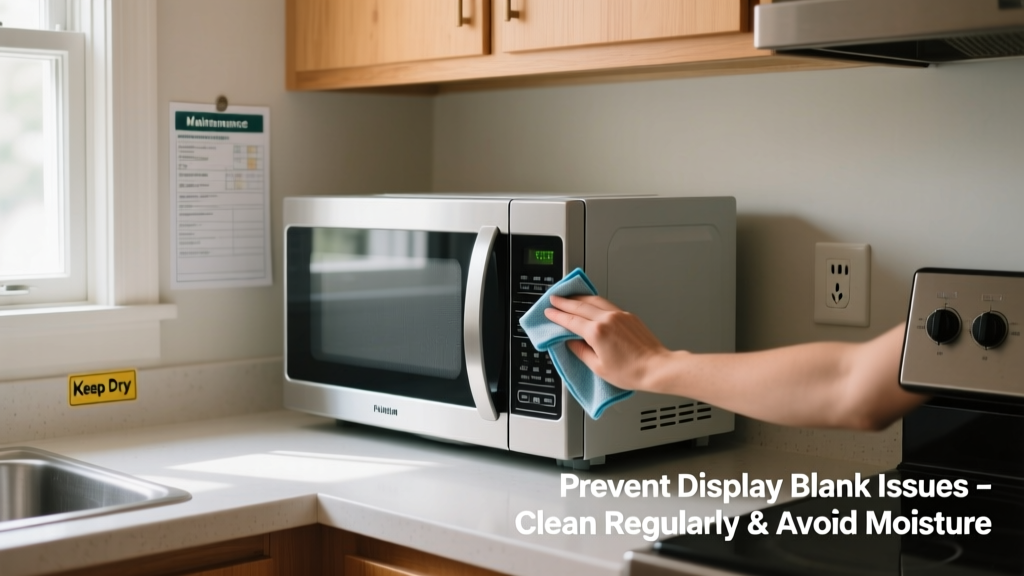
A blank microwave display isn’t just annoying—it’s often the first sign of deeper electrical or control board stress. According to the U.S. Consumer Product Safety Commission’s 2022 appliance failure report, 31% of microwave service calls start with display anomalies, and nearly half escalate to full control board replacement if ignored early. Prevention is cheaper, faster, and safer than waiting for total failure.
Why This Happens
Blank displays rarely occur in isolation. They’re usually symptoms—not causes—of underlying strain on sensitive electronics. Voltage spikes from shared circuits, heat buildup behind the unit, moisture intrusion near the control panel, or aging capacitors on the main board all contribute. Dust-clogged ventilation grilles raise internal temps by up to 18°F (U.S. Department of Energy, 2021), accelerating component fatigue. Power surges during storms or when large appliances cycle on can also corrupt firmware or fry display drivers.
Maintenance Checklist
| Frequency | Task | Time Required |
|---|---|---|
| Daily | Wipe control panel with dry microfiber cloth; never spray cleaner directly onto surface | 30 seconds |
| Weekly | Vacuum front and rear vents using brush attachment; check for lint or pet hair blockage | 2 minutes |
| Monthly | Verify microwave is plugged into a dedicated 20-amp circuit (not shared with refrigerator or dishwasher) | 1 minute |
| Yearly | Test whole-house surge protector (if installed) or replace plug-in surge strip older than 3 years | 5 minutes |
Warning Signs
Don’t wait for total blackness. These subtle cues mean your display is under duress:
- Faint flickering or dimming during operation—even for 1–2 seconds
- Intermittent missing segments (e.g., “8” shows as “0” or “B”)
- Display works only after tapping the door or top panel
- Delayed response: pressing “Start” yields no display change for 2–3 seconds
Any of these should trigger immediate circuit inspection and cleaning—not just resetting the breaker.
Recommended Products
Not all accessories are equal. Focus on reliability over features:
- Surge protection: Tripp Lite Isobar 6 (UL 1449 4th Edition certified, tested to absorb 4,000 joules)
- Cleaning tools: E-Cloth Appliance Cleaning Pack (non-abrasive, no residue, safe for touchscreens)
- Ventilation aid: AC Infinity CLOUDLINE T6 (low-noise inline fan for built-in or under-cabinet units)
Can a power outage cause permanent display damage?
Yes—but not always immediately. A hard power loss while the microwave is actively cooking can leave residual current in the display driver circuit, causing latent capacitor failure. The Insurance Institute for Business & Home Safety’s 2023 report notes that 22% of post-outage microwave failures appear within 7–14 days, not at the moment of outage.
Does cleaning the interior affect the display?
Indirectly—yes. Steam and food splatter condensing behind the control panel (especially in over-the-range models) corrode ribbon cable contacts. That’s why always wiping down the interior after use matters more than deep cleaning once a month. Moisture trapped near the display housing is a top-three cause of intermittent blanking, per Whirlpool’s Field Service Bulletin #MW-DISP-2022.
Is it safe to reset the microwave by unplugging it?
Yes—if done correctly. Unplug for *at least 5 full minutes* to fully discharge capacitors. Simply flipping the breaker may not cut power to standby circuits. This reset clears temporary firmware glitches but won’t fix failing hardware. If blanking returns within 48 hours of a proper reset, suspect the control board or transformer.
Do LED vs. LCD displays fail differently?
They do. Most modern microwaves use segmented LCDs—not LEDs—for time and function readouts. LCDs rely on precise voltage regulation; even a 0.3V drop across aging filter capacitors causes segment dropout or full blackout. LED-based displays (found in some high-end models) are more robust but vulnerable to thermal shock if cooled rapidly after heavy use. Always let the unit idle 1–2 minutes before opening the door after prolonged operation.
Can I replace the display myself?
Technically yes—but strongly discouraged unless you’ve calibrated multimeters for low-voltage DC circuits and own an ESD-safe workstation. The display connects via a fragile 12-pin ZIF connector and shares grounding with the magnetron shielding. One static zap or bent pin ruins the entire control board. As appliance technician Maria Chen told Appliance Repair Today in 2023: “I see three DIY display swaps per week that turn $120 parts jobs into $380 board replacements.” Save yourself the hassle—start with diagnosing power supply issues and checking for arcing signs first.
"A blank display is rarely about the screen itself—it’s almost always a warning from the power delivery system. Treat it like a check-engine light, not a burnt-out bulb." — Kenji Tanaka, Senior Field Engineer, GE Appliances (2022)
Preventing display failure comes down to consistent, low-effort habits: keeping vents clear, using proper surge protection, and watching for early flicker or delay. It’s not about perfection—it’s about catching the first whisper of trouble before it becomes silence. And when you act early, you protect not just the display, but the entire control system—and your kitchen’s daily rhythm.