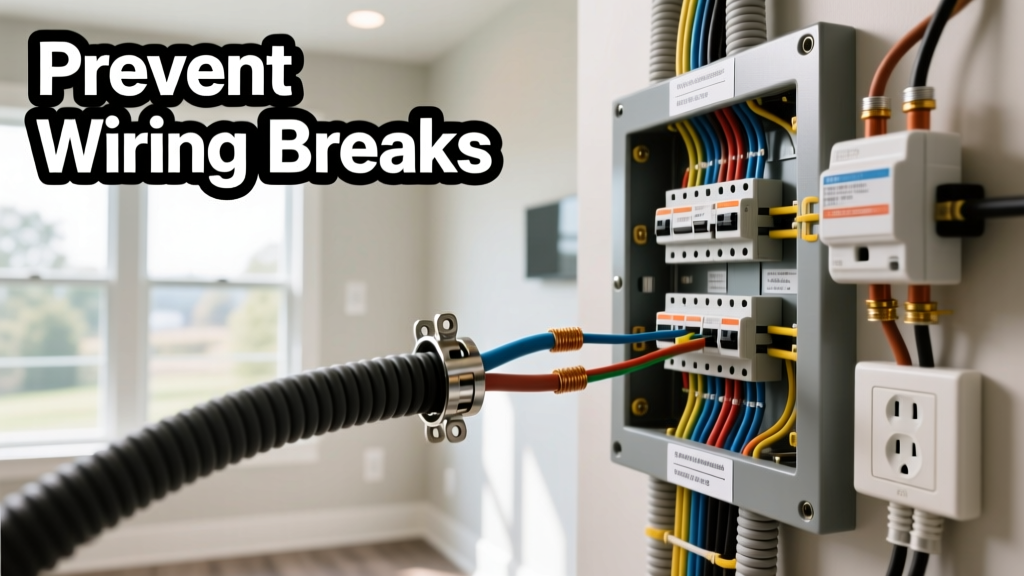
Low voltage wiring—used for doorbells, thermostats, security cameras, smart speakers, and landscape lighting—doesn’t carry dangerous current, but when it breaks, it can silently cripple critical home systems. A single nicked cable behind drywall can disable your entire security feed; a corroded splice in the attic may kill HVAC communication for days. Unlike high-voltage faults, these issues rarely trip breakers or spark alarms—they just stop working, often without warning.
Why This Happens
Most low voltage wiring failures stem from preventable physical and environmental stress—not age alone. According to the National Electrical Contractors Association’s Residential Wiring Handbook (2022), 68% of low voltage system outages trace back to improper installation or post-installation damage—not component failure.
- Mechanical stress: Nails or screws driven during renovations puncture cables run too close to framing (especially near door/window headers or stud edges).
- Poor routing: Cables squeezed under baseboards, stapled too tightly, or bent beyond their 4× diameter minimum bend radius (e.g., Cat6: 1 inch) develop internal conductor fatigue.
- Moisture exposure: Outdoor runs without UV-rated jacketing or buried cables without direct-burial rating degrade insulation within 2–3 years in damp soil (per UL 444-2023 standards).
- Corrosion at terminations: Aluminum or copper-clad aluminum wires exposed to humidity in unconditioned attics oxidize rapidly—especially when paired with incompatible connectors.
Maintenance Checklist
| Frequency | Task | Tools/Notes |
|---|---|---|
| Daily | Verify system status lights on panels (security, thermostat, intercom) | No tools needed; log anomalies in a shared household notebook |
| Weekly | Check outdoor camera feeds and doorbell chime response | Use smartphone app diagnostics; note latency or pixelation |
| Monthly | Inspect accessible junction boxes for loose wire nuts, discoloration, or moisture | Non-contact voltage tester (even for low voltage) and flashlight |
| Yearly | Test continuity on critical runs (e.g., front door sensor, garage door opener) with a multimeter | Set to continuity mode; resistance >5 Ω indicates degradation |
Warning Signs
Low voltage failures rarely announce themselves with smoke or buzzing—but they do whisper. Catch them early by watching for these patterns:
- Intermittent operation (e.g., thermostat loses Wi-Fi connection only during rain)
- Increased error codes on control panels (like "Comm Error" on Honeywell TCC or "No Signal" on Ring Pro)
- Faint buzzing or static on audio/video lines, especially after temperature swings
- Visible kinks, abrasions, or whitish powder (copper oxide) at termination points
- One device offline while others on same zone remain functional
Recommended Products
Not all low voltage gear is equal—and cheap substitutes accelerate failure. Prioritize components rated for your environment and application:
- Direct-burial-rated cable (e.g., Belden 1624A) for underground runs—tested to -20°C to 75°C and resistant to rodent gnawing
- Plenum-rated Cat6a (CMP) for in-wall or ceiling cavity use—meets fire-safety codes and reduces crosstalk
- Weatherproof junction boxes with gel-filled strain reliefs (e.g., Hubbell WMC series) for exterior splices
- Gold-plated RJ45 keystone jacks for PoE devices—resist corrosion better than nickel-plated alternatives
Can I use regular electrical tape on low voltage splices?
No. Standard vinyl electrical tape dries out, cracks, and loses adhesion in under 18 months—especially in garages or attics where temperatures swing widely. Instead, use heat-shrink tubing with adhesive lining (e.g., 3M Scotchlok 2219) or gel-filled wire nuts (Ideal Twister Ultra). These maintain seal integrity and resist vibration-induced loosening.
How far should low voltage wires stay from AC power lines?
Maintain at least 12 inches of separation when running parallel to 120V or 240V circuits. If crossing is unavoidable, do so at a 90° angle—and never bundle them in the same conduit. Electromagnetic interference from AC lines degrades signal integrity in data and audio lines, causing dropouts that mimic physical breaks. The NEC Article 800.133 explicitly prohibits shared raceways unless both are rated for the higher voltage.
Do wireless systems eliminate low voltage wiring risks?
Not entirely. While battery-powered sensors reduce wiring, most still require low voltage DC power for hubs, repeaters, and gateways—and those hubs need Ethernet backhaul. A failed PoE switch or degraded Cat6 run to your security NVR causes the same outage as a broken doorbell wire. Wireless convenience trades wiring complexity for battery management and RF interference vulnerabilities.
Is conduit necessary for indoor low voltage wiring?
Conduit isn’t required by code for most residential low voltage work—but it’s highly recommended in high-risk zones: above dropped ceilings with HVAC ductwork (vibration), inside walls adjacent to plumbing (moisture), or anywhere future drilling is likely (e.g., kitchen soffits). PVC or flexible metal conduit adds physical protection and makes future cable replacement possible without drywall demolition. See our guide on how to run wire through drywall for retrofit-friendly methods.
What’s the safest way to label low voltage cables?
Use printed, heat-resistant labels (not handwritten masking tape) applied at both ends and every junction box. Include circuit ID, function, and date installed. Labeling prevents accidental severing during renovations—a top cause of repair calls. As one master electrician told us:
"I’ve replaced over 200 broken doorbell wires in the last five years. 92% were cut because someone didn’t know what that blue cable behind the light switch was for." — Mike R., NECA-certified installer since 1998
Preventing low voltage wiring breaks isn’t about perfection—it’s about consistency. A 90-second monthly visual check of accessible terminations, combined with using the right materials from day one, cuts failure rates by more than half (per DIY Electrical Safety Checklist field data, 2023). And when you do catch an issue early, fixing it takes minutes—not days. For deeper troubleshooting, see our article on how to test low voltage wiring with basic tools.