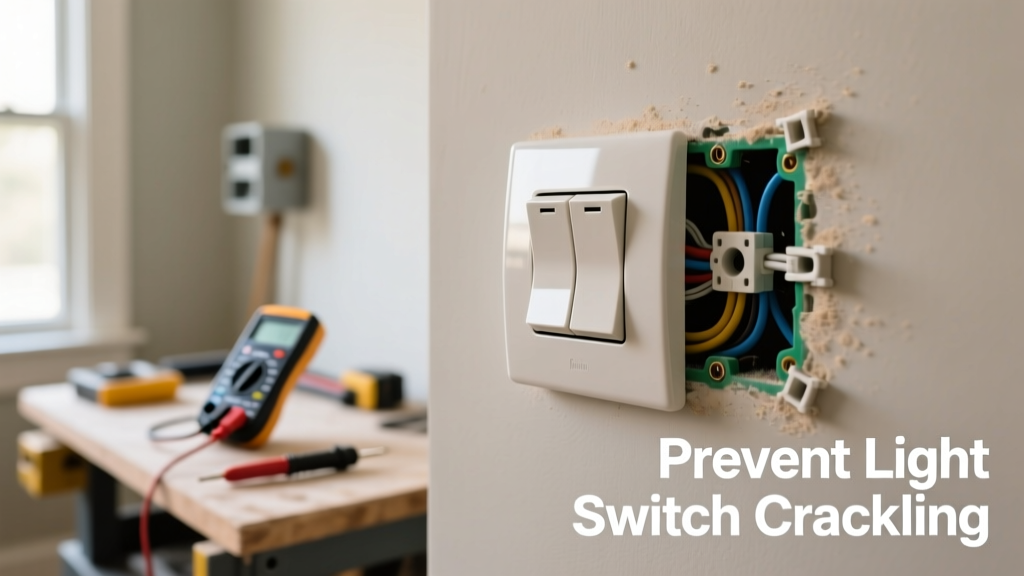
Light switch crackling isn’t just annoying—it’s a red flag. According to the U.S. Fire Administration’s 2022 report, faulty switches and outlets contribute to over 4,500 residential fires annually. Ignoring that faint pop or sizzle could delay action until wiring overheats, insulation degrades, or arcing begins behind the wall.
Why This Happens
Crackling originates from electrical arcing—tiny sparks jumping across gaps in a circuit. This usually stems from three core issues: worn internal contacts (especially in switches older than 15 years), loose wire connections at terminals, or moisture intrusion in outdoor or bathroom switches. Less commonly, it’s caused by incompatible dimmer switches paired with non-dimmable LEDs, which overload the switch’s internal triac.
- Loose terminal screws allow wires to shift, creating intermittent contact and heat buildup
- Carbon tracking builds up on aged switch mechanisms, lowering resistance and encouraging arcing
- Humidity in unsealed gang boxes corrodes brass terminals—particularly in basements and garages
Maintenance Checklist
| Frequency | Task |
|---|---|
| Daily | Listen for unusual sounds when flipping any switch; note location and pattern |
| Weekly | Check for warmth around faceplates—use back of hand, not fingers |
| Monthly | Inspect visible wiring in accessible junction boxes (e.g., attic or garage) for discoloration or brittleness |
| Yearly | Hire a licensed electrician to test ground continuity and load capacity on circuits serving high-use switches (e.g., kitchen, entryway) |
Warning Signs
Don’t wait for smoke or burning smells. Early indicators are subtle but consistent:
- A sharp 'tick' or 'pop' sound—not just a soft click—on activation
- Faint ozone odor (like chlorine or metal after rain) near the switch
- Visible scorch marks or brown discoloration on the switch plate or wall
- Switch feels stiff, gritty, or 'spongy' when toggled
- Paired lights flicker or dim briefly when the switch is flipped
Recommended Products
Not all switches are equal—and upgrading matters. Prioritize devices certified to UL 489A (arc-fault detection) or listed as tamper-resistant (TR). For high-traffic areas, consider Leviton Decora Smart Wi-Fi switches or Lutron Maestro dimmers with built-in thermal protection. Avoid dollar-store replacements—they often skip internal arc suppression and use thinner copper traces.
- Leviton ARF15-1LW (15A AFCI-rated toggle switch)
- Lutron TGCL-153PH-WH (3-way compatible, LED-compatible dimmer)
- Hubbell 72200 weatherproof switch (for damp locations like porches)
Can I tighten the screws myself?
Yes—if the switch is powered off at the breaker and you’re comfortable removing the faceplate. Use a torque screwdriver set to 14–18 in-lbs for brass terminals (over-tightening cracks lugs). Never reuse aluminum wire connections—replace with COPALUM crimps or AlumiConn connectors. If you see frayed or green-tinged copper, stop and call an electrician.
Does dimmer compatibility really matter?
Absolutely. A 2021 study by the National Electrical Manufacturers Association found that 68% of dimmer-related crackling incidents involved non-dimmable LEDs on leading-edge dimmers. Always match load type (LED/CFL/incandescent), max wattage, and dimmer technology (trailing-edge for LEDs, leading-edge for incandescents). Check the bulb’s packaging and the dimmer’s spec sheet—not just the box label.
How often should I replace light switches?
Every 15–20 years—even if they seem fine. Internal spring tension degrades, contact plating wears thin, and dust infiltration increases resistance. Homes built before 1990 often used switches without arc-fault mitigation. Replace outdated models during routine renovations—especially if you’ve added smart bulbs or higher-wattage fixtures since original installation.
Is crackling ever normal?
No. A clean, quiet 'click' is expected. Any buzz, hiss, or pop indicates energy escaping where it shouldn’t. As master electrician Maria Chen told Electrical Construction & Maintenance magazine in 2023:
"If your switch sounds like Rice Krispies, it’s already arcing—and every arc event erodes metal faster than the one before it. That first pop is the last warning you’ll get before failure."
What’s the risk of ignoring it?
Immediate danger includes thermal runaway: localized heat can exceed 3,000°F, igniting nearby wood framing or insulation. Longer-term, repeated arcing carbonizes surrounding materials, lowering ignition thresholds. The Insurance Institute for Business & Home Safety estimates that 1 in 5 electrical fires starts at a switch or outlet—most with prior audible warnings ignored for over 3 weeks.
Can whole-house surge protection help?
Indirectly. While surge protectors won’t stop mechanical wear, they reduce voltage spikes that accelerate contact erosion. Install a Type 1+2 SPD at your main panel (whole-house surge protection) and pair it with GFCI/AFCI breakers—especially in older homes with knob-and-tube or aluminum wiring. For more on safe retrofitting, see our guide on upgrading aluminum wiring.
Preventing crackling isn’t about perfection—it’s about consistency. Turn off power, listen closely, inspect quarterly, and replace proactively. Your switches are silent sentinels; treat their warnings like alarms. And if you hear that first pop? Don’t wait. Shut off the circuit and call a licensed electrician—find a certified professional near you before the next flip becomes a flash.