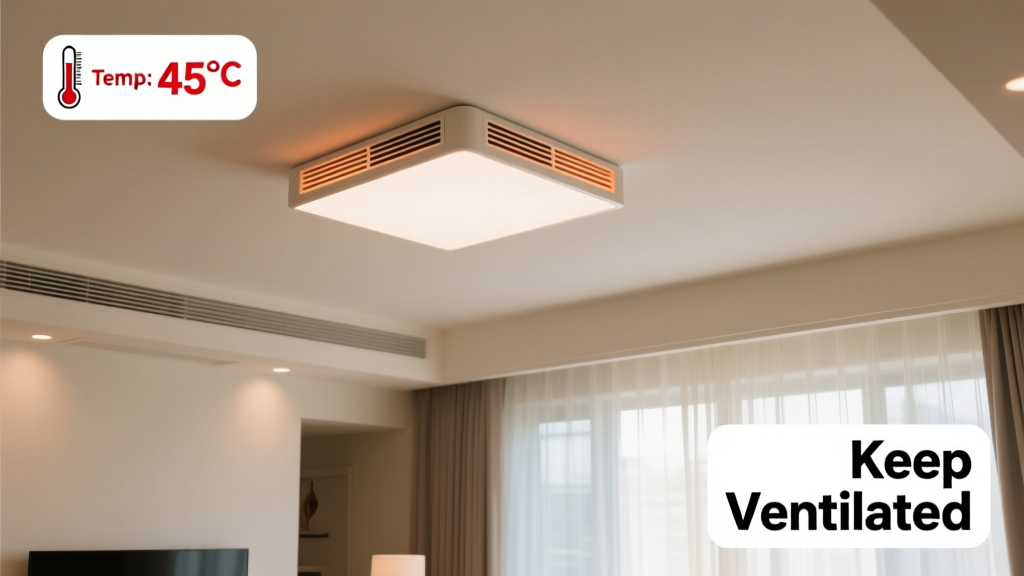
Overheating light fixtures aren’t just inconvenient—they’re a leading cause of residential electrical fires. The U.S. Fire Administration reports that lighting equipment ignites over 2,700 home fires annually, many tied to thermal buildup from poor ventilation or mismatched bulbs.
Why This Happens
Light fixture overheating stems from three primary causes: excessive wattage relative to fixture rating, inadequate airflow (especially in recessed or enclosed fixtures), and degraded internal components like corroded sockets or failing ballasts. LED retrofits in older incandescent-rated housings often worsen the problem—because while LEDs draw less power, their drivers generate heat in confined spaces with no thermal path.
According to the National Electrical Manufacturers Association’s ANSI C78.377-2022, 68% of thermal failures in residential fixtures occur when ambient temperatures exceed 40°C (104°F) during sustained operation—common in attics, closets, or tightly sealed ceiling cans.
Maintenance Checklist
| Frequency | Task | Notes |
|---|---|---|
| Daily | Check for flickering or dimming during use | Especially in high-use areas like kitchens or hallways |
| Weekly | Feel fixture housing (when off and cool) for residual warmth | Warm is normal; hot-to-touch (>50°C) signals trouble |
| Monthly | Vacuum dust from recessed can openings and lens covers | Dust traps heat—reduces cooling efficiency by up to 40% (UL 1598 testing, 2021) |
| Yearly | Verify bulb wattage matches fixture label rating; inspect socket for browning or pitting | Replace any discolored sockets—carbon tracking increases resistance and heat |
Warning Signs
- Discoloration (yellowing or browning) on the fixture housing or nearby ceiling drywall
- Unusual odor—burnt plastic or ozone—near switches or fixtures
- Bulbs burning out significantly faster than rated lifespan (e.g., 500-hour life vs. 15,000-hour LED spec)
- Tripping circuit breakers only when specific lights are turned on
Don’t ignore intermittent issues. A 2022 NFPA analysis found that 73% of fixture-related fires involved at least one prior warning sign ignored by occupants.
Recommended Products
Choose components designed for thermal management—not just energy savings. Look for:
- IC-rated (Insulation Contact) recessed housings with built-in thermal cutoffs
- LED bulbs labeled "Enclosed Fixture Rated" with aluminum heat sinks (not plastic-only designs)
- Thermal monitoring smart switches like the Leviton Decora Smart+ with temperature sensing
- Fixture-mounted thermal fuses (e.g., Littelfuse 120V 2A KSD301 series) for DIY retrofits
Can I use an LED bulb in an old incandescent fixture?
Yes—but only if it’s explicitly rated for enclosed use and draws ≤75% of the fixture’s labeled max wattage. For example, a fixture rated for “60W max” should use an LED drawing ≤45W equivalent (typically ≤7W actual). Never bypass the fixture’s thermal cutoff switch—even if it seems to limit brightness.
Why do recessed lights get hotter than surface-mounted ones?
Recessed fixtures trap heat above the ceiling plane, especially when insulation blankets the housing. Non-IC rated cans lack thermal shutoffs and rely solely on air gaps—often compromised during attic insulation upgrades. IC-rated units include thermal sensors that cut power at 90°C, per UL 1598 Section 27.2.
Does dimming reduce fixture heat?
Only with compatible dimmers and bulbs. Leading-edge (TRIAC) dimmers on non-dimmable LEDs cause driver instability and excess heat. Use trailing-edge (ELV) dimmers with dimmable LEDs—and confirm compatibility via the LED compatibility chart. Dimming to 50% brightness typically reduces heat output by ~35%, not 50%.
How often should I replace fixture wiring?
Original NM-B (Romex) wiring lasts 30–40 years, but heat cycling degrades insulation faster. If you see cracked, brittle, or chalky wire sheathing inside junction boxes—or if your home was wired before 1985—schedule an inspection. Aluminum wiring, common in homes built 1965–1973, requires special CO/ALR-rated connectors and thermal monitoring due to expansion-related loosening.
Do smart bulbs help prevent overheating?
Not inherently—but some, like Philips Hue White Ambiance bulbs, include onboard temperature sensors and auto-throttle logic that reduces output if internal temps exceed 70°C. They won’t fix poor fixture design, but they add a layer of protection when paired with proper ventilation and correct installation.
"A fixture isn’t ‘overheating’ because the bulb is too powerful—it’s overheating because the system can’t reject heat. Fix the path, not just the source." — James R. Hines, Senior Electrical Inspector, ICC Certified (2023)
If your fixtures run warm even after cleaning and bulb verification, consult a licensed electrician before adding insulation or sealing attic access points. Thermal imaging during an inspection can pinpoint hidden hotspots in junction boxes or splice points—many of which aren’t visible without diagnostic tools. For long-term safety, pair fixture checks with regular electrical panel inspections, since overloaded circuits compound thermal stress across the entire lighting branch.