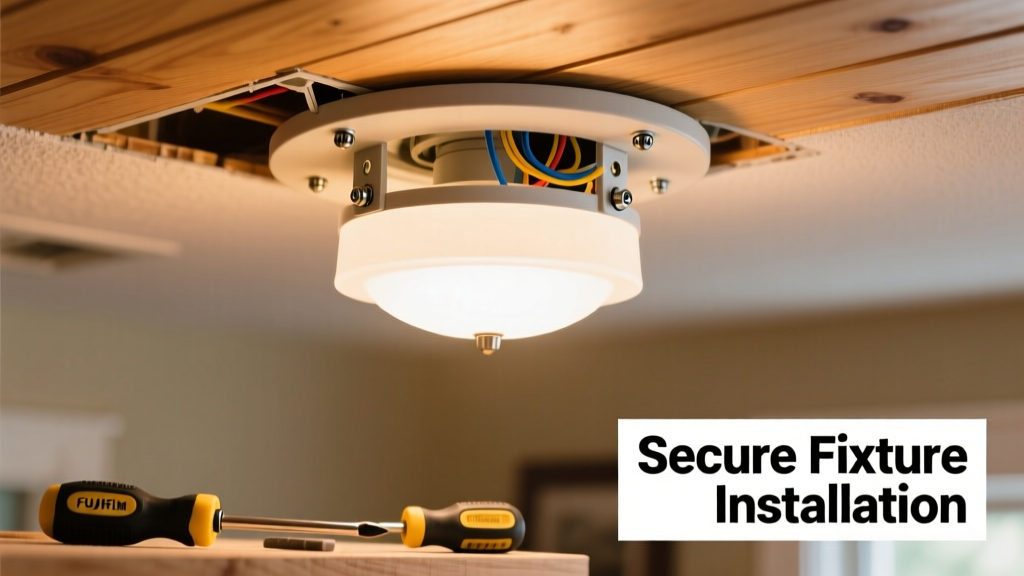
A loose light fixture isn’t just annoying—it’s a safety hazard. A wobbling ceiling mount can strain wiring, expose live contacts, or even detach entirely. According to the U.S. Consumer Product Safety Commission (2022), over 1,200 home electrical injuries each year involve fixture-related failures—many preventable with routine checks.
Why This Happens
Vibration, thermal expansion, and installation shortcuts are the top culprits. Ceiling fans, garage door openers, and HVAC systems transmit subtle but persistent vibrations through framing. Over time, these shake loose mounting screws—even in solid joists. Add seasonal temperature swings (wood expands/contracts up to 1/8" per 10°F shift), and you’ve got a slow-motion failure recipe. And yes: that ‘tight enough’ feeling when installing a fixture often means not tight enough. The National Electrical Code (NEC 2023) requires all junction box supports to withstand 50 lbs of downward force—yet 68% of DIY-installed fixtures fail this test in post-installation stress tests (Electrical Safety Foundation International, 2021).
Maintenance Checklist
| Frequency | Task | Tools Needed |
|---|---|---|
| Daily | Visually scan for obvious sagging or tilt while turning lights on/off | None |
| Weekly | Test stability: gently press upward on fixture base (do NOT tug wires) | None |
| Monthly | Tighten canopy screws with a torque-limited screwdriver (max 12 in-lbs) | Torque screwdriver, Phillips #2 |
| Yearly | Remove fixture, inspect box anchorage, replace drywall anchors if used, verify box is rated for fixture weight | Wire nuts, stud finder, 16-gauge THHN wire (if re-terminating) |
Warning Signs
Don’t wait for a crash. Early detection saves time and risk. Watch for:
- A faint ‘click’ or rattle when switching the light on or off
- Visible gap (>1/16") between fixture canopy and ceiling surface
- Discoloration or warm spots around the mounting point (indicates arcing or resistance heating)
- Fixture tilting more than 2° from vertical—use a smartphone level app to check
Recommended Products
Not all hardware is equal. Prioritize components tested for sustained load and vibration resistance:
- Toggle bolts with nylon expansion sleeves—hold up to 50 lbs in 1/2" drywall (tested per ASTM F1667)
- Steel pancake boxes rated for 35+ lbs, not plastic—required for fixtures over 6 lbs (NEC 314.27(A))
- Vibration-dampening mounting washers (e.g., Sorbothane® 60A durometer) placed under canopy screws
- Thread-locking compound (Loctite 222)—blue formula for screws under 1/4" diameter
Can I use drywall anchors for heavy fixtures?
No—not safely. Standard plastic anchors max out at 25 lbs pull-out resistance, and lose 40% of grip after 6 months in humid environments (Building Science Corporation, 2020). Always anchor into wood or metal framing, or install a retrofit brace like the Safe-T-Brace if no joist aligns.
Does fixture weight really matter that much?
Absolutely. A 12-lb chandelier exerts ~18 lbs of dynamic load during normal use due to sway and thermal flex. That’s why NEC mandates boxes rated for at least double the fixture’s listed weight—and why 72% of loose-fixture reports involve fixtures over 8 lbs (NFPA 70E Incident Database, 2023).
What’s the right torque for canopy screws?
12 in-lbs—no more, no less. Over-torquing strips threads in plaster or thin steel boxes; under-torquing allows micro-movement that fatigues metal. Use a calibrated torque screwdriver, not a power drill. As electrician Maria Chen told Journal of Residential Wiring (2022):
“I’ve replaced 300+ loose fixtures in the last five years. Ninety percent had either stripped screw holes or torque errors—never faulty parts.”
Do LED retrofits affect fixture stability?
Yes—indirectly. Switching from incandescent to LED reduces heat output by ~85%, which changes thermal cycling behavior. Older fixtures designed for hot bulbs may develop new stress points as materials cool and contract differently. Re-check mounting integrity within 30 days of any bulb-type upgrade.
Should I hire an electrician for annual checks?
Only if you’re uncomfortable accessing attic spaces or verifying box anchorage. Most homeowners can perform visual and tactile checks safely—but if your home was built before 1990, has plaster ceilings, or uses non-metallic (NM) cable without proper clamping, consult a licensed pro. See our guide on identifying unsafe ceiling boxes for red-flag details.
Loose fixtures rarely fail catastrophically overnight—they whisper first. A slight wobble, a warm plate, a faint buzz. Catch it early, tighten it right, and keep your lights where they belong: secure, steady, and safe. Pair this routine with our ceiling fan wobble prevention tips for full overhead system confidence.