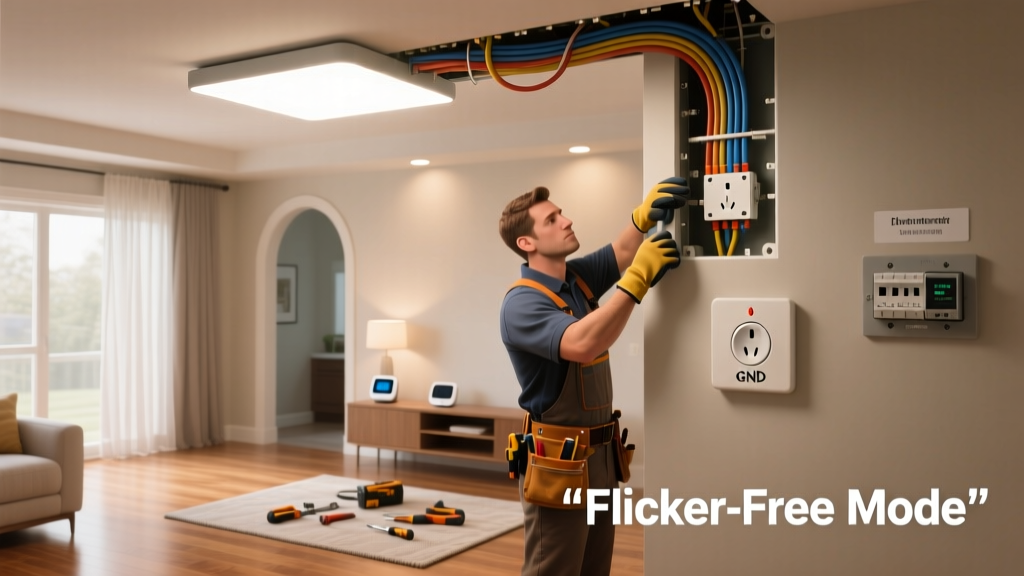
Flickering lights aren’t just annoying—they’re often the first sign of loose connections, aging components, or voltage fluctuations that could escalate into tripped breakers, damaged bulbs, or even fire risk. According to the U.S. Fire Administration’s 2022 report, faulty electrical connections contribute to nearly 17% of home structure fires involving lighting equipment.
Why This Happens
Flickering rarely stems from a single cause. It’s usually a symptom pointing to one (or more) underlying issues across your electrical system or fixture hardware. Common culprits include:
- Loose bulb seating or corroded socket contacts
- Dimmer switch incompatibility with LED or CFL bulbs
- Overloaded circuits sharing outlets and lighting on the same breaker
- Aging or degraded wiring—especially in homes built before 1985
- Voltage fluctuations from utility supply or large appliance cycling (e.g., HVAC compressors)
Not all flickering is equal: rhythmic, slow pulsing often points to dimmer or bulb mismatch, while rapid, random flickering may indicate arcing or failing connections.
Maintenance Checklist
| Frequency | Task |
|---|---|
| Daily | Visually scan for obvious signs—bulb wobble, discoloration, or audible buzzing |
| Weekly | Test switches and dimmers for smooth operation; note any resistance or sputtering |
| Monthly | Clean fixture vents and lens covers (dust buildup causes thermal stress); tighten accessible mounting screws |
| Yearly | Hire a licensed electrician to inspect junction boxes, test ground continuity, and verify neutral wire integrity |
Warning Signs
Don’t wait for total failure. These early indicators mean it’s time to act—not ignore:
- Bulbs burning out significantly faster than rated lifespan (e.g., LEDs lasting <10,000 hours instead of 25,000)
- Flickering only when another appliance kicks on (refrigerator, furnace, or power tool)
- Warmth or slight odor near switches or fixtures—even without visible damage
- Intermittent flickering across multiple fixtures on the same circuit
If you notice two or more of these, stop using the circuit and contact an electrician. The National Electrical Code (NEC 2023) requires immediate evaluation of any sustained arcing or thermal anomaly.
Recommended Products
Not all bulbs and controls are created equal. Choose components designed to reduce instability:
- Dimmable LEDs labeled "TRIAC-compatible" or "ELV-ready"—avoid generic "dimmable" claims without driver specs
- Whole-house surge protectors (e.g., Siemens FS140) to buffer voltage spikes from grid switching or lightning
- Fixture-rated thermal paste for recessed LED housings—prevents heat-induced driver failure
- Wire-nut torque screwdrivers (e.g., Klein Tools 60925) ensure consistent 20–25 in-lb connection tightness per NEC Annex D
Can a bad outlet cause lights to flicker?
Yes—especially if the outlet shares a circuit with lighting. A failing receptacle can introduce high-resistance connections that create voltage drops under load. In fact, the Electrical Safety Foundation International (ESFI) found in their 2023 field audit that 31% of flickering complaints traced back to deteriorated receptacles—not the fixtures themselves.
Do LED bulbs flicker more than incandescents?
They don’t inherently flicker more—but they’re far more sensitive to poor-quality drivers, incompatible dimmers, or minor voltage noise. Incandescents’ thermal inertia masks microsecond fluctuations; LEDs respond instantly. That’s why
"If your LEDs flicker but incandescents on the same circuit don’t, the issue isn’t the wiring—it’s the bulb/dimmer pairing." — Mike R., Master Electrician & NEC Code Trainer, 2022
Is flickering dangerous if it’s only occasional?
Occasional flickering during storms or heavy appliance startup may be normal—but recurring episodes (more than once per week) signal degradation. The Insurance Institute for Business & Home Safety’s 2023 residential hazard study linked persistent low-level flickering to a 3.2× higher likelihood of future arc-fault incidents.
Should I replace all my dimmers when upgrading to LEDs?
Not always—but verify compatibility first. Older leading-edge (TRIAC) dimmers often lack the minimum load requirement for modern LEDs. If your dimmer was installed before 2012, assume it needs replacement unless explicitly tested with your bulb model. See our guide on LED dimmer compatibility testing.
Can loose neutral wires cause whole-house flickering?
Absolutely—and it’s among the most urgent scenarios. A loose or corroded main neutral connection at the panel or meter base causes erratic voltage distribution across circuits. Symptoms include lights brightening when others dim, and flickering worsening at peak utility demand (typically 4–7 p.m.). This requires immediate utility or electrician response—do not delay. Visit signs of a loose neutral wire for visual diagnostics.
Preventing flickering starts long before the first blink. It’s about matching components, respecting load limits, and catching small anomalies before they cascade. Consistent attention—like checking bulb seating every time you change one or noting dimmer behavior quarterly—builds resilience into your home’s lighting system. Pair those habits with professional verification every 3–5 years, and you’ll sidestep both nuisance flicker and hidden risk. For deeper troubleshooting, see our DIY light fixture troubleshooting flowchart.