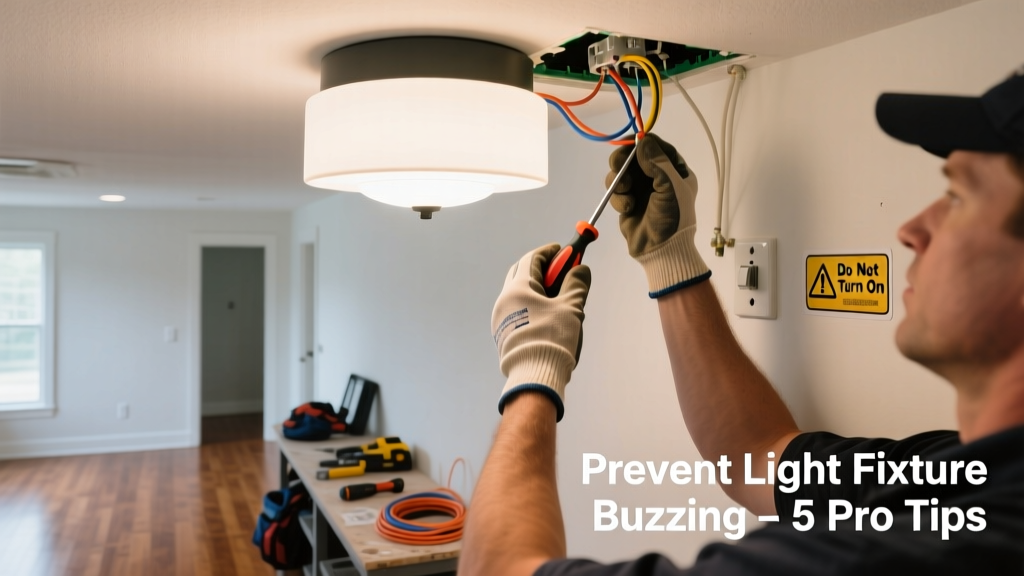
Light fixture buzzing isn’t just annoying—it’s often the first audible sign of electrical stress, loose components, or incompatible dimmers. Left unaddressed, it can escalate into arcing, overheating, or even insulation breakdown. According to the U.S. Fire Administration’s 2022 report, faulty lighting accounts for nearly 7% of home electrical fires—many preceded by persistent buzzing.
Why This Happens
Buzzing originates from physical vibration or electromagnetic oscillation within the fixture or circuit. Common culprits include:
- Dimmer-switch incompatibility: Leading cause of buzz in LED fixtures—especially with trailing-edge dimmers paired with non-dimmable bulbs
- Loose wire connections: At the fixture junction box or socket terminal, causing micro-arcing and harmonic vibration
- Transformer or ballast failure: Magnetic low-voltage transformers (12V systems) and aging fluorescent ballasts hum at 60 Hz or harmonics
- Voltage fluctuations: Consistent overvoltage (>125V) stresses drivers and induces coil resonance in electronic components
Maintenance Checklist
| Frequency | Task | Tools Needed |
|---|---|---|
| Daily | Listen for new or changing buzz tones during routine room use | None |
| Weekly | Check for warmth on fixture housing (use back of hand—not fingers) | Thermometer (optional) |
| Monthly | Tighten mounting screws and test bulb seating; verify no visible corrosion on socket contacts | Phillips screwdriver, cotton swab, isopropyl alcohol |
| Yearly | Inspect junction box wiring: torque terminal screws to manufacturer spec (typically 18–22 in-lbs); replace brittle wire nuts | Torque screwdriver, UL-listed wire nuts |
Warning Signs
Don’t wait for loud buzzing—early indicators are subtle but telling:
- Faint 60 Hz hum only when lights are dimmed below 30%
- Buzz that changes pitch when adjusting dimmer position
- Intermittent buzzing paired with flickering or delayed startup (common with failing LED drivers)
- Odor of hot plastic or ozone near ceiling-mounted fixtures
Recommended Products
Not all products solve buzzing—but these are proven to reduce or eliminate it when matched correctly:
- Leading-edge dimmers (e.g., Lutron DVCL-153P) for incandescent/halogen; avoid with most LEDs
- ELV (electronic low-voltage) dimmers like Leviton D26HD for magnetic transformer loads
- Dimmable LED bulbs certified for your dimmer model—check compatibility lists at LED bulb compatibility checklist
- Decoupling rubber grommets (e.g., McMaster-Carr #91245K12) to isolate vibrating transformers from metal housings
Can a buzzing light fixture cause a fire?
Yes—repeated arcing from loose connections or failing drivers generates localized heat exceeding 300°F, degrading wire insulation. The National Fire Protection Association’s Electrical Fire Causes Report (2023) cites poor connections as the top ignition source in lighting-related fires.
Why does my new LED fixture buzz only when dimmed?
Most likely dimmer incompatibility. Unlike incandescents, LEDs require stable low-current signaling. Trailing-edge dimmers often send inconsistent phase-cut waveforms that cause driver capacitors to vibrate. Always cross-reference your bulb’s datasheet with the dimmer’s compatible load list—don’t rely on “dimmable” labeling alone.
Is buzzing worse in older homes? Why?
Yes—especially homes with knob-and-tube or early aluminum wiring. Voltage regulation is less stable, and neutral-ground bonds may be degraded. A 2021 study by the Electrical Safety Foundation International found homes built before 1960 were 3.2× more likely to have measurable voltage harmonics linked to fixture buzzing.
Do smart bulbs buzz less than standard LEDs?
Not inherently—but many smart bulbs (e.g., Philips Hue White Ambiance) use higher-quality constant-current drivers and built-in EMI filtering. Their internal dimming avoids external dimmer incompatibility entirely. For best results, pair them with wall switches wired as on/off only—not dimmers.
Can I fix buzzing without calling an electrician?
You can safely address ~60% of cases: reseating bulbs, tightening fixture screws, swapping incompatible bulbs, or replacing outdated dimmers. But if buzzing persists after those steps—or occurs with multiple fixtures on one circuit—call a licensed electrician. Loose neutrals or shared neutrals between circuits require metered diagnostics and NEC-compliant correction.
"A consistent 120Hz buzz (twice line frequency) almost always points to rectifier ripple in a failing LED driver—replace it immediately. Don't wait for failure." — John R. Delaney, Master Electrician & NFPA 70E Instructor, 2023
Preventing light fixture buzzing isn’t about perfection—it’s about consistency. Rotate through your monthly checklist, keep dimmer-bulb pairings documented, and treat any new buzz like a diagnostic alert—not background noise. For deeper electrical health insights, see our guide on home electrical panel inspection and voltage fluctuation troubleshooting.