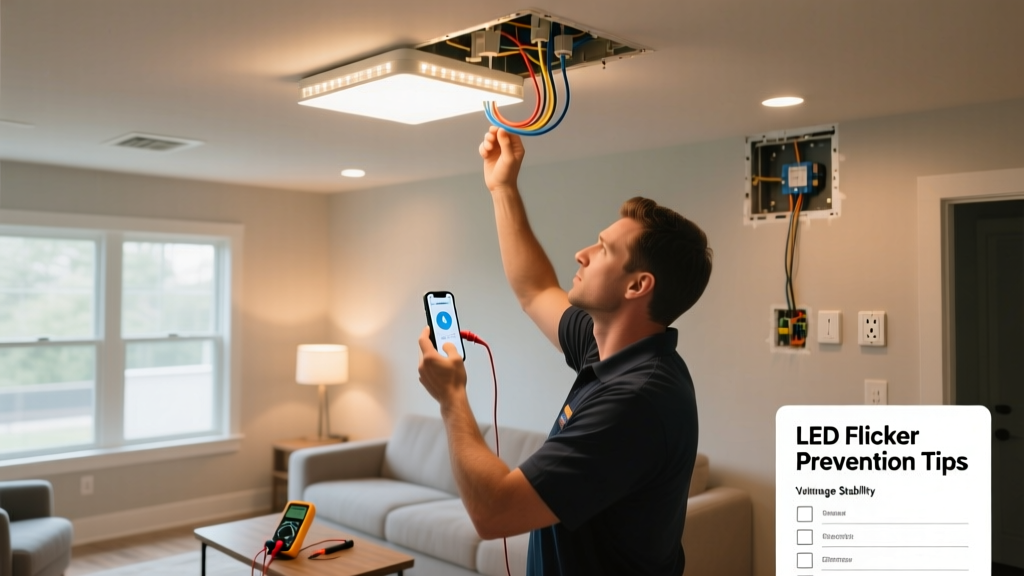
LED flickering isn’t just annoying—it’s a red flag. Persistent flicker can signal voltage instability, failing drivers, or incompatible dimmers, and may shorten bulb life by up to 40% (U.S. Department of Energy, 2022). Worse, chronic flicker contributes to eye strain, headaches, and reduced concentration—especially in home offices and kitchens where task lighting matters most.
Why This Happens
Flickering stems from electrical mismatches—not faulty bulbs alone. The most common culprits include incompatible dimmer switches (especially legacy leading-edge models), overloaded circuits, low-quality LED drivers, and voltage fluctuations from large appliances cycling on and off. According to the National Electrical Manufacturers Association (NEMA, 2021), over 68% of reported LED flicker cases involve dimmer-bulb incompatibility.
- Dimmer switch type mismatch (e.g., using non-ELV bulbs with electronic low-voltage dimmers)
- Loose wiring at fixture terminals or junction boxes
- Shared neutrals between circuits causing neutral wire overload
- Power supply ripple from aging or undersized LED drivers
Maintenance Checklist
| Frequency | Task |
|---|---|
| Daily | Visually scan for erratic behavior during peak appliance use (e.g., AC or microwave running) |
| Weekly | Check for warmth at switch plates and fixture bases—excessive heat suggests driver stress |
| Monthly | Tighten mounting screws on dimmer switches and verify no buzzing sound during operation |
| Yearly | Test circuit voltage under load with a multimeter; replace any dimmer older than 7 years |
Warning Signs
Don’t wait for total failure. Early detection prevents cascading issues across connected fixtures. Watch for:
- Intermittent flicker only when HVAC or refrigerator kicks on
- Flickering isolated to one circuit—not the whole house
- Bulbs dimming slightly before flickering (sign of driver voltage sag)
- Correlated flicker across multiple fixtures on same dimmer
Recommended Products
Investing in compatible, high-fidelity components pays off. Prioritize products certified for your setup:
- TRIAC-compatible dimmers labeled "LED-optimized" (e.g., Lutron Diva DVCL-153P)
- LED bulbs with built-in constant-current drivers (look for UL Class P rating)
- Whole-house surge protectors with voltage regulation (e.g., Siemens FS140)
- Non-contact voltage testers for safe DIY circuit checks (see our tool guide)
Can a bad circuit breaker cause LED flickering?
Yes—especially if it’s arcing internally or tripping near its thermal limit. A failing breaker may allow intermittent voltage drops without fully tripping. If flickering coincides with breaker warmth or a faint humming noise, call a licensed electrician immediately. According to the Electrical Safety Foundation International (ESFI, 2023), 12% of residential arc-fault incidents begin with unexplained lighting anomalies.
Do LED bulbs flicker more in cold weather?
Some do—particularly cheaper models with electrolytic capacitors that stiffen below 32°F. Cold reduces capacitor efficiency, worsening ripple filtering. Look for bulbs rated for outdoor or garage use (e.g., -22°F minimum operating temp) if installing in unheated spaces like porches or basements.
Why do only some bulbs flicker on the same dimmer?
Even bulbs from the same brand batch can vary in driver tolerance. Slight manufacturing variances in capacitor ESR (equivalent series resistance) or PWM frequency tuning mean some units respond poorly to marginal dimmer output. Always test 2–3 bulbs per fixture before full replacement—and stick with the same model number.
Is flickering dangerous?
Rarely life-threatening, but potentially hazardous. Stroboscopic effect from 70–100 Hz flicker can make rotating machinery appear stationary—a real risk in workshops. More commonly, it triggers migraines in 10% of people with photosensitive epilepsy (Epilepsy Foundation, 2022). Consistent flicker also degrades driver electrolytics faster, raising fire risk in enclosed fixtures.
"If you’re seeing flicker on a new LED install, don’t blame the bulb first—9 times out of 10, it’s the dimmer or circuit design." — Mike R., Master Electrician & NEMA Lighting Systems Committee Member, 2023
Should I replace all my dimmers at once?
No—unless they’re pre-2015 or lack an LED compatibility label. Instead, prioritize rooms with frequent use (kitchen, living room) and those where flicker is already present. Use a dimmer-bulb compatibility chart to cross-reference before buying. Replace only what’s needed—and always power off the circuit at the panel before swapping.
Preventing LED flicker isn’t about perfection—it’s about consistency. Tightening connections, matching components, and catching early signs keeps light steady and systems healthy. When your kitchen lights stay rock-solid while the dishwasher runs, you’ll know your preventive work paid off.