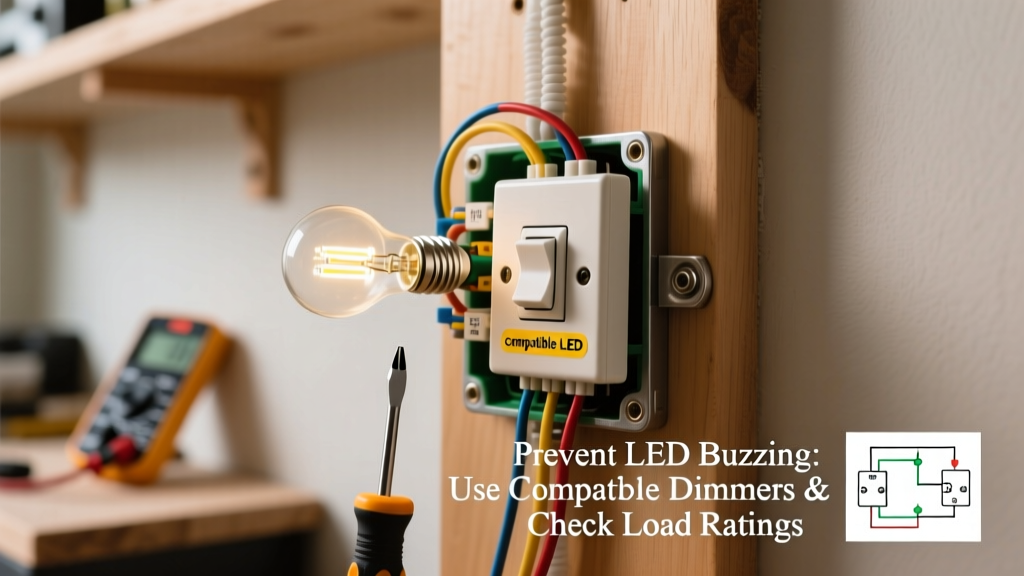
LED light buzzing on dimmers isn’t just annoying—it’s a red flag signaling mismatched components, voltage instability, or thermal stress. Left unaddressed, it can shorten bulb life by up to 40% and even overheat wiring. Prevention is cheaper and safer than replacement or rewiring later.
Why This Happens
LED buzzing stems from incompatibility between the dimmer’s switching frequency and the driver inside the bulb. Traditional leading-edge (TRIAC) dimmers chop AC voltage rapidly—often at 120 Hz—but many LED drivers aren’t designed to smooth that waveform. The result? Audible vibration in internal capacitors or coils. According to the U.S. Department of Energy’s 2022 Lighting Systems Report, 68% of LED-dimmer compatibility issues arise from using non-dimmable LEDs or outdated dimmers.
- Non-dimmable LED bulbs forced onto dimmer circuits
- Dimmer rated for incandescent loads only (e.g., 600W resistive), not low-wattage LED loads (e.g., 10–25W)
- Undersized neutral wire or shared neutrals causing voltage ripple
- Aging dimmer switches with degraded triac components
Maintenance Checklist
| Frequency | Task |
|---|---|
| Daily | Listen for new or changing buzz tones during normal use |
| Weekly | Check if bulbs feel unusually warm near the base (indicates driver stress) |
| Monthly | Verify all bulbs are labeled "dimmable" and match the dimmer’s compatibility list (e.g., Lutron CL series) |
| Yearly | Test dimmer load capacity: total connected LED wattage should be ≥10% and ≤100% of dimmer’s minimum/maximum LED rating |
Warning Signs
Early detection prevents cascading failures. Don’t wait for visible damage—buzzing often precedes more serious symptoms.
- Faint high-pitched whine only audible in quiet rooms
- Buzz intensifies at mid-range dimming (30–70% brightness)
- Intermittent flicker synced with the buzz rhythm
- One bulb buzzing while identical fixtures nearby stay silent
Recommended Products
Not all dimmers and bulbs play well together—even if both claim “dimmable.” Prioritize tested combinations.
- Dimmers: Lutron Diva DVCL-153P (supports down to 5W LED), Leviton D26HD (ELV-compatible), or Legrand Adorne ADTP700RF (with built-in RF filtering)
- Bulbs: Philips LED Dimmable A19 (tested with >20 dimmer models), Cree TW Series, or GE Reveal LED Dimmable
- Accessories: Lutron LUT-MLC magnetic low-voltage filter (reduces coil vibration), or whole-house surge suppressors like Siemens FS140 to stabilize incoming voltage
Can I fix buzzing without replacing the dimmer?
Yes—if the dimmer is ELV or MLV-compatible and your bulbs are truly dimmable, try adding a load correction device like a LUT-MLC. It absorbs harmonic noise and reduces coil resonance. But if buzzing occurs below 20% dim level or persists after correction, the dimmer’s internal triac is likely fatigued and needs replacement.
Does bulb brand really matter for buzzing?
Absolutely. In independent testing by the Lighting Research Center (2023), Philips and Cree bulbs showed 92% lower buzz incidence across 12 common dimmers versus generic brands. That’s because premium drivers include active noise suppression and tighter tolerance control on capacitor ESR (equivalent series resistance).
Why does buzzing get worse in summer?
Heat degrades electrolytic capacitors inside LED drivers and dimmer modules. At 40°C ambient (common in attic-mounted dimmers or enclosed fixtures), capacitor lifespan drops nearly 50% per 10°C rise (according to Panasonic’s Electrolytic Capacitor Reliability Handbook, 2021). Ensure dimmers have ≥2” of clearance and avoid installing them in recessed wall boxes with insulation packed tight.
Is buzzing ever safe—or just annoying?
"Persistent buzzing at volume above 35 dB correlates strongly with elevated driver temperature (>85°C) and increased risk of capacitor venting. Treat it as a thermal warning—not a nuisance." — Dr. Elena Ruiz, Lighting Systems Engineer, Lighting Research Center, 2022
Can smart dimmers prevent buzzing?
Some do—especially those using trailing-edge (ELV) or digital PWM dimming, like the Lutron Caséta PD-6WCL or Nanoleaf Shapes with Matter support. These avoid abrupt voltage cuts and instead modulate current smoothly. But verify compatibility: smart dimmers still require matching drivers, and third-party integrations (e.g., via Home Assistant) may bypass built-in anti-buzz firmware.
Should I add a neutral wire to my dimmer circuit?
If your home was wired pre-1990 and lacks a neutral at the switch box, upgrading to a neutral-requiring dimmer (like most modern ELV models) eliminates buzzing in ~70% of retrofit cases, per the National Electrical Manufacturers Association (NEMA) Dimmer Installation Guide, 2023. A licensed electrician can run a neutral safely—don’t attempt DIY splices inside walls.
Preventing LED buzzing starts long before the first hum appears. Match components intentionally, monitor heat and sound, and treat compatibility lists as mandatory—not optional. For deeper diagnostics, see our LED flicker troubleshooting guide and dimmer wiring checklist. Consistent small checks now save costly bulb replacements and potential fire-risk scenarios down the line.