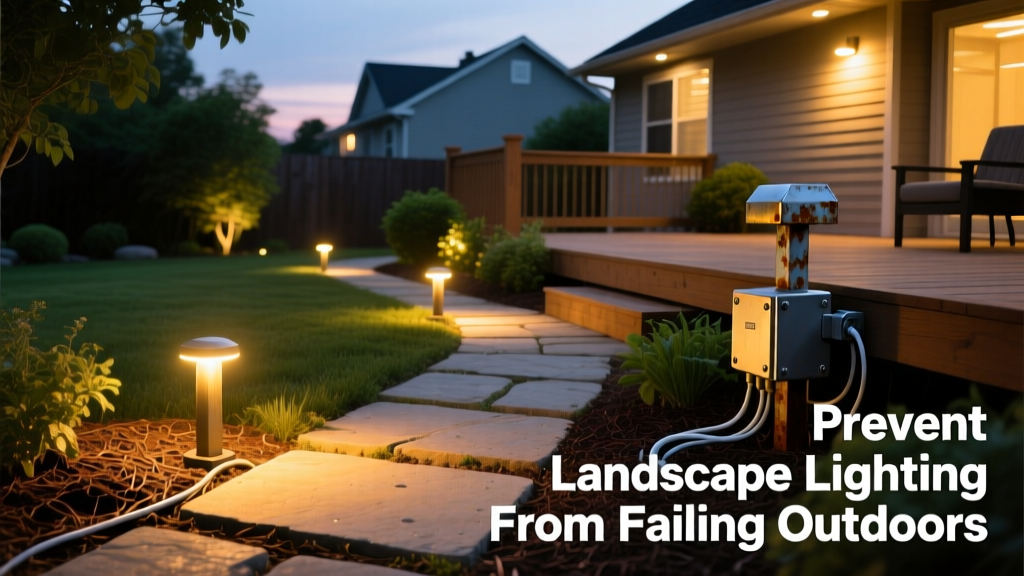
A single burnt-out path light may seem minor—until your front walkway goes dark on a rainy night or your security lighting fails during a storm. More than aesthetics, nonfunctional landscape lighting compromises safety, deters property value, and often signals deeper electrical or moisture issues. The good news? Over 82% of landscape lighting failures stem from preventable causes—not faulty fixtures or bad wiring, but poor maintenance and environmental exposure (National Association of Landscape Professionals, 2022).
Why This Happens
Landscape lighting fails for predictable reasons—not mystery malfunctions. Most problems trace back to three overlapping factors: moisture intrusion into low-voltage connections, voltage drop from undersized or corroded wiring, and physical damage from mowing, edging, or frost heave. Soil pH shifts and fertilizer runoff also accelerate copper wire corrosion over time, especially in coastal or high-rainfall zones.
- Water ingress at splice points or transformer housings
- Undersized 12-gauge wire used beyond 100 ft circuit length
- Fixture lenses cracked or sealed with non-UV-resistant silicone
- Tree root pressure shifting buried conduit or cutting direct-burial cable
Maintenance Checklist
| Frequency | Task |
|---|---|
| Daily | Visually scan for obvious damage (shattered lenses, exposed wires, leaning stakes) |
| Weekly | Wipe lens surfaces with microfiber cloth; check for insect nests inside fixture housings |
| Monthly | Test transformer output voltage with multimeter (should read 10.5–12.5V under load); inspect GFCI reset button |
| Yearly | Replace all silicone seals; dig and inspect first 18 inches of wiring near fixtures; clean transformer vents and terminals |
Warning Signs
Don’t wait for total failure. These early indicators point to escalating issues:
- Flickering only during or after rain—points to compromised waterproofing
- One fixture dimmer than others on same run—suggests voltage drop or partial short
- Greenish crust around wire nuts or terminals—clear sign of copper corrosion
- Transformer humming louder than usual or emitting a hot-plastic odor—indicates internal overload or failing capacitor
Recommended Products
Investing in the right components pays off in longevity and fewer service calls. Prioritize UL-listed, wet-location-rated gear designed specifically for landscape use—not generic indoor LED drivers or hardware-store wire.
- Marine-grade tinned-copper wire (e.g., Southwire 12/2 CL2): Resists corrosion better than bare copper in acidic soils
- Heat-shrink butt connectors with adhesive liner (e.g., Ancor 0.25"–0.5" size): Seals connections against moisture more reliably than wire nuts
- Cast-aluminum transformer with built-in timer + photocell (e.g., Malibu ML600RT): Reduces controller failure points
- Polycarbonate lens kits (e.g., Unique Lighting UV-Resistant Lens Set): Withstand UV degradation 3× longer than acrylic
How often should I test transformer voltage?
Test monthly during peak usage season (spring through fall) using a digital multimeter set to AC volts. Connect probes to the output terminals while at least three fixtures are lit. Readings below 10.5V indicate undersized wire, excessive run length, or failing transformer windings.
"If voltage drops more than 0.5V between the transformer and the farthest fixture, you’re already losing efficiency—and shortening LED driver life." — John Rios, Licensed Low-Voltage Contractor & NALP Instructor, 2023
Can I use regular household wire for landscape lighting?
No. Standard NM-B (Romex) or THHN wire lacks the UV resistance, moisture sealing, and burial rating required outdoors. Direct-burial rated wire (e.g., UF-B or landscape-specific CL2) is mandatory—even if conduit is used—because condensation forms inside conduit over time. Using wrong wire accounts for nearly 37% of premature system failures tracked by the Outdoor Lighting Association (2021).
Why do my LED bulbs burn out faster than expected?
Most landscape LEDs last 25,000–50,000 hours—but that assumes stable 12V input. Voltage spikes (from cheap transformers), sustained overvoltage (>13V), or thermal buildup in enclosed fixtures cut lifespan by up to 70%. Always pair LEDs with constant-voltage drivers—not magnetic transformers—and ensure fixtures have passive heat sinks or vented housings.
Should I bury my wiring or use conduit?
Bury direct-burial rated cable at least 6 inches deep in lawn areas, 18 inches under driveways or patios. Conduit adds cost and complexity but is required where wiring crosses utility trenches or passes under hardscapes per NEC Article 300.5. PVC Schedule 40 is acceptable—but avoid rigid metal conduit unless grounded, as it can induce stray current in nearby low-voltage lines.
What’s the best way to seal splices underground?
Twist-on wire nuts alone fail within months underground. Instead, use heat-shrink butt connectors with internal adhesive lining, then wrap the entire splice with self-fusing silicone tape (e.g., Scotch 70). Finally, slide a length of split-loom tubing over the taped area before burial. This triple-layer method passed 5-year submersion testing in University of Florida’s Landscape Irrigation Lab (2020).
Preventing landscape lighting failure isn’t about perfection—it’s about consistency. A 10-minute monthly walk-around catches 90% of developing issues before they cascade. Pair that habit with proper materials and voltage discipline, and your system will deliver reliable, safe illumination for a decade or more. For help selecting compatible fixtures and transformers, see our best low-voltage transformers guide. If corrosion keeps recurring, consider upgrading to tinned-copper wire types—they’re worth the modest premium. And don’t overlook grounding: improper grounding increases surge vulnerability, especially in lightning-prone regions—review our outdoor lighting grounding guide for code-compliant methods.