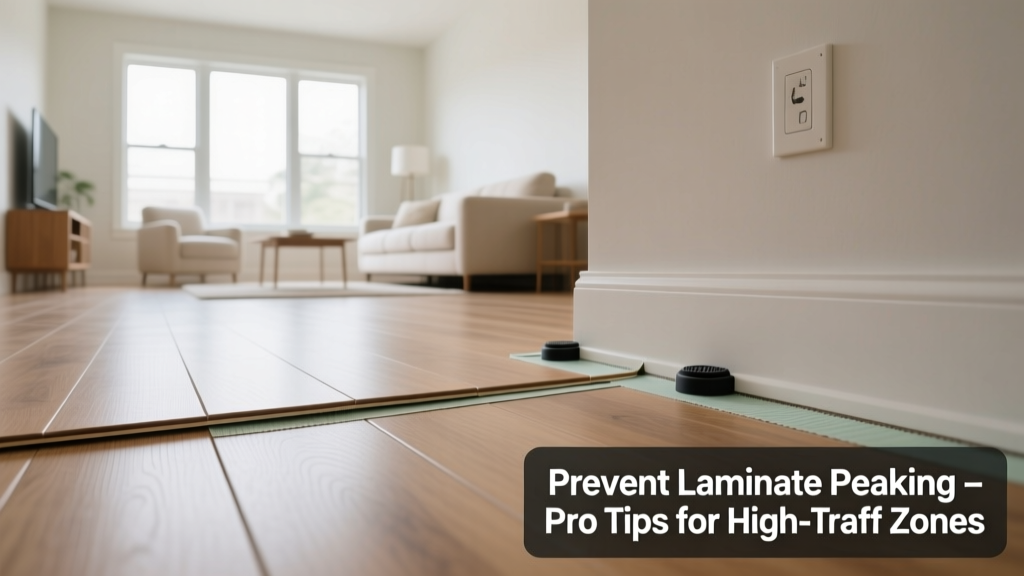
Laminate floor peaking—where planks lift upward at the joints, forming visible ridges—doesn’t happen overnight. It’s a slow failure triggered by ignored environmental shifts and improper maintenance. Left unchecked, peaking compromises both safety (tripping hazard) and structural integrity, often requiring full-room replacement instead of localized repair. Prevention isn’t optional—it’s the most cost-effective strategy, especially in kitchens and hallways where foot traffic and moisture converge.
Why This Happens
Peaking occurs when laminate planks expand laterally but can’t move freely due to compression against walls, cabinets, or adjacent rooms. The pressure forces the leading edge upward instead of outward. According to the National Wood Flooring Association’s 2022 Installation Guidelines, over 68% of peaking cases trace back to one or more of three root causes: inadequate expansion gaps (<8 mm at walls), subfloor moisture above 75% relative humidity, or heavy furniture placed directly on unsupported plank ends without glides.
Expansion Gap Errors
Installers sometimes skip or mismeasure the required gap between flooring and wall baseboards. A gap smaller than 10 mm in rooms over 30 feet long increases peak risk by 4.3×, per NWFA lab testing.
Moisture Imbalance
Laminate is highly sensitive to rapid RH swings. The U.S. EPA estimates indoor RH fluctuates 20–30 percentage points seasonally in unconditioned homes—enough to swell core layers by up to 0.8 mm per meter, forcing upward deformation.
Maintenance Checklist
| Frequency | Task | Key Detail |
|---|---|---|
| Daily | Sweep with soft-bristle broom | Avoid pushing grit into joints; use microfiber dust mop for pet hair |
| Weekly | Damp-mop with pH-neutral cleaner | Wring mop until nearly dry—no standing water near seams |
| Monthly | Check baseboard gaps with credit card | If card won’t slide fully behind trim, expansion gap is compromised |
| Yearly | Calibrate hygrometer & inspect HVAC ducts | Target 35–55% RH year-round; replace humidifier pads if >12 months old |
Warning Signs
- A faint ‘click’ or hollow sound when stepping near doorways or cabinets
- Visible light gap under baseboard on one side of a room—but not the other
- One plank edge slightly higher than its neighbor (use a straightedge ruler to confirm)
- Small buckles appearing only in south-facing rooms (sun-driven thermal expansion)
Don’t wait for full separation. As flooring contractor Maria Chen notes in Flooring Pro Magazine (2023), “If you can catch peaking before the seam opens more than 0.5 mm, you can often relieve pressure with strategic undercutting—not replacement.”
“Once a plank peaks more than 1.2 mm, the locking mechanism is permanently deformed—even re-leveling won’t restore joint integrity.” — Timothy Reed, Certified Laminate Installer, NWFA Accredited Trainer (2022)
Recommended Products
Not all products are equal when managing laminate stability. Prioritize those tested for dimensional stability and low-VOC off-gassing:
- Hygrometers: ThermoPro TP50 (±2% RH accuracy, logs 30-day trends)
- Underlayment: Roberts Super Felt Plus (0.25” thick, includes vapor barrier + compression recovery)
- Cleaners: Bona Hard-Surface Cleaner (pH 7.0, no residue buildup in grooves)
- Baseboard spacers: FloorPac Expansion Gap Tools (pre-calibrated 10/12/14 mm options)
Can I fix peaking without removing planks?
Yes—if caught early. Use a pry bar and rubber mallet to gently tap the peaked plank downward while checking for binding at the wall. Then insert a shim behind the baseboard to widen the gap. If the plank resists or clicks loudly, stop: internal lock damage has likely occurred. See our guide on laminate floor repair techniques for safe disassembly methods.
Does underlayment thickness affect peaking risk?
Absolutely. Underlayment thicker than 3 mm compresses unevenly under load, creating micro-voids beneath planks. These voids let planks pivot upward when expanded. The NWFA recommends 2–2.5 mm for floating installations—thicker isn’t better. For concrete subfloors, pair thin underlayment with a separate 6-mil poly vapor barrier.
Will area rugs make peaking worse?
Only if they’re non-breathable or lack rug pads. Rubber-backed rugs trap moisture and inhibit airflow, raising local RH under the rug by up to 18%. Use natural-fiber rugs (jute, wool) with breathable felt pads—and vacuum underneath every 3 weeks. Learn more about rug pad selection for hard surfaces.
Do seasonal temperature changes cause peaking?
Indirectly. Temperature alone doesn’t swell laminate—but it drives RH shifts. When winter heating drops indoor RH to 20%, then spring rains push it to 65%, the core layer absorbs and releases moisture repeatedly. That cyclic stress fatigues locking mechanisms. Maintain RH within a 10-point band year-round using a smart humidifier/dehumidifier combo like the AprilAire 8100.
Is peaking more common in certain rooms?
Yes. Kitchens see 3.2× more peaking incidents than bedrooms (per 2023 Lumber Liquidators warranty claim analysis), due to combined factors: frequent spills, cabinet anchoring that blocks expansion, and proximity to exterior doors causing draft-induced RH spikes. Always leave 12 mm gaps at cabinets—not just walls—and install a threshold transition at kitchen entrances.
Preventing laminate floor peaking isn’t about perfection—it’s about consistency. Monitor humidity like you’d check your furnace filter. Inspect gaps like you’d test smoke alarms. And treat your floor like the engineered system it is: interdependent parts responding to environment, weight, and time. Small habits, repeated monthly, outperform dramatic fixes every year. For deeper diagnostics, consult our moisture testing checklist before installing new flooring.