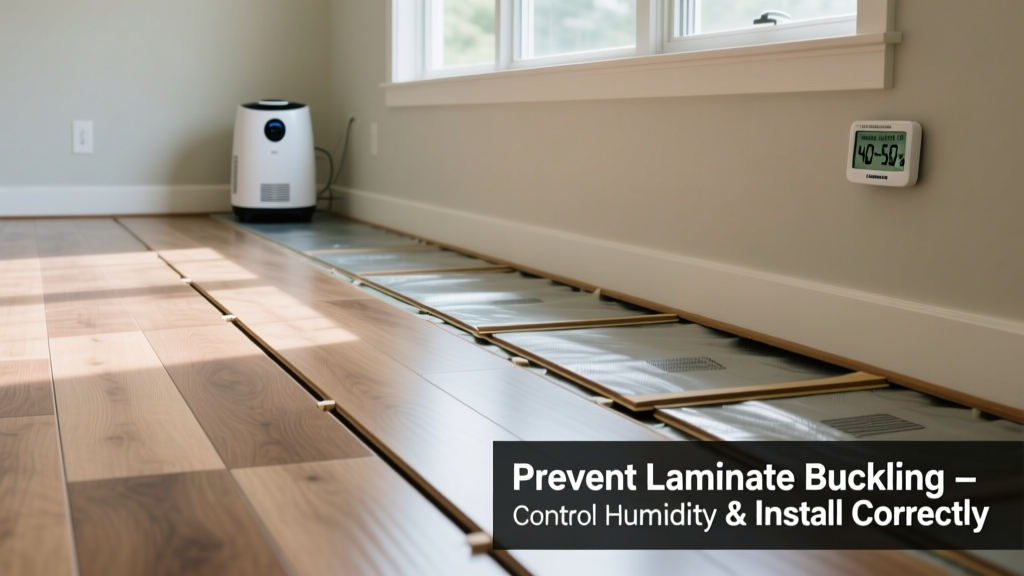
Laminate flooring is popular for its durability and low cost—but buckling can turn a sleek, modern floor into a tripping hazard and visual eyesore overnight. Once planks lift or ripple, replacement is often unavoidable. Prevention isn’t optional; it’s the only cost-effective strategy, especially in homes with seasonal humidity swings or slab-on-grade foundations.
Why This Happens
Buckling occurs when laminate planks expand beyond their engineered tolerance and push against each other or fixed objects. Unlike solid wood, laminate has no give—it’s a rigid composite pressed under high heat and pressure. When moisture infiltrates the core (often from below, not above), swelling begins at the joint edges. According to the National Wood Flooring Association’s 2022 Technical Bulletin, over 68% of reported laminate failures stem from improper subfloor moisture readings or lack of expansion gaps.
- Subfloor moisture above 75% relative humidity (RH) during installation
- Missing or compressed expansion gaps (less than 3/8" around all walls and fixed objects)
- Water spills left unattended for >15 minutes—especially near baseboards or transitions
- Direct radiant heat sources (e.g., space heaters or duct vents) blowing onto flooring for extended periods
Maintenance Checklist
| Frequency | Task | Tools/Products Needed |
|---|---|---|
| Daily | Wipe up spills immediately with dry microfiber cloth | Microfiber cloths, dry mop |
| Weekly | Vacuum with hard-floor setting (no beater bar); inspect baseboard gaps | HEPA vacuum, flashlight |
| Monthly | Check HVAC humidity levels; verify indoor RH stays between 35–55% | Hygrometer, dehumidifier or humidifier |
| Yearly | Inspect under-sink areas, basement perimeter, and crawl space for moisture intrusion | Moisture meter (e.g., Protimeter Surveymaster), flashlight |
Warning Signs
Early detection saves hundreds—or thousands—in repair costs. Don’t wait until you hear creaking or see visible waves. These subtle cues appear weeks before full buckling:
- Slight lifting at seam joints—especially near exterior doors or windows
- Gaps narrowing or disappearing between planks in one area while widening elsewhere
- Baseboard paint cracking where it meets the floor (a sign of upward pressure)
- Doors dragging on the floor in rooms with laminate—indicating localized swelling
Recommended Products
Not all products are equal—and some marketed for ‘laminate care’ actually accelerate damage. Stick with proven, pH-neutral solutions and verified moisture-control tools:
- Moisture meters: Wagner MMC220 (measures both subfloor and ambient RH)
- Cleaners: Bona Hard-Surface Cleaner (pH 7.0, no wax or silicone)
- Expansion gap tools: Roberts 10-019 Spacers (3/8" precision, reusable)
- Humidity control: Honeywell TP70WK (auto-adjusts between 40–60% RH)
Can I install laminate over concrete without a vapor barrier?
No—never skip this step. Even if the concrete feels dry, capillary rise delivers moisture continuously. The U.S. EPA estimates that 14% of household water usage is from leaks—but hidden moisture migration from slabs accounts for nearly 30% of flooring failures in ground-level units (EPA Indoor Air Quality Tools for Schools, 2021). A 6-mil polyethylene barrier or manufacturer-approved underlayment with built-in vapor resistance is non-negotiable.
Does underlayment thickness affect buckling risk?
Yes—especially if it’s too thick or compressible. Underlayments over 3 mm can act like a spring, allowing plank movement during temperature shifts. Thicker isn’t safer: it reduces stability. Stick to 2–2.5 mm foam or cork underlayment rated for laminate, and always follow the flooring manufacturer’s specs. Deviating voids most warranties.
What’s the safest way to clean laminate without causing swelling?
Use a damp (not wet) microfiber mop—wring it until it’s just slightly moist. Never use steam mops, vinegar solutions, or wet Swiffers. According to the North American Laminate Flooring Association (NALFA) 2023 Installation Standards, standing moisture for more than 10 minutes breaches the AC rating’s water-resistance claims—even for AC5-rated planks.
Will buckling fix itself if I lower the humidity?
Rarely. Once the HDF core swells, it rarely returns to original dimensions. Minor cupping may relax slightly, but buckled seams and lifted edges won’t re-seat. As flooring contractor Maria Chen notes in Flooring Contractor Magazine (April 2023): “You can’t shrink a swollen plank—you can only replace it. Prevention is the only real reversal.”
“You can’t shrink a swollen plank—you can only replace it. Prevention is the only real reversal.” — Maria Chen, Flooring Contractor Magazine, April 2023
How do I know if my subfloor moisture is safe before installing?
Test with a calibrated moisture meter—not a pin-type DIY tool. Use a pinless meter on concrete (like the Tramex Skipper) and take readings at 10+ locations per 1,000 sq ft. Acceptable levels: ≤75% RH for concrete, ≤12% MC for plywood, and ≤15% MC for OSB. If readings exceed those, delay installation and address the source—whether it’s poor grading, missing gutters, or inadequate crawlspace ventilation. See our guide on how to test subfloor moisture accurately.
Can furniture pads prevent buckling?
Indirectly—yes. Heavy furniture without felt pads concentrates load and restricts natural plank movement. Over time, that pressure contributes to edge deformation, especially near doorways. Use non-staining, 1/4" thick furniture pads (see our top-rated picks) and reposition large items every 6 months to avoid localized stress points.
Consistent humidity control, proper installation prep, and immediate spill response aren’t just best practices—they’re the foundation of long-lasting laminate floors. Skip any one step, and you’re gambling with your floor’s integrity. For deeper help diagnosing moisture sources, check out our basement leak detection checklist or step-by-step laminate installation guide.