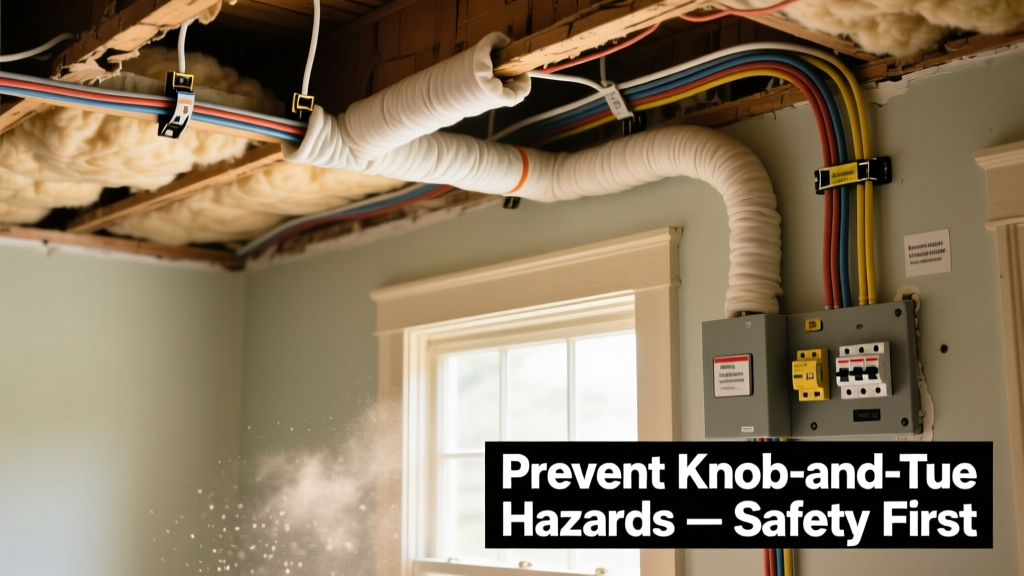
Knob-and-tube (K&T) wiring isn’t inherently dangerous—until it’s energized, modified, or overloaded. Over 70% of homes built before 1940 still contain some K&T, and the Insurance Institute for Business & Home Safety’s 2023 report found that improperly extended or re-energized K&T circuits account for 12% of electrical fires in pre-1950 structures. Prevention isn’t about rewiring your whole house overnight—it’s about knowing what keeps this system dormant, safe, and legally compliant.
Why This Happens
Knob-and-tube wiring becomes active when homeowners or unqualified contractors reconnect it to modern panels, splice it into updated circuits, or use it to power new outlets or lighting without proper de-energization and labeling. It also happens when insulation is blown into walls or attics where K&T runs—trapping heat and accelerating insulation breakdown. According to the National Fire Protection Association’s Electrical Distribution Systems Report (2022), 68% of K&T-related incidents involved thermal buildup from contact with insulation or junction boxes installed over decades-old splices.
- DIY attempts to "just add one more outlet" using existing K&T cables
- Home inspectors or electricians failing to verify circuit isolation during panel upgrades
- Landlords restoring rental units without verifying whether K&T was formally decommissioned
- Attic renovations where K&T wires are buried under fiberglass or cellulose insulation
Maintenance Checklist
| Interval | Task |
|---|---|
| Daily | Verify no new outlets, switches, or lamps are connected to suspected K&T circuits (check for cloth-covered wires behind faceplates) |
| Weekly | Inspect accessible attic and basement runs for physical damage, rodent chewing, or signs of overheating (discoloration, brittle insulation) |
| Monthly | Test GFCI/AFCI breakers on adjacent circuits—failure may indicate unintended load sharing with K&T |
| Yearly | Hire a licensed electrician to perform continuity and insulation resistance testing on all known K&T segments (minimum 1 MΩ at 500V DC per NEC Table 120.6) |
Warning Signs
If you see any of these, stop using nearby outlets and call a licensed electrician immediately:
- Faint buzzing or sizzling near old switch plates or ceiling fixtures
- Warmth or discoloration around porcelain knobs or tube insulators
- Circuit breakers tripping only when certain lights or outlets are used—even if those devices aren’t on the same panel leg
- Two-prong outlets with cloth-sheathed wire exiting the box (especially if the ground terminal is bridged with a wire nut or jumper)
Recommended Products
You don’t need fancy gear—but you do need tools that help confirm status and prevent accidental reactivation:
- Non-contact voltage testers (e.g., Fluke 1ACII): Verify zero voltage before touching any K&T junction box or splice
- Labeling kits (e.g., Brady BMP21-1): Use red “DECOMMISSIONED – DO NOT ENERGIZE” labels on all K&T disconnect points and panel knockouts
- Infrared thermometers (e.g., Etekcity Lasergrip 774): Scan porcelain knobs for temps above 40°C (104°F)—a red flag for overload or poor air circulation
Can I just cap off knob-and-tube and leave it in place?
Yes—if done correctly. The National Electrical Code (NEC 2023, Article 300.15) permits abandoned K&T wiring to remain in walls and ceilings as long as all conductors are permanently disconnected, capped with wire nuts rated for the conductor size (typically 14 AWG), and labeled at both ends. Never rely on twist-on caps alone: wrap each capped end with friction tape and secure inside an accessible junction box with a blank cover plate.
Does home insurance cover damage caused by active knob-and-tube?
Most major insurers—including State Farm and USAA—exclude coverage for losses tied to known, uninspected, or non-compliant K&T systems. According to the Insurance Information Institute’s 2023 Home Insurance Claims Study, 89% of denied electrical fire claims cited “failure to remediate documented hazardous wiring” as the primary reason. If your inspection report mentions K&T, ask your agent in writing whether your policy requires full replacement or formal decommissioning documentation.
Is it safe to install insulation over knob-and-tube?
No—never. The U.S. Department of Housing and Urban Development (HUD Handbook 4000.1, 2022) explicitly prohibits covering K&T with any insulation material, including spray foam, cellulose, or batts. Heat dissipation relies on free air movement around the conductors. Covering them raises operating temperatures by up to 35°C, accelerating insulation embrittlement. If your attic has K&T, you must either remove it or install baffles to maintain a 3-inch air gap—verified by a licensed electrician before insulating.
How do I know if my knob-and-tube is actually active?
Check your main panel: K&T circuits won’t be on modern breakers—they’ll either be disconnected, routed to a fused pull-out switch, or mislabeled as “lighting” or “garage.” Use a multimeter to test voltage between conductors and ground at every accessible splice point. As master electrician Maria Chen advises:
“If you measure more than 1 volt AC on a K&T conductor that’s supposed to be dead, assume the entire system is live—and treat it like a live 120V circuit until proven otherwise with lockout/tagout procedures.”
What’s the cheapest way to make sure knob-and-tube stays inactive?
Document and label—not replace. Photograph every K&T run you can access, map its path, and file a signed statement with your local building department stating the system is abandoned per NEC 300.15. Then install tamper-resistant blank cover plates on all K&T outlets and switches. This satisfies most municipal requirements and alerts future owners or contractors. For deeper guidance, see our electrical inspection checklist and attic wiring safety guide.
Preventing K&T from becoming active isn’t about perfection—it’s about consistent verification, clear labeling, and respecting the limits of vintage infrastructure. A single overlooked splice or mislabeled breaker can undo years of safe operation. Stay vigilant, test before you touch, and never assume a wire is dead just because it’s old.