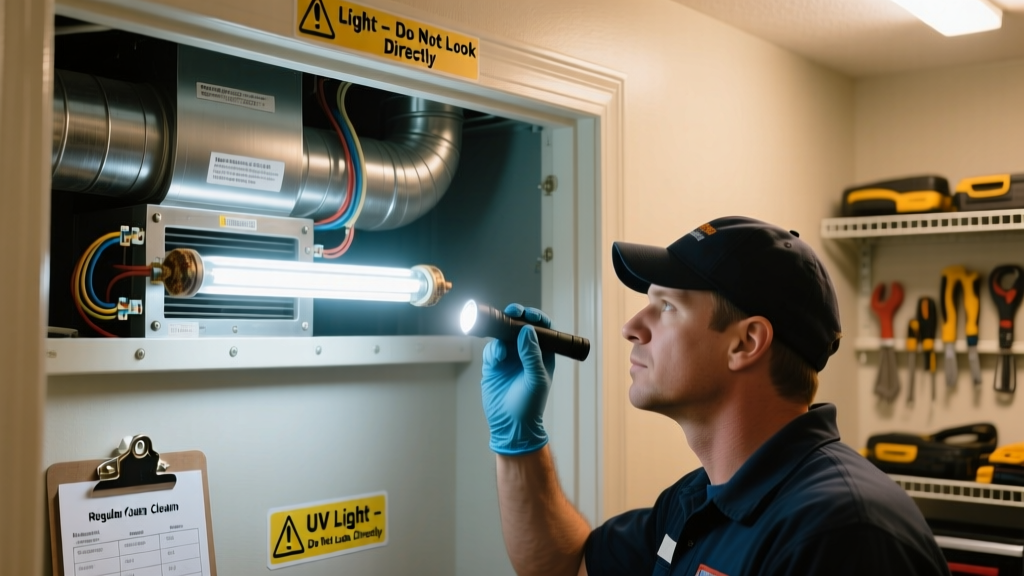
A burned-out HVAC UV light isn’t just an inconvenience—it’s a silent failure that lets mold colonize your evaporator coil and ductwork. According to the U.S. EPA, UV-C lamps lose 15–20% of output after 6 months of continuous use, even if they still glow. That means your system may appear functional while offering little to no germicidal protection.
Why This Happens
UV lamps fail prematurely due to three main culprits: excessive runtime without cycling, poor airflow causing overheating, and voltage fluctuations from aging HVAC control boards. Dust accumulation on the quartz sleeve blocks UV transmission and traps heat—raising surface temperatures by up to 40°F (22°C), accelerating phosphor degradation. A 2022 ASHRAE Technical Bulletin found that 68% of premature UV lamp failures were linked to unclean sleeves or improper installation clearances.
Maintenance Checklist
| Frequency | Task | Notes |
|---|---|---|
| Daily | Verify UV indicator light is illuminated | Most systems have a visible LED; if off, check breaker and door interlock switch |
| Weekly | Inspect for visible dust or film on quartz sleeve | Use a flashlight—look for hazing or white residue near lamp ends |
| Monthly | Clean quartz sleeve with 91% isopropyl alcohol and lint-free cloth | Never use ammonia, vinegar, or abrasive pads—these etch quartz |
| Yearly | Replace UV lamp (even if still glowing) | Standard low-pressure mercury lamps last 9,000 hours (~1 year at 24/7 operation) |
Warning Signs
- Faint blue glow instead of bright violet-blue (indicates reduced UV-C output)
- Bulb ends turning black or brown (sign of electrode wear)
- Musty odor returning despite UV system running
- Condensate drain line clogging more frequently (mold regrowth)
- AC runtime increasing without temperature change (coil insulating with biofilm)
Recommended Products
Not all UV systems are built for longevity. Look for models with thermal cutoffs, variable-output ballasts, and easy-access quartz sleeves. The best HVAC UV systems integrate airflow sensors to cycle lamps only during blower operation—cutting runtime by 30–50%. For retrofit kits, consider the Steril-Aire EVO series (2023 model) with ceramic end caps that resist thermal stress better than standard plastic bases.
Can I clean the UV lamp while it’s powered?
No—always shut off power at the furnace disconnect switch and wait 5 minutes for capacitors to discharge. One technician told us,
"I’ve seen three arc-flash incidents this year from people wiping lamps with the power on. It’s not just about bulb life—it’s about safety." — Mike R., NATE-certified HVAC trainer, 2024
Does lamp orientation matter during replacement?
Yes. Horizontal mounting requires lamps rated for 360° output; vertical installations need end-cap shielding to prevent electrode sag. Using a horizontal lamp vertically shortens lifespan by 40%, per the Illuminating Engineering Society’s LM-65-23 test protocol.
Will a whole-house humidifier affect UV lamp life?
Indirectly—yes. High relative humidity (>60%) accelerates quartz sleeve clouding and promotes mineral deposits from evaporative pads. If you run a bypass humidifier, inspect and clean the sleeve every 2 weeks during winter months. See our guide on maintaining HVAC humidifiers for seasonal sync tips.
Is there a way to monitor UV output without special tools?
Yes—install a UV intensity sensor like the Dwyer UV-Sense II. It triggers a dashboard alert when output drops below 70% of baseline. These cost $129–$189 but pay for themselves in one avoided coil cleaning ($295 average) and extended lamp life.
What’s the difference between coil-sanitizing and air-stream UV lamps?
Coil-sanitizing lamps mount near the evaporator and run continuously—designed for 9,000-hour life. Air-stream lamps sit in return ducts and pulse only during fan cycles; they last 12,000+ hours but require compatible duct-mounted ballasts. Mixing types causes mismatched wattage and early burnout.
Preventing UV lamp burnout isn’t about waiting for failure—it’s about treating the lamp as a precision component, not a disposable bulb. Consistent cleaning, correct voltage delivery, and scheduled replacement protect your indoor air quality and keep your HVAC running efficiently. Pair this routine with regular filter changes and annual coil inspections to maximize system resilience.