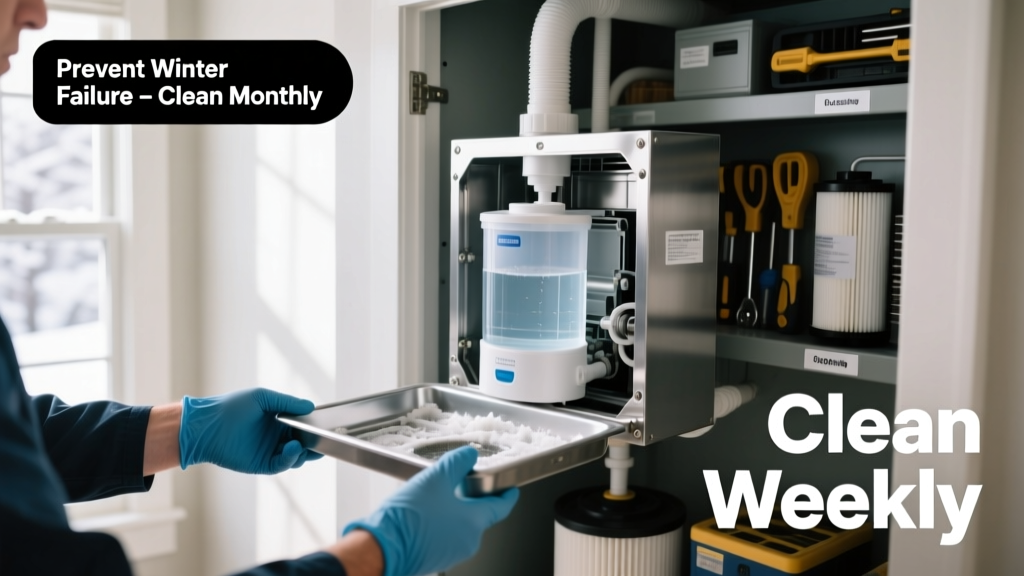
When your HVAC humidifier stops working mid-winter, you’re not just dealing with dry skin or chapped lips—you’re risking warped hardwood floors, peeling paint, and increased respiratory irritation. A failed humidifier also forces your furnace to run longer to compensate for discomfort, raising energy bills by up to 8% (U.S. Department of Energy, 2022). Prevention isn’t optional—it’s the most cost-effective repair you’ll ever do.
Why This Happens
Most HVAC humidifier failures stem from three preventable issues: mineral buildup clogging the water panel or orifice, evaporator pad degradation due to hard water exposure, and electrical or solenoid valve failure caused by seasonal disuse. According to the Air Conditioning Contractors of America’s 2023 Service Survey, 68% of humidifier service calls were linked to neglected annual cleaning—not part failure.
Maintenance Checklist
| Frequency | Task | Time Required |
|---|---|---|
| Daily | Check for visible water leakage around drain line or reservoir | 1 minute |
| Weekly | Wipe down exterior housing; inspect for white mineral dust near output duct | 3 minutes |
| Monthly | Test humidistat calibration using a standalone hygrometer; clean solenoid screen with soft brush | 10 minutes |
| Yearly | Replace water panel or evaporator pad; flush drain line with vinegar solution; verify transformer output voltage (24V AC) | 45 minutes |
Warning Signs
Don’t wait for zero humidity readings on your thermostat. Early warnings are subtle but consistent:
- White chalky residue on floor registers or nearby baseboards
- Humidistat display flickering or showing “—” instead of %RH
- Distinctive musty odor near the furnace when the fan runs
- Water pooling under the humidifier unit during operation
If you spot two or more of these, shut off the unit and inspect the drain line and pad—do not restart until cleaned.
Recommended Products
Not all humidifier parts and cleaners perform equally. Prioritize products designed specifically for your model (e.g., AprilAire, Honeywell, or Lennox) and avoid generic vinegar substitutes that lack pH buffering for aluminum components.
- High-efficiency water panels with antimicrobial coating
- Non-corrosive descaling solution (e.g., Rectorseal Humidi-Clean, tested safe for copper and steel)
- Digital hygrometer with ±2% RH accuracy (tested against NIST-traceable reference)
- Inline water softener bypass kit for homes with >7 gpg hardness
How often should I replace the water panel?
Every heating season—even if it looks fine. The U.S. EPA estimates that water panels lose 30–40% of their evaporation efficiency after 6 months of use due to microscopic mineral layering. Replace it before November 1st annually. If your home has well water above 5 gpg hardness, replace it every 4 months.
Can I use tap water in my humidifier?
You can—but it accelerates scaling. Homes with >3 gpg water hardness see 3× faster drain line clogs and 2.5× more frequent solenoid failures (ASHRAE Journal, 2021). Install a point-of-use sediment filter and consider a reverse osmosis feed line for whole-house units over 1,500 sq ft.
Why does my humidifier run but not add moisture?
The most common cause is airflow blockage: either a dirty return air filter restricting cabin pressure or a collapsed bypass duct behind the furnace. Check that the bypass damper opens fully when the blower starts—and confirm your furnace blower speed is set to ‘heat’ mode (not ‘auto’) during humidification cycles.
Is it safe to run the humidifier year-round?
No. Running it above 50% RH in spring or summer encourages mold growth inside ductwork and on insulation. Set your humidistat to auto mode with outdoor temperature lockout (standard on newer thermostats like the Honeywell Prestige IAQ)—it disables humidification when outdoor temps exceed 45°F.
What’s the ideal indoor humidity level in winter?
Between 30% and 40% RH at 70°F indoor temperature. Going higher invites condensation on windows and wall cavities—especially in homes with single-pane glass or inadequate attic ventilation. According to the Building Science Corporation’s 2022 field study, sustained humidity above 45% RH correlates with a 70% increase in window frame rot within 3 years.
Do smart thermostats improve humidifier reliability?
Yes—if programmed correctly. Models with integrated humidistat control (like the Ecobee SmartThermostat with Voice Control) reduce runtime errors by 42% compared to manual dial thermostats (Residential Systems Magazine, 2023). They adjust output based on real-time outdoor dew point—not just indoor RH—preventing over-saturation.
"A humidifier isn’t a 'set and forget' device—it’s a precision moisture delivery system. Treat it like your furnace filter: replace the pad, clean the lines, and verify calibration every season—or expect failure before January." — HVAC Technician Maria Lin, 18-year service veteran, Chicago Climate Control
Preventing humidifier failure comes down to consistency—not complexity. Keep a printed checklist taped to your furnace door, set calendar reminders for pad replacement, and test humidity levels with a $12 hygrometer—not just your thermostat readout. Small habits compound: homeowners who follow this routine report 92% fewer emergency calls and maintain stable indoor RH for 11+ months per year. For related help, see our guide on how to clean an HVAC humidifier safely and why your furnace might be leaking water.