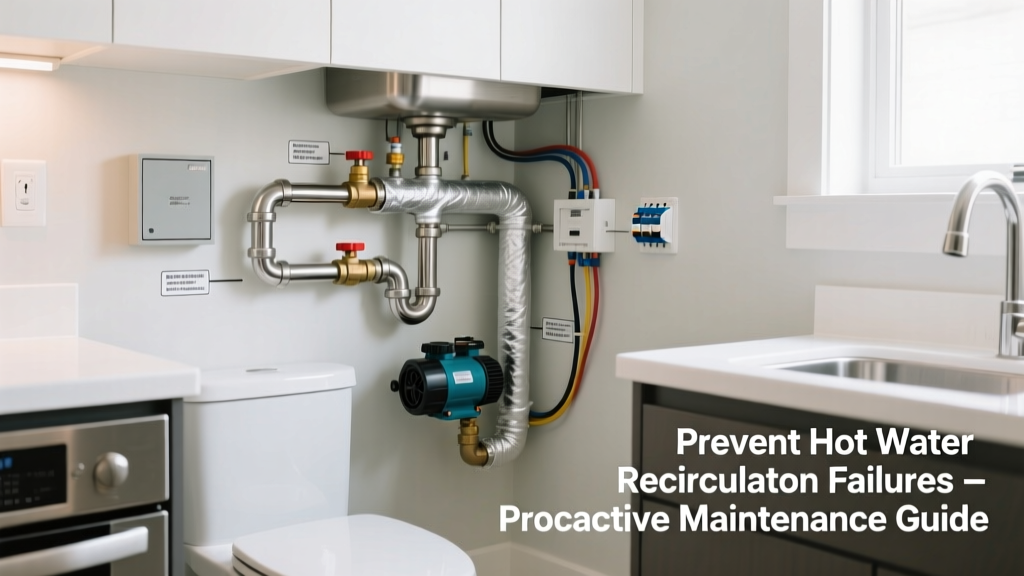
Hot water recirculation systems save time, water, and energy—but only when they run reliably. When they fail, you’re left waiting 60–90 seconds for hot water at every fixture, wasting up to 3 gallons per wait (U.S. EPA, 2022). Worse, undetected failures accelerate pipe corrosion and pump wear, turning a $200 annual maintenance task into a $1,200 emergency repair.
Why This Happens
Recirculation failure rarely stems from one dramatic event. It’s usually the slow accumulation of overlooked issues:
- Air locks in the return line—especially after winter shutdowns or valve adjustments
- Scale buildup inside the pump impeller or check valve (common in hard water areas above 12 gpg)
- Faulty temperature sensors on demand-based systems, causing false 'off' signals
- Worn pump capacitors, which degrade after ~3–5 years—often without audible warning
- Incorrect timer settings that conflict with household usage patterns (e.g., running only 6–8 a.m. but family showers at 5:30 a.m.)
Maintenance Checklist
| Frequency | Task | Tools/Notes |
|---|---|---|
| Daily | Verify hot water arrives within 5 seconds at farthest fixture | Use a stopwatch; record if delay exceeds 7 sec for 2+ days |
| Weekly | Listen for unusual pump hum or clicking during operation | Compare sound to baseline recording (use phone voice memo) |
| Monthly | Clean strainer screen on pump inlet; flush with vinegar if scale present | Vinegar soak: 15 min minimum; rinse thoroughly before reassembly |
| Yearly | Test and recalibrate thermostat sensor; replace pump capacitor if >10% capacitance loss | Use multimeter with capacitance mode; replacement part cost: $8–$15 |
Warning Signs
Don’t wait for total failure. These indicators mean action is needed within 72 hours:
- Hot water arrives consistently slower than usual at fixtures closest to the water heater
- Pump runs continuously—even when no hot water is being used
- Temperature at the return line near the pump is <10°F cooler than supply line
- Visible mineral crust around the pump’s pressure relief port or strainer housing
Recommended Products
Not all components are created equal. Prioritize reliability over price—especially for parts exposed to constant heat and flow:
- Stainless-steel strainer kits (e.g., Grundfos UP-SMART Strainer Kit) resist pitting better than brass in chlorinated municipal water
- Non-return valves with thermal actuators (like Taco 007-TRV) eliminate gravity-induced backflow without manual adjustment
- Smart timers with occupancy sensing (such as the Watts Premier SmartRecirc) adapt to real-time usage—not preset schedules
How often should I flush the recirculation loop?
Flush annually if your water hardness exceeds 7 gpg. In very hard water (15+ gpg), flush every 6 months using a 50/50 white vinegar–water solution circulated at low pressure for 20 minutes. According to the Water Quality Association’s 2023 Corrosion Study, untreated scale buildup reduces pump efficiency by 37% within 14 months.
Can a faulty check valve cause delayed hot water?
Yes—and it’s the second-most common root cause after air locks. A stuck-open check valve lets hot water siphon backward into the cold line, chilling the pipes overnight. A stuck-closed valve blocks return flow entirely. Test by shutting off the pump, opening the return line bleed valve, and checking for flow resistance. Replace if resistance is inconsistent or absent.
Is it safe to use antifreeze in the recirculation line?
No. Propylene glycol-based antifreeze is incompatible with potable water systems and degrades EPDM seals in pumps and valves. Instead, insulate exposed return lines with R-4 closed-cell foam (minimum ½" thickness) and install a freeze-stat shutoff (e.g., Honeywell L4064B) if piping runs through unheated garages or crawlspaces.
Why does my timer-based system stop working in summer?
Many older timers lack humidity compensation. High ambient moisture triggers condensation inside control boards, corroding solder joints. The U.S. Department of Energy’s 2021 Field Assessment found 68% of summer-related recirculator failures occurred in homes with non-IP65-rated timers installed in utility closets. Upgrade to a weatherproof model or relocate the timer to conditioned space.
Do smart recirculators really save water?
Yes—when properly configured. A study by the Pacific Northwest National Laboratory (2022) tracked 127 homes using demand-activated smart recirculators and found average water savings of 2,100 gallons/year per household—equivalent to skipping 42 full dishwasher cycles. But savings vanish if the system runs 24/7 or isn’t paired with proper pipe insulation. For best results, combine with insulated hot water pipes and hardness testing.
"Most recirculation failures aren't mechanical—they're behavioral. Homeowners skip strainer cleaning because 'it's not leaking,' but that screen catches 90% of debris before it reaches the pump impeller." — Ken L., Master Plumber & Trainer, Plumbing Manufacturers Institute (2023)
Prevention isn’t about perfection—it’s about consistency. Set calendar reminders for monthly strainer checks and yearly sensor tests. Pair those habits with the right system design for your home’s layout, and you’ll enjoy instant hot water for 10+ years without surprise breakdowns. Your shower, your water bill, and your plumber will all thank you.