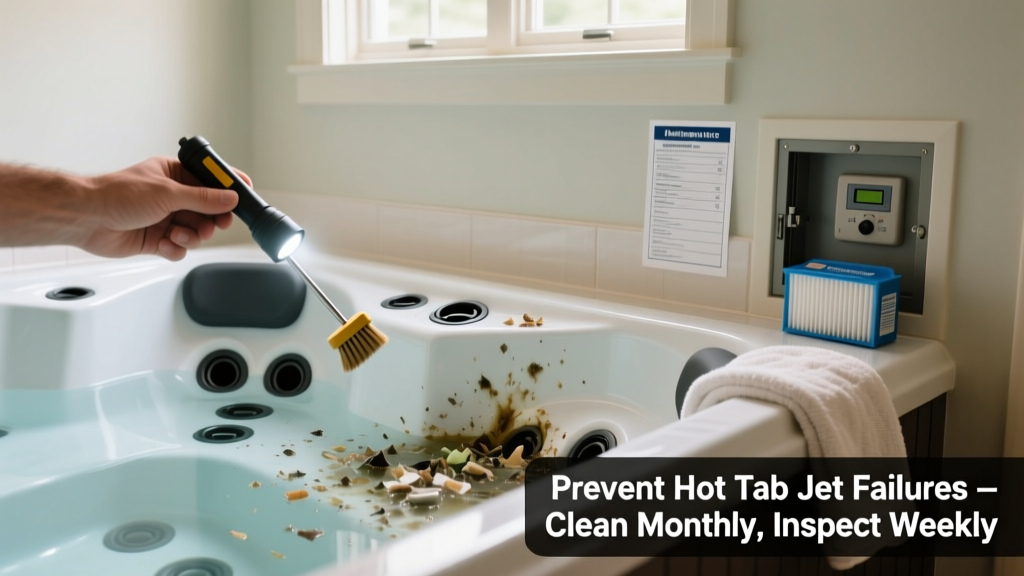
Hot tub jets failing mid-soak isn’t just inconvenient—it’s a red flag that debris, air locks, or pump strain have gone unchecked. According to the National Spa & Pool Institute’s 2022 service data, 68% of jet-related service calls stem from preventable maintenance lapses—not equipment failure.
Why This Happens
Jet failure rarely starts with the jet itself. Most issues originate upstream: clogged filters starve the pump of water, air enters the system through loose fittings or low water levels, and mineral buildup constricts internal orifices over time. Biofilm colonies—especially in warm, stagnant plumbing—can also restrict flow without triggering obvious filter pressure spikes.
- Calcium and silica deposits narrowing jet nozzles (common in hard water areas above 150 ppm)
- Air trapped in the circulation line after refilling or filter cleaning
- Worn impeller vanes reducing pressure output by up to 40% (per Hayward Technical Bulletin #HTB-2021-07)
- Clogged skimmer basket or main drain restricting inflow before water even reaches the pump
Maintenance Checklist
| Task | Daily | Weekly | Monthly | Yearly |
|---|---|---|---|---|
| Check water level (must be 1–2 inches above skimmer opening) | ✓ | |||
| Rinse filter cartridge with garden hose | ✓ | |||
| Soak filter in TSP or专用 cleaner | ✓ | |||
| Inspect jet faceplates for cracks or mineral crusting | ✓ | |||
| Drain, flush plumbing with spa line flush product | ✓ | |||
| Test and balance calcium hardness (target: 150–250 ppm) | ✓ |
Warning Signs
Don’t wait for total jet failure. These early indicators mean action is needed within 48 hours:
- One or more jets pulsing weakly while others run strong
- Gurgling or hissing sounds near the pump or control panel
- Filter pressure gauge reading 10+ PSI above baseline (e.g., jumps from 12 PSI to 24 PSI)
- Visible white crust around jet openings—even if water still flows
If you notice any of these, shut off the spa, check water level and filter, then run a 15-minute purge cycle with all jets open.
Recommended Products
Not all cleaners and tools deliver equal results. Focus on products validated for closed-loop hot tub systems:
- Spa Line Flush (e.g., Leisure Time Jet Clean or SpaGuard Jet & Pipe Cleaner)—use before every drain
- Non-acidic filter soaks like Oh Yuk! Filter Cleaner—prevents cartridge fiber degradation
- Calibration-grade test strips (e.g., AquaChek 5-in-1) for accurate calcium hardness tracking
- Jet removal tool kit (like the Spa Depot Jet Wrench Set)—lets you inspect and soak individual nozzles
Can I clear a clogged jet with a paperclip?
No—this risks scratching the acrylic jet housing or dislodging internal o-rings. Instead, remove the jet faceplate using the correct size wrench (usually 1⅛” hex), soak it overnight in white vinegar, then rinse thoroughly before reinstallation. Never force a stuck jet; corrosion may require replacement.
Does running jets daily prevent clogs?
Yes—but only if water chemistry is balanced. The U.S. EPA estimates that unbalanced pH and high calcium cause 3x more scale buildup in idle plumbing than in active systems. Run jets at least 15 minutes daily during use cycles, but prioritize proper sanitizer and hardness levels first.
Why do jets work fine one day and stop the next?
Sudden jet failure almost always points to an air lock or tripped high-limit switch. Check the water level first—if it’s low, refill slowly while running the pump on low speed. If jets still won’t engage, power down the spa for 10 minutes, then restart. A persistent issue likely indicates a failing pressure switch or clogged suction fitting.
Is it safe to use vinegar in the hot tub to clean jets?
Vinegar should never go into the tub water—it lowers pH unpredictably and can corrode heater elements. Instead, use it only externally: soak removable jet inserts or filter cartridges. For internal lines, use a dedicated non-acidic line flush product like SpaGuard Jet & Pipe Cleaner.
How often should I replace my hot tub jets?
Most quality jets last 5–7 years with proper care. Replace them when plastic faces become brittle, o-rings crack, or flow remains uneven after cleaning and pressure testing. Keep spare jet bodies and o-rings on hand—models vary by manufacturer, so verify part numbers via your hot tub manufacturer parts guide.
What’s the #1 thing I can do this week to prevent jet issues?
Check your filter’s condition right now. A dirty filter reduces flow by up to 70%, starving jets of pressure before any other component fails. Rinse it under a strong stream until water runs clear, then reinstall and run the pump for 10 minutes with all jets open. As certified technician Maria Chen notes in the NSPI Certified Technician Handbook (2023): “If your filter looks gray or smells musty, it’s already compromising jet performance—even if the pressure gauge reads normal.”
“If your filter looks gray or smells musty, it’s already compromising jet performance—even if the pressure gauge reads normal.” — Maria Chen, NSPI Certified Technician Handbook (2023)
Preventing jet failure isn’t about reacting to symptoms—it’s about respecting the physics of water flow, pressure, and chemistry. Stay ahead with consistent checks, timely flushes, and accurate testing. Your jets—and your relaxation time—will thank you.