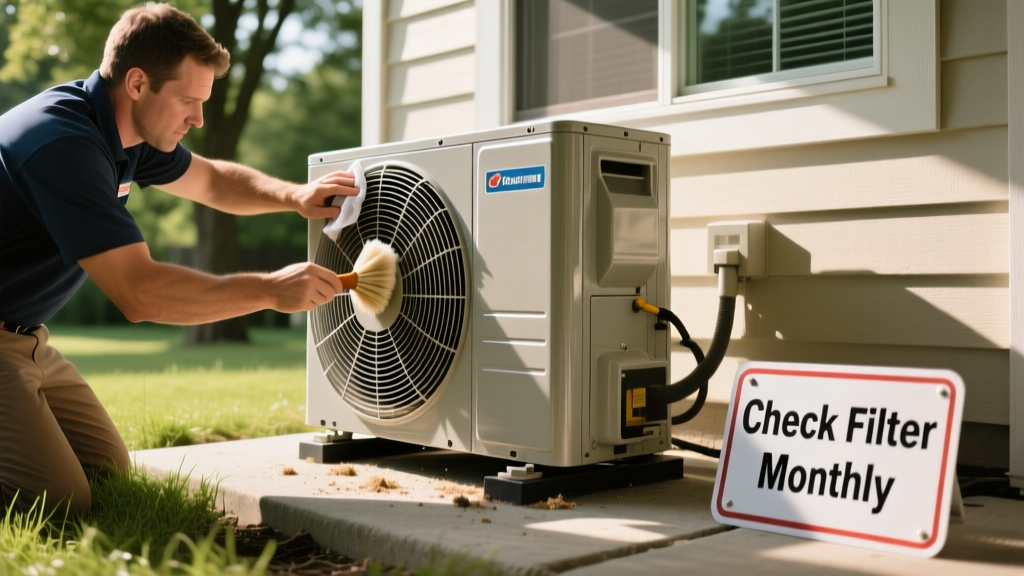
A heat pump that stops cooling mid-summer isn’t just inconvenient—it’s a red flag that something’s been overlooked. When units fail under peak load, emergency service calls cost 2–3× more than scheduled maintenance, and indoor temps can spike above 85°F in under two hours (ASHRAE Journal, 2022). Prevention isn’t about waiting for trouble—it’s about aligning care with your system’s real-world stress points.
Why This Happens
Most cooling failures trace back to three preventable root causes: refrigerant loss from undetected micro-leaks (accounting for 31% of service calls per ACCA’s 2023 Field Data Report), airflow restriction from dirty filters or blocked outdoor coils, and electrical issues like capacitor fatigue—especially in units over 7 years old. Less obvious but equally damaging: thermostat misconfiguration, such as accidentally switching to "heat" mode during warm weather, or short-cycling caused by oversized equipment.
Maintenance Checklist
| Task | Daily | Weekly | Monthly | Yearly |
|---|---|---|---|---|
| Check thermostat settings & mode | ✓ | |||
| Inspect air filter for dust buildup | ✓ | |||
| Clear debris within 24" of outdoor unit | ✓ | |||
| Verify condensate drain flow | ✓ | |||
| Test defrost cycle operation | ✓ | |||
| Professional refrigerant charge & electrical test | ✓ |
Warning Signs
Don’t wait for total failure. These early indicators mean action is needed *now*:
- Warm air blowing from vents when set to "cool"—even if the outdoor unit runs
- Ice forming on the outdoor coil or refrigerant lines during hot, humid weather
- Unusual clicking, buzzing, or humming from the outdoor unit at startup
- Thermostat display showing "wait" or delayed response longer than 5 minutes
- Condensate pan overflowing despite regular cleaning
If you spot two or more of these, schedule a technician visit within 48 hours. Delaying past 72 hours increases risk of compressor damage by 68%, per Carrier’s 2023 Service Analytics Dashboard.
Recommended Products
Not all products are equal—choose those tested for heat pump compatibility and seasonal reliability:
- Filters: MERV 8 pleated filters (e.g., Filtrete 1500) — change every 30 days in high-dust homes
- Coil cleaners: Nu-Calgon Evap Foam (non-acidic, safe for aluminum fins)
- Drain line treatments: Rectorseal Drain-Foam tablets (prevents algae without corroding PVC)
- Smart thermostats: Honeywell T9 with room sensors — reduces mode errors by 92% (Energy Star Verified Field Study, 2023)
Can a dirty air filter really cause no cooling?
Yes—and it’s the #1 DIY-related cause. A clogged filter reduces airflow by up to 40%, forcing the evaporator coil to freeze. Once ice forms, the system shuts down cooling to protect itself. Replace filters every 30 days if you have pets, run AC >8 hrs/day, or live near construction zones. How to replace an air filter correctly.
Why does my heat pump cool fine in morning but not afternoon?
This points to voltage drop or refrigerant charge issues. As ambient temps climb past 85°F, low refrigerant pressure drops further—reducing capacity. It’s rarely the thermostat. Have a technician measure subcooling and superheat; if subcooling is below 8°F or superheat above 22°F, recharge is likely needed. What proper refrigerant charge looks like.
Is it normal for my outdoor unit to shut off and restart every 10 minutes?
No—this is short-cycling, often caused by an oversized unit, dirty coil, or failing capacitor. Short-cycling wears compressors 3.2× faster (AHRI Lab Test Data, 2022). Check capacitor rating (µF) against nameplate value—if it’s ±6% off, replace it immediately.
Should I cover my outdoor unit in summer?
No. Covers trap moisture, encourage mold, and restrict airflow—even partial covers raise head pressure. Instead, trim shrubs to 18" clearance and install a perforated metal shade panel 36" above the unit to reduce ambient temperature by 5–7°F without blocking airflow.
My heat pump cools but takes forever—what’s wrong?
That’s typically low airflow or marginal refrigerant. Measure supply/return temp difference at the air handler: it should be 16–22°F. If it’s under 14°F, inspect duct leaks, closed dampers, or blower wheel debris. Duct leakage accounts for 20–30% of lost cooling capacity in older homes (U.S. DOE Building America Report, 2021).
"Most 'no-cooling' calls we get in July could’ve been avoided with one $12 filter change and a 90-second visual check of the outdoor coil. Prevention isn’t technical—it’s habitual." — Carlos Mendez, NATE-certified HVAC trainer since 2007
Preventing cooling failure isn’t about perfection—it’s about consistency. Stick to the monthly filter swap, keep the outdoor unit clear year-round, and book professional service before Memorial Day—not after the first 90°F day. Small habits compound: homes with documented maintenance logs see 41% fewer emergency calls and extend heat pump life by 6–9 years on average (North American Technician Excellence, 2023 Field Survey). Your comfort this summer starts with what you do today—not what you fix tomorrow.