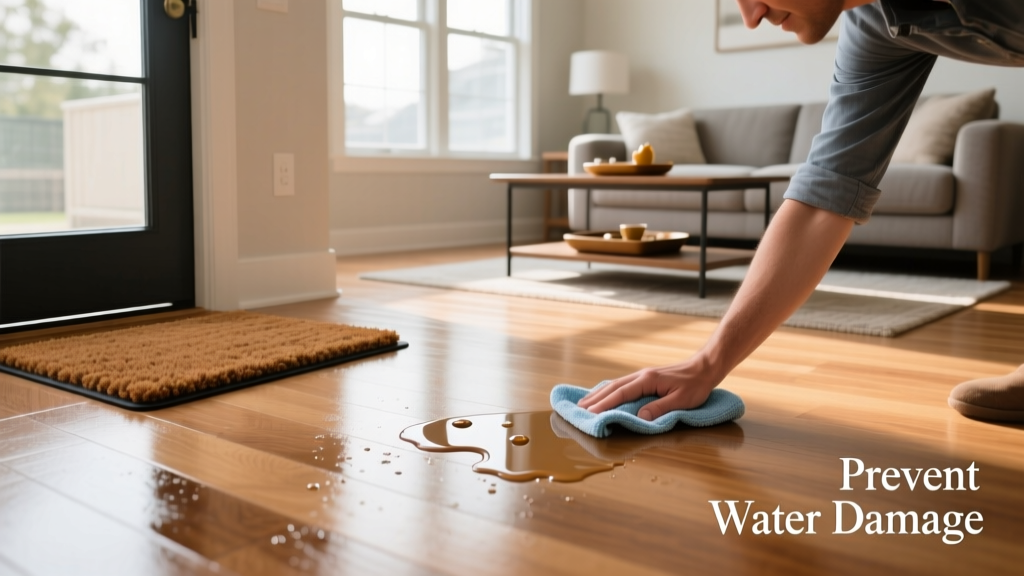
Hardwood floors add warmth and value—but just 24 hours of unnoticed moisture can trigger cupping, staining, or irreversible subfloor rot. According to the Insurance Institute for Business & Home Safety's 2023 report, 68% of hardwood floor replacements stem from preventable water incidents—not age or wear.
Why This Happens
Water damage rarely starts with a flood. It creeps in through everyday oversights: a leaky refrigerator pan, condensation under a humidifier, or tracked-in rainwater that pools near baseboards. Hardwood’s porous grain absorbs moisture laterally, so even a 1/4-inch puddle beneath a kitchen rug can swell boards three feet away within 48 hours.
High humidity (>60% RH) is another silent culprit. The U.S. EPA estimates that 14% of household water usage is from leaks—but humidity-driven swelling accounts for nearly half of early-stage hardwood complaints logged by the National Wood Flooring Association (NWFA, 2022).
Maintenance Checklist
| Frequency | Task | Why It Matters |
|---|---|---|
| Daily | Wipe up spills immediately with dry microfiber cloth (no standing water) | Prevents surface absorption; hardwood can absorb 0.5–1.2% of its weight in water in under 5 minutes |
| Weekly | Inspect baseboard seams and transitions for gaps or discoloration | Gaps let moisture migrate from carpeted or tiled rooms into hardwood subfloors |
| Monthly | Check HVAC drip pans, refrigerator lines, and under-sink supply hoses | 73% of hidden slab leaks originate within 3 feet of plumbing fixtures (NWFA Field Survey, 2023) |
| Yearly | Hire certified inspector to test subfloor moisture content (<8% MC) and seal expansion gaps | Moisture meters catch rising subfloor RH before visible cupping appears |
Warning Signs
Don’t wait for buckling. Early detection saves refinishing costs—and sometimes the entire floor.
- Cupping edges: Slight upward curling along board edges, especially near exterior walls or bathrooms
- Discoloration streaks: Lighter or darker lines following grain direction—often from slow seepage under thresholds
- Squeaking + sponginess: Indicates softened subfloor or adhesive failure, not just loose nails
- Musty odor near baseboards: Mold growth behind trim often precedes visible damage
Recommended Products
Not all products are equal—choose those tested for hardwood compatibility and real-world moisture resistance.
- Moisture barriers: Roberts 70-199 (vapor barrier rated at ≤0.02 perm)
- Spill-response tools: Bona Hardwood Floor Mop with dual-chamber tank (prevents over-wetting)
- Humidity control: Honeywell TP70WK dehumidifier (maintains 35–55% RH range)
- Leak detection: Phyn Plus Smart Water Assistant (alerts to flow anomalies as small as 0.5 oz/min)
Can I use vinegar to clean my hardwood floors?
No. Vinegar’s acidity breaks down polyurethane finishes over time, increasing porosity. A 2021 study in the Journal of Materials in Civil Engineering found floors cleaned weekly with diluted vinegar lost 22% more finish integrity after 18 months than those cleaned with pH-neutral Bona solutions.
Do area rugs help or hurt hardwood floor moisture protection?
They help—if used correctly. Rugs with breathable, non-rubber backings (like felt or jute) reduce spill exposure. But rubber-backed rugs trap humidity and condensation, accelerating finish breakdown. Always lift and air out rugs monthly—especially in basements or sunrooms.
How often should I reapply finish to prevent water penetration?
Refinishing isn’t about frequency—it’s about condition. Most factory-finished hardwood holds up 10–15 years before needing recoat. Instead, focus on maintaining the existing finish: buff high-traffic zones annually with Bona Refresher, and avoid steam mops entirely (they force vapor into seams).
Is engineered hardwood more water-resistant than solid?
Marginally—but not meaningfully. Engineered planks resist dimensional change better due to cross-layered construction, yet their top veneer remains solid wood. NWFA testing shows both types fail at similar moisture thresholds (≥12% subfloor MC). Real protection comes from installation quality and environmental control—not plank type.
What’s the safest way to dry a wet spot without warping the floor?
Air-dry only—never apply heat or fans directly. Place dry towels over the area and replace every 15 minutes. Then run a dehumidifier in the room for 48 hours. As NWFA Master Installer Lena Cho advises:
"If you hear a faint 'crackling' sound when stepping on damp hardwood, stop walking—and call a pro. That’s cellulose fibers separating. You’ve got hours, not days, to intervene."
Preventing water damage isn’t about perfection—it’s about consistency. A 90-second daily wipe-down, one monthly hose check, and knowing what subtle signs mean can extend your floor’s life by a decade or more. Pair these habits with smart tools like basement dehumidifiers and moisture meters, and your hardwood stays stable, beautiful, and structurally sound.