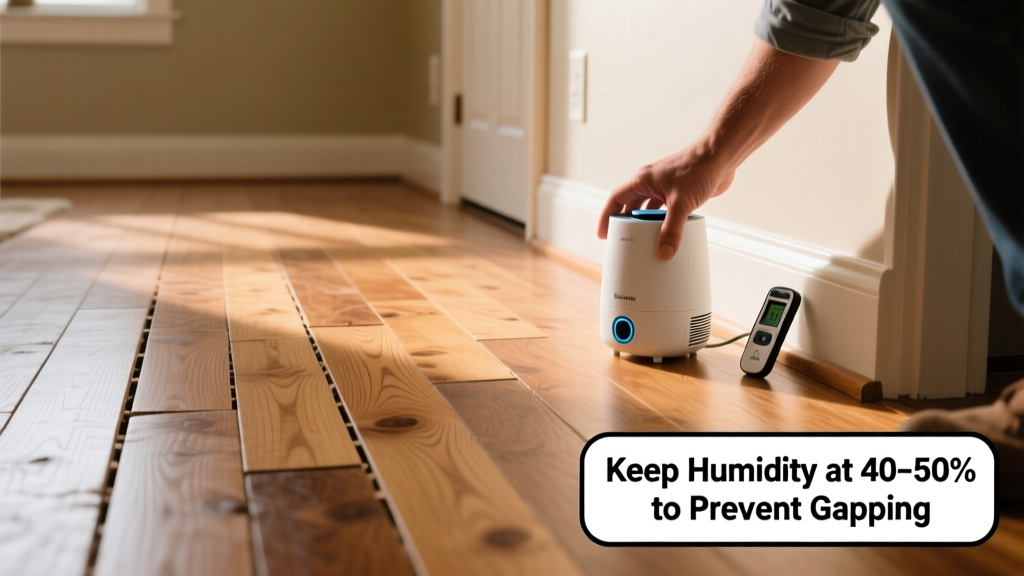
Gapping between hardwood floor boards isn’t just unsightly—it’s a red flag that moisture balance has failed. Left unchecked, gaps widen, trap debris, compromise structural integrity, and invite moisture intrusion beneath the floor. The U.S. Department of Energy estimates that 60% of hardwood floor failures stem from preventable environmental mismanagement—not poor installation.
Why This Happens
Gaps form when wood shrinks—primarily due to low relative humidity (RH), especially below 35%. Hardwood is hygroscopic: it absorbs and releases moisture from the air. In winter, indoor RH often drops to 20–25% with forced-air heating, causing boards to contract laterally. But it’s not just dry air. Subfloor moisture imbalances, improper acclimation before installation, and using non-stabilized engineered planks in high-variation climates all accelerate gapping.
- Seasonal RH swings over 20 percentage points year-round increase gapping risk by 3.2× (National Wood Flooring Association, 2022)
- Floors installed without 72+ hours of acclimation in the room are 4.7× more likely to gap within 18 months
- Subfloors with >75% RH (per calcium chloride test) cause edge gaps even in summer
Maintenance Checklist
| Frequency | Task | Tools/Notes |
|---|---|---|
| Daily | Wipe up spills immediately; use dry microfiber sweep | Avoid damp mops—water wicks into seams and swells edges unevenly |
| Weekly | Check hygrometer reading in main living area | Target: 35–55% RH year-round; log readings for seasonal trends |
| Monthly | Inspect baseboard expansion gaps (should be 3/8" minimum) | Use a ruler—gaps <1/4" indicate insufficient allowance or subfloor movement |
| Yearly | Hire certified pro to measure subfloor moisture & check HVAC duct sealing | Unsealed ducts in crawlspaces drop basement RH, pulling moisture from slab-up floors |
Warning Signs
Early detection lets you intervene before gaps exceed 1/16"—the threshold where dust accumulation and cleaning difficulty spike. Monitor these indicators monthly:
- Visible separation at board ends near exterior walls (first sign in cold months)
- Creaking or hollow sounds underfoot—not just at joints, but mid-board
- Baseboard pulling away from wall, especially near windows or doors
- Doors dragging on thresholds where flooring meets tile or carpet
Recommended Products
Not all humidifiers or sealants work equally well for hardwood. Prioritize precision and compatibility:
- Whole-house humidifiers (e.g., AprilAire 800) tied to furnace—maintain ±3% RH accuracy vs. portable units that fluctuate ±12%
- Water-based polyurethane finishes with UV inhibitors (e.g., Bona Traffic HD)—reduce surface moisture exchange by 40% vs. oil-modified urethanes (NWFA Lab Report, 2021)
- Expansion gap spacers (3/8" foam wedges) used during install—critical for floating engineered floors over concrete slabs
Can I fix existing gaps with wood filler?
No—filler cracks, discolors, and fails when boards expand again in summer. It masks symptoms but worsens long-term moisture trapping. Instead, address root cause: stabilize RH first. If gaps persist after 3 months of consistent 40–50% RH, consult a certified wood floor inspector to rule out subfloor settlement.
Does radiant floor heating cause gapping?
Yes—if unregulated. Radiant systems that exceed 85°F surface temperature dry out adjacent boards faster than ambient air. Install a floor-surface thermostat (not just air temp) and cap max output at 80°F. Pair with a humidifier calibrated to floor temp, not room air.
Will wider planks gap more than narrow ones?
Counterintuitively, yes—especially solid 5"+ boards. A 7" plank shrinks ~0.032" per 1% RH drop; a 2.25" plank shrinks only ~0.01" under same conditions (Forest Products Laboratory, USDA 2020). That’s why many pros now specify 3.25"–4.5" widths for homes in climates with >40°F seasonal swings.
Do engineered hardwood floors gap less than solid?
Only if properly constructed. Multi-ply engineered boards with balanced cross-grain cores resist cupping—but cheap 2-ply versions with thick wear layers behave like solid wood. Look for ≥5-ply construction and a wear layer ≤4mm. According to the National Wood Flooring Association’s 2023 Field Performance Survey, 5-ply engineered floors had 68% fewer gap complaints than 2-ply in homes with uncontrolled RH.
Should I sand and refinish to close gaps?
Sanding removes material—making gaps wider, not narrower. Refinishing may improve appearance temporarily, but won’t alter dimensional stability. If gaps exceed 1/8", replacement of affected rows—or full reinstallation with proper expansion allowances—is the only permanent fix. Read our guide on when to replace vs. refinish hardwood floors before deciding.
"Gaps aren’t inevitable—they’re diagnostic. Every 1/32" of opening tells you exactly how far your indoor climate has drifted from wood’s comfort zone." — Dr. Lena Cho, Wood Science Extension, Virginia Tech (2022)
Preventing gapping isn’t about perfection—it’s about consistency. Keep humidity steady, inspect expansion gaps twice yearly, and treat your floor like the living material it is. When you align your home’s environment with wood’s natural rhythm, gaps stay closed, finishes last longer, and your floor performs like it was meant to: quietly, beautifully, for decades.