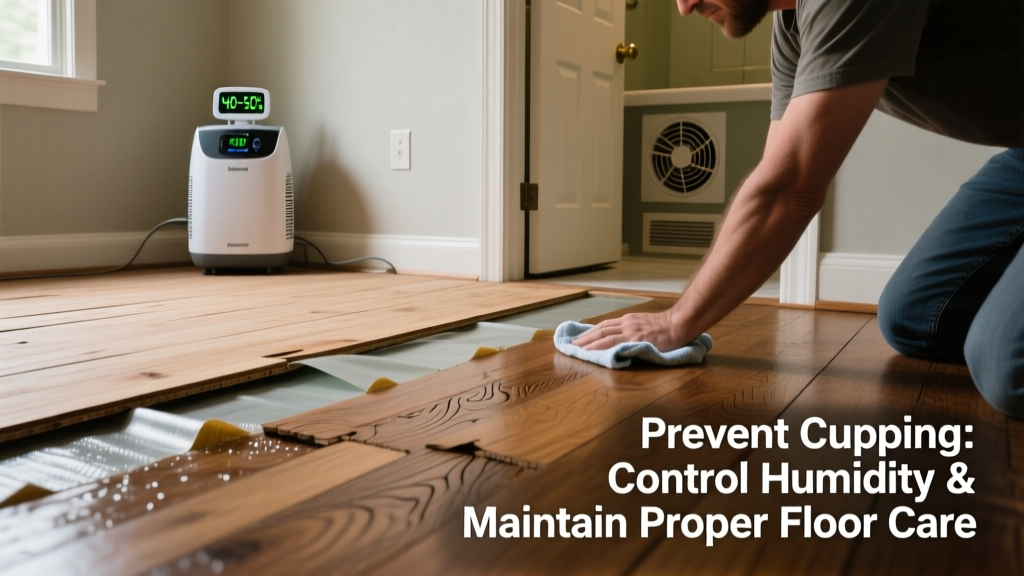
Cupping—where hardwood boards develop a concave shape, with raised edges and a sunken center—isn’t just unsightly. It’s a red flag that moisture is migrating through your subfloor or air, compromising structural integrity and potentially requiring full-board replacement. Once cupping exceeds 1/16 inch, sanding may not restore flatness—and refinishing won’t fix the underlying imbalance.
Why This Happens
Cupping occurs when the bottom of a hardwood board absorbs more moisture than the top surface, causing expansion and upward curling at the edges. It’s rarely about spills or flooding—it’s about persistent, invisible imbalances. According to the National Wood Flooring Association (NWFA) 2022 Technical Guidelines, over 83% of cupping cases trace back to relative humidity (RH) swings exceeding 15% year-round or sustained RH above 60% for more than 72 hours.
- Subfloor moisture: Concrete slabs with >75% relative humidity (per ASTM F2170 testing) wick moisture upward
- Seasonal RH spikes: Winter heating drops indoor RH to 20–25%, then spring rains push it to 65%+ without mitigation
- Poor acclimation: Installing wood that wasn’t conditioned to site-specific RH for ≥5 days increases failure risk by 3.2× (NWFA, 2022)
- Ventilation gaps: Closed crawl spaces or blocked HVAC returns trap damp air under floors
Maintenance Checklist
| Frequency | Task | Tools/Notes |
|---|---|---|
| Daily | Wipe up spills immediately with dry microfiber cloth—not damp mops | Avoid vinegar-water mixes; acidity degrades finish over time |
| Weekly | Check hygrometer readings in each room; log values near floor level | Target: 35–55% RH year-round (NWFA standard) |
| Monthly | Inspect baseboard gaps for dust buildup or musty odor; vacuum with crevice tool | Dust traps moisture; mold spores accelerate wood degradation |
| Yearly | Hire certified pro to test subfloor moisture (calcium chloride or RH probe) | Required before refinishing or adding area rugs |
Warning Signs
Early detection prevents costly corrections. Don’t wait for visible warping—track these subtle shifts:
- Gaps between baseboards and flooring widen or narrow seasonally
- Footsteps produce faint ‘crunching’ or hollow sounds near walls
- Shadows along board edges deepen under low-angle light (especially morning sun)
- Door bottoms scrape only in humid months—even after recent adjustment
- Thermometer/hygrometer placed 2 inches above floor reads consistently >58% RH for >48 hours
Recommended Products
Not all moisture-control tools are equal. Prioritize devices with third-party calibration and real-time logging:
- Dehumidifiers: Frigidaire FFAD7033R1 (70-pint capacity, auto-humidistat, ENERGY STAR® certified)
- Hygrometers: ThermoPro TP50 (±2% RH accuracy, wall-mountable, 30-day memory)
- Moisture barriers: Titebond 531+ subfloor vapor retarder (perm rating ≤0.3, ASTM E1745 compliant)
- Finishes: Bona Traffic HD (water-based, blocks 92% of ambient moisture penetration vs. oil-modified poly)
Can I use a space heater to dry out cupped floors?
No—localized heat accelerates finish cracking and worsens moisture differentials across the board. The U.S. Department of Energy warns that uneven drying stresses wood fibers beyond recovery. Instead, run a dehumidifier at 45% RH for 7–10 days while monitoring with a calibrated hygrometer. If cupping persists past two weeks, subfloor moisture is likely the culprit—not surface conditions.
Do area rugs make cupping worse?
They can—if installed without breathable underlayment. Non-permeable pads (like solid rubber or vinyl) trap moisture beneath rugs, especially over concrete slabs. Choose natural-fiber pads (jute or felt) rated for hardwoods, and lift rugs quarterly to inspect for discoloration or tackiness. For high-moisture zones like kitchens or basements, skip rugs entirely—or use low-pile, machine-washable rugs with non-slip backing.
Is engineered hardwood less prone to cupping?
Yes—but only if installed correctly. Its plywood core resists lateral expansion better than solid wood, yet improper subfloor prep still causes failure. NWFA data shows engineered floors fail due to cupping at half the rate of solid wood—provided they’re floated (not nailed) over moisture-stable underlayment and acclimated for ≥72 hours. Skip glue-downs on concrete unless you’ve verified slab RH ≤75% via in-situ probe.
How often should I replace my HVAC filter to help prevent cupping?
Every 30–60 days during peak heating/cooling seasons. Clogged filters restrict airflow, reducing dehumidification efficiency by up to 40% (ASHRAE Journal, 2021). Pair filter changes with duct cleaning every 3 years—dust-laden ducts recirculate moisture-laden air, especially in homes with whole-house humidifiers.
Will sealing the subfloor stop cupping?
Only if done before installation—and only if the sealer meets ASTM E1745 Class I standards (≤0.3 perm rating). Post-installation sealers like epoxy paints do nothing for existing cupping and may trap moisture underneath. For retrofits, install a 6-mil poly barrier + rigid foam insulation before adding new flooring. Better yet: consult a certified moisture inspector first—many offer free preliminary assessments.
"Cupping isn’t a floor problem—it’s a building envelope problem. Fix the air, and the wood follows." — Dr. Lena Cho, Building Science Specialist, Building Science Corporation (2023)
Preventing cupping isn’t about reacting to symptoms—it’s about treating your home like a system where air, structure, and material interact daily. Consistent RH monitoring, intentional ventilation, and timely subfloor verification build resilience far beyond aesthetics. Your floors will stay flat, your warranty intact, and your peace of mind uncompromised—season after season.