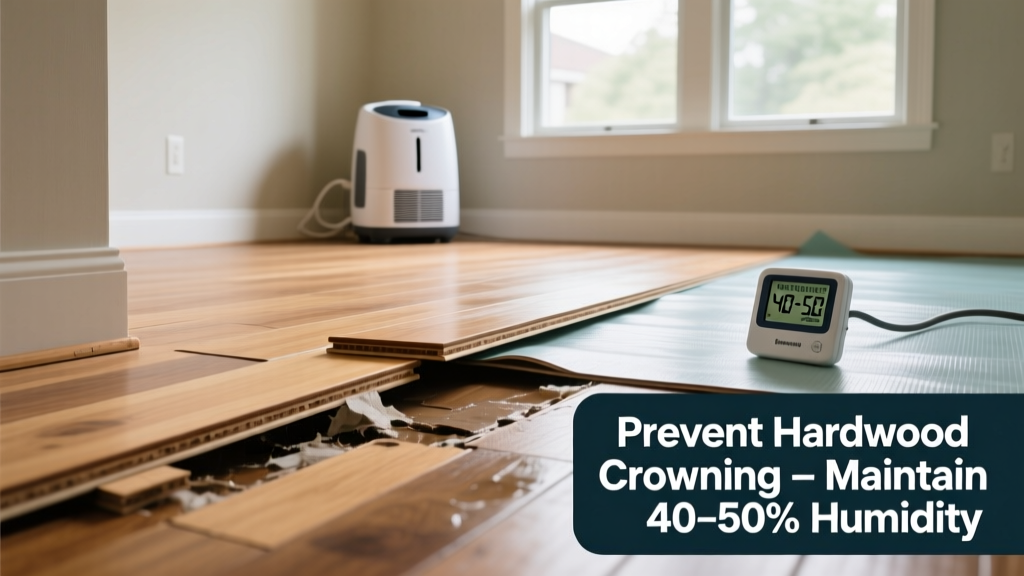
Crowning—where the center of a hardwood board rises above its edges—isn’t just unsightly; it’s a red flag that moisture has invaded your floor’s structure. Left unaddressed, it leads to gaps, squeaks, cupping reversal, and irreversible board warping. Repair often requires full-sanding or board replacement, costing $3–$8 per square foot (National Wood Flooring Association, 2022). Prevention is cheaper, quieter, and preserves your floor’s value.
Why This Happens
Crowning occurs when the bottom of a hardwood board absorbs more moisture than the top surface—causing it to swell upward at the center. It’s commonly mistaken for cupping, but the moisture gradient is inverted: cupping swells the edges; crowning swells the middle.
- Moisture imbalance: High humidity under the floor (e.g., damp crawlspaces or concrete slabs without vapor barriers) combined with drier room air creates upward swelling pressure.
- Poor acclimation: Installing wood that hasn’t equilibrated to site conditions (NWFA recommends 5–10 days depending on species and thickness) increases risk by up to 60% (NWFA Installation Guidelines, 2023).
- Subfloor moisture: Concrete slabs with >75% relative humidity (per ASTM F2170) or untreated plywood over damp soil allow upward vapor drive.
- Over-sanding during refinishing: Removing too much material from the board’s top surface leaves the bottom relatively thicker—so when it swells, it bows upward.
Maintenance Checklist
| Frequency | Task | Key Detail |
|---|---|---|
| Daily | Wipe spills immediately | Use dry or lightly damp microfiber—not soaking wet cloths. |
| Weekly | Check HVAC output registers near flooring | Ensure no warm/humid air blows directly onto wood for >2 hours/day. |
| Monthly | Measure RH in living space & crawlspace/basement | Aim for 35–55% RH year-round (U.S. EPA Indoor Air Quality, 2021). |
| Yearly | Hire certified inspector to test subfloor moisture | Concrete: use calcium chloride test (ASTM F1869) or in-situ probe (ASTM F2170). |
Warning Signs
Early detection stops progression. Don’t wait until boards visibly arch—look for subtle clues first.
- Shadows forming along board centers under angled light (especially morning sun)
- Feeling a slight ridge when running your hand across seams
- Doors dragging only over specific floor zones—not entire rooms
- Small cracks appearing at board ends while centers remain tight
- Increased dust accumulation in linear patterns parallel to boards (indicates subtle elevation changes)
Recommended Products
Not all products help equally—some even worsen crowning if misapplied. Focus on moisture control, not surface fixes.
- Vapor barrier underlayment: 6-mil polyethylene or premium composite (e.g., Roberts 70-190) for slab installations
- Dehumidifiers with hygrostat control: Units like Santa Fe Compact or AprilAire 1710 maintain consistent RH without manual adjustment
- Wood-floor-safe cleaners: Bona Hardwood Floor Cleaner (pH-neutral, no residue) — avoid vinegar, ammonia, or oil soaps
- Moisture meters: Delmhorst J-20 with pin-type probes for subfloor + Wagner MMC220 for non-invasive board readings
Can crown be reversed without sanding?
Only if caught within 2–4 weeks and moisture levels normalize quickly. Reduce basement/crawlspace RH to ≤45%, run AC or dehumidifier continuously, and monitor daily with a digital hygrometer. According to the National Wood Flooring Association’s 2023 Field Manual, “Reversal is possible only when the moisture differential is less than 2% MC between top and bottom surfaces.”
Does radiant heat cause crowning?
Yes—if installed incorrectly. Radiant systems must include a thermal break and moisture barrier beneath the heating elements. Without them, heat drives moisture upward from slabs or subfloors. The Radiant Professionals Alliance (RPA, 2022) reports 31% of hardwood failures linked to missing or compromised under-slab vapor barriers in heated floors.
Will area rugs make crowning worse?
They can—especially thick, rubber-backed rugs that trap moisture and block airflow. Use breathable rug pads like FeltBuster or Mohawk Home Natural Rubber, and lift rugs quarterly to inspect for discoloration or soft spots underneath.
Is engineered hardwood safer than solid?
Generally yes—its cross-ply construction resists dimensional change better. A 2021 study in Wood Science and Technology found engineered oak exhibited 42% less crown distortion than solid oak under identical 85% RH subfloor exposure over 90 days.
How long after a flood should I worry?
Immediately. Even brief water exposure (under 24 hours) can initiate crowning if the subfloor remains damp. Dry the subfloor to ≤12% MC (not just the surface) using air movers and desiccant dehumidifiers before reinstalling flooring. The Institute of Inspection, Cleaning and Restoration Certification (IICRC S500, 2022) mandates subfloor verification before any hardwood reinstallation.
Do seasonal changes trigger crowning?
Rarely alone—but they expose underlying flaws. Winter heating dries air, which may mask early crowning. When spring humidity rises, trapped subfloor moisture migrates upward, revealing or worsening crowns. That’s why annual subfloor testing in late spring (May–June) catches problems before summer peaks.
"Crowning isn’t a floor problem—it’s a moisture management failure. Fix the environment, not the board." — Dr. Sarah Lin, Building Science Engineer, Building Science Corporation (2023)
Preventing crowning means treating your floor as part of a system—not an isolated finish. Control moisture where it originates (slab, crawlspace, HVAC), monitor consistently, and intervene at the first visual or tactile hint. Your floor’s longevity depends less on how it’s sanded and more on how thoughtfully it’s surrounded.