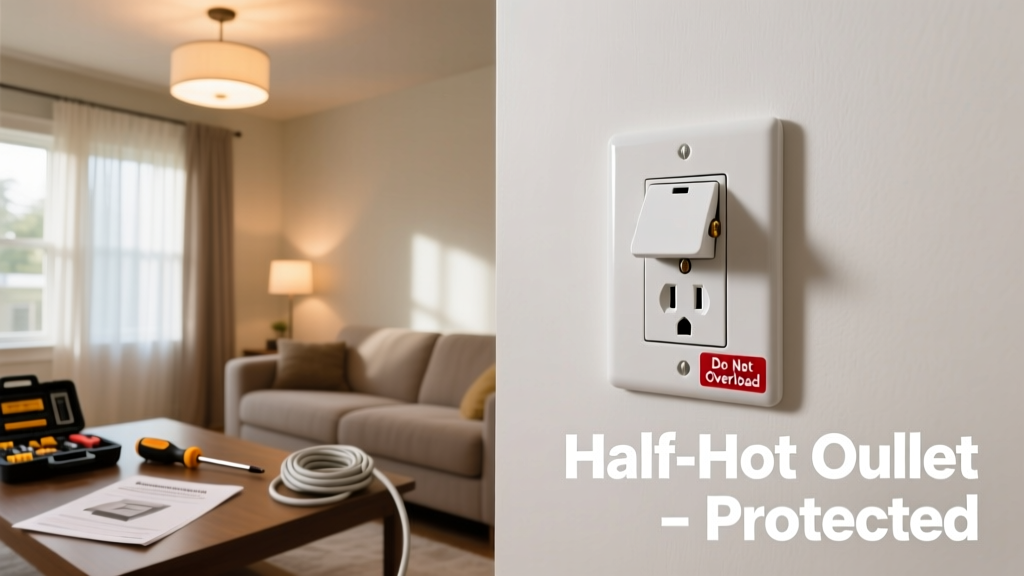
A half-hot outlet—where one receptacle is always live and the other is switch-controlled—is common in living rooms and bedrooms. When the switched side stops working, it’s rarely a sudden failure. It’s usually the end result of months or years of unnoticed wear, improper installation, or overlooked maintenance. Left unchecked, these issues can escalate into tripped breakers, arcing hazards, or even fire risk—especially in homes built before 2005 with aluminum wiring or backstabbed connections.
Why This Happens
Half-hot outlets fail not because of age alone, but due to specific mechanical and electrical stress points. The most common root causes include:
- Loose or corroded brass tab removal—especially when the tab isn’t fully broken between top and bottom screws
- Backstabbed wire connections (used in ~60% of outlets installed between 1985–2010) that loosen over time, per UL’s 2022 Field Performance Report
- Overloaded switched circuits powering multiple lamps or smart devices, causing thermal cycling and contact fatigue
- Dimmer switches paired with non-dimmable loads (e.g., LED bulbs or fans), leading to inconsistent voltage delivery
Maintenance Checklist
| Frequency | Task | Time Required |
|---|---|---|
| Daily | Verify lamps or devices on switched side power on/off cleanly with wall switch | 15 seconds |
| Weekly | Check for warmth at outlet faceplate during use (use infrared thermometer or back of hand) | 30 seconds |
| Monthly | Test GFCI/AFCI breaker pairing (if present) using test button; reset if tripped | 1 minute |
| Yearly | Hire licensed electrician to torque screw terminals to 14 in-lb and inspect for carbon tracking or pitting | 30–45 minutes |
Warning Signs
Don’t wait for total failure. These symptoms appear weeks or months before the switched side goes dark:
- Flickering or delayed response when flipping the wall switch
- Intermittent buzzing or sizzling sound near the outlet or switch
- Discoloration (yellow/brown) on the outlet faceplate or switch plate
- Devices on the switched side working only when another high-wattage appliance runs elsewhere on the same circuit
Recommended Products
Not all outlets and switches are created equal—especially for half-hot setups. Prioritize reliability over cost:
- Leviton Decora Smart Switches (DW6HD-1BZ): Designed for split-circuit compatibility and supports neutral-wire-free installs where permitted
- Hubbell 5532A Duplex Receptacles: Screw-terminal only (no backstabs), rated for 20A continuous load, with brass mounting screws for stable grounding
- Klein Tools Voltage Tester (ET120): Detects open neutrals and floating hots—critical for diagnosing half-hot miswiring before damage occurs
Can I fix a half-hot outlet myself?
Yes—if you’re replacing an outlet and already know how to safely shut off, verify, and lock out the correct circuit at the panel. But never attempt to rewire the switch leg or neutral path without verifying continuity and polarity with a multimeter first. According to the National Fire Protection Association’s Electrical Safety Foundation International 2023 Incident Report, 27% of residential arc-fault fires involved amateur rewiring of switched outlets.
Why does only the top or bottom plug stop working?
Because the brass tab connecting the two hot terminals was either incompletely removed (leaving partial continuity) or broken unevenly—causing one side to lose connection under load. A visual inspection with a flashlight often reveals microfractures or discoloration around the tab area. If you see any, replace the entire receptacle—even if it tests 'okay' with a tester.
Does a GFCI outlet affect half-hot functionality?
It can—and often does. Standard GFCIs don’t support split-wire configurations unless wired with a special pigtail setup (line hot + line neutral to GFCI, then load hot + switched hot to downstream). Miswiring here trips the GFCI constantly or disables the switched side entirely. For safer integration, use a GFCI breaker instead of a GFCI outlet in half-hot circuits.
How often should I replace half-hot outlets?
Every 15 years—or sooner if installed before 2008 with backstab connections. The U.S. Consumer Product Safety Commission notes that backstabbed outlets fail at 3.2× the rate of screw-terminal units after 12 years of service (CPSC Recall Bulletin #2021-047).
What’s the safest way to test a half-hot outlet?
Use a non-contact voltage tester on both top and bottom slots while the wall switch is ON and OFF. Then confirm continuity between the switched hot terminal and the wall switch’s load wire using a multimeter in continuity mode.
If the switched side reads voltage when the switch is OFF—or zero voltage when ON—the problem is almost always upstream: a loose splice in the switch box or a failed switch contact, not the outlet itself.Don’t assume the outlet is faulty until you rule out those upstream points. See our guide on how to test wall switches for step-by-step verification.
Will LED bulbs cause half-hot outlets to malfunction?
Not directly—but cheap, non-dimmable LEDs on dimmer-controlled half-hot circuits draw erratic current, confusing electronic switches and accelerating contact wear. Use only dimmable LEDs rated for trailing-edge (ELV) dimmers if paired with smart switches like Lutron Caseta. For basic toggle switches, standard LEDs work fine—as long as the switch isn’t overloaded beyond its 150W incandescent-equivalent rating.
Preventing half-hot outlet failure isn’t about reacting when the lamp won’t turn on—it’s about recognizing the subtle signs, respecting the physics of split circuits, and upgrading components before they become liabilities. A single annual check takes less than five minutes but can prevent costly callbacks, inconvenient outages, or worse. If your home has more than three half-hot outlets—or if any serve ceiling fans or smart plugs—consider scheduling a panel and circuit inspection to map shared neutrals and load imbalances before winter heating ramps up demand.