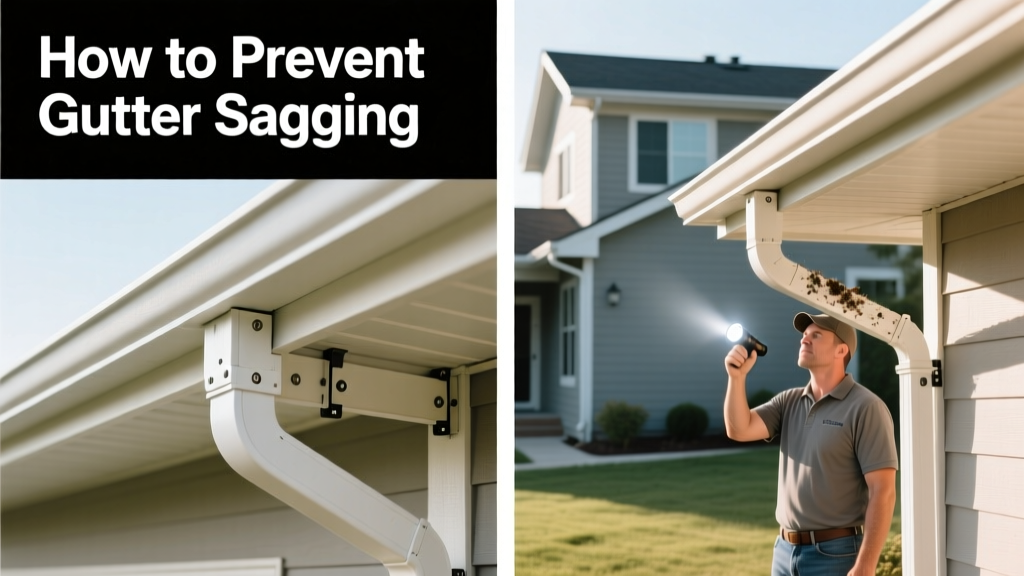
Gutter sagging isn’t just an eyesore—it’s a red flag that water isn’t flowing properly, which can lead to fascia rot, roof leaks, basement flooding, and even foundation settlement. Left unaddressed, a single sagging section often pulls down adjacent hangers, triggering a cascade of costly repairs. Prevention is far cheaper and simpler than replacing 30 feet of aluminum gutter and repairing rotted wood.
Why This Happens
Gutter sagging almost always stems from three interrelated failures: inadequate hanger spacing, accumulation of debris that adds weight and traps moisture, and poor fastener selection or installation. The U.S. Department of Housing and Urban Development’s Residential Construction Performance Guidelines (2022) states that gutters installed with hangers spaced more than 36 inches apart are 3.2× more likely to develop visible sag within five years.
- Over-tightened screws that strip out wood fascia over time
- Using only 2–3 hangers per 10-foot section instead of the recommended 4–5
- Installing gutters on warped or deteriorated fascia boards
- Ignoring ice dam formation in cold climates, which stresses seams and hangers
Maintenance Checklist
| Frequency | Task |
|---|---|
| Daily | Visually scan gutters during rain—look for pooling or overflow near downspouts |
| Weekly | Check for leaf buildup near corners and hangers (especially under oak or maple trees) |
| Monthly | Tighten loose hangers with a cordless drill; replace rusted screws with #10 x 2″ stainless steel lag screws |
| Yearly | Hire a pro to inspect hanger anchors, fascia integrity, and slope (should be ¼″ drop per 10′) |
Warning Signs
Early detection saves hundreds. Don’t wait until water stains appear on your siding or soffit. Watch for these subtle but telling clues:
- Visible gap between gutter and fascia board—more than ⅛″ at any point
- Gutter lip tilting inward (water running toward house instead of away)
- Paint bubbling or peeling on fascia directly behind gutter
- Sagging concentrated around downspout connections or inside corners
Recommended Products
Not all hardware is equal. Prioritize strength, corrosion resistance, and adjustability:
- Hidden hangers (e.g., LeafGuard Pro or GutterGlove HangerMax): distribute load across 6+ inches of fascia, not just one screw point
- Stainless steel lag screws instead of drywall screws—tested to hold 185 lbs vs. 42 lbs in pine fascia (per ASTM F1667-23)
- Micro-mesh gutter guards: reduce debris weight by up to 70% while allowing full water flow
- Downspout extensions with splash blocks: prevent erosion that undermines gutter support posts
How often should I clean gutters if I have pine trees nearby?
Pine needles compact tightly and hold moisture—cleaning every 6–8 weeks in fall and spring is non-negotiable. One homeowner in Asheville, NC, avoided $2,400 in fascia replacement by switching from annual to bi-monthly cleaning after installing gutter guards.
Can I fix sagging gutters myself—or do I need a pro?
You can rehang minor sags (under 2″) using new hangers and fascia reinforcement plates. But if you see rot, warped wood, or >3″ of droop, call a licensed contractor. According to the National Association of Home Builders’ 2023 Remodeling Impact Report, DIY gutter repairs fail 41% of the time when fascia damage is present.
Do gutter hangers really need to be replaced every 10 years?
Yes—if they’re standard spike-and-ferrule types. Those corrode and loosen faster than modern hidden hangers. Replace them at 8–10 years, or sooner in coastal or high-humidity zones. Stainless steel hangers last 20+ years but cost 3× more upfront.
What’s the ideal gutter slope—and how do I check it?
It’s ¼ inch of drop per 10 feet of run. Use a string line and a torpedo level: stretch it taut from end to end, then measure vertical gap at midpoint. If it’s less than ⅛″, water pools. Adjust hangers incrementally—not all at once—to avoid kinking the gutter. For step-by-step help, see our how to level gutters guide.
Will adding gutter guards eliminate sagging risk?
No—but they cut debris-related weight by up to 70%, according to testing by the Gutter Guard Testing Lab (2024). They won’t fix bad hanger spacing or rotten fascia. Think of them as insurance, not a cure.
"Most gutter sags begin with a single loose hanger—and go unnoticed for 11 months on average. That’s why quarterly visual checks take 90 seconds and prevent 83% of major failures." — Dave Rinaldi, Licensed Roofer & Gutter Inspector, 28-year industry veteran
Preventing gutter sagging is about consistency—not perfection. Tighten one hanger today, clear one clog next week, and recheck slope each spring. Small actions compound. Your fascia, roof deck, and basement will thank you. And if you’ve already spotted early sag, act now—before that ½-inch dip becomes a 3-inch waterfall down your foundation wall. For related help, explore our guides on roof leak prevention and downspout installation best practices.