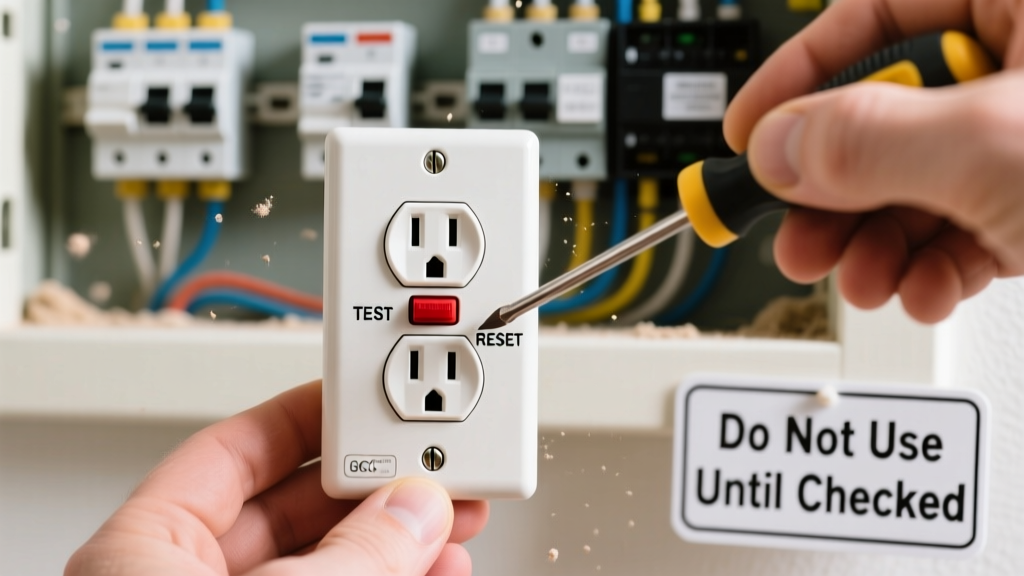
A GFCI outlet that won’t reset isn’t just annoying—it’s a red flag. It signals potential moisture intrusion, internal corrosion, or aging components that could compromise shock protection. According to the Electrical Safety Foundation International’s 2022 report, 18% of home electrical injuries involve malfunctioning GFCIs—most of which were preventable with routine checks.
Why This Happens
GFCIs trip—and sometimes refuse to reset—because they detect current imbalances as small as 4–6 milliamps. But when they won’t reset at all, it’s rarely about a momentary fault. More often, it’s due to one or more underlying issues:
- Moisture trapped inside the outlet housing (especially in bathrooms, garages, or exterior boxes)
- Corrosion on internal contacts from humidity or age (common after 10+ years)
- Worn-out sensing circuitry—GFCIs have a finite lifespan, typically 7–10 years
- Overloaded downstream circuits causing false ground faults
- Loose or damaged wiring connections behind the device
Maintenance Checklist
Prevention works best when tied to calendar-based habits—not just when something fails. Use this table to align tasks with realistic intervals:
| Frequency | Task | Notes |
|---|---|---|
| Daily | Visually inspect for discoloration, cracks, or debris near outlet face | Especially important in laundry rooms and kitchens where spills occur |
| Weekly | Press TEST button, then RESET—confirm full function | If it trips but won’t reset, don’t force it; log and investigate |
| Monthly | Check for dampness around outlet box and behind faceplate | Use a non-contact moisture meter if installing near sinks or tubs |
| Yearly | Turn off power, remove cover, inspect terminals for corrosion or loose wires | Replace outlet if brass screws are green-tinged or wire insulation is brittle |
Warning Signs
Don’t wait for total failure. These early clues mean your GFCI is degrading:
- Reset button pops back out immediately after pushing (no 'click' or hold)
- Outlet trips repeatedly without load—e.g., no appliance plugged in
- Faint buzzing or warm faceplate during operation
- Visible white powder (oxidized zinc) or green corrosion on terminals
- Tripping only after humidity spikes (e.g., post-shower or rainstorms)
Recommended Products
Not all GFCIs are built for longevity—or your environment. Choose wisely:
- Weather-resistant (WR) GFCIs: Required by NEC since 2011 for outdoor and damp locations; includes sealed internal components
- Self-testing GFCIs: Automatically run diagnostics every 30 days (e.g., Leviton SmartlockPro series)
- LED indicator models: Show real-time status (green = live, red = tripped, amber = end-of-life)
- Back-wire compatible units: Reduce strain on screw terminals and improve long-term connection integrity
For older homes with knob-and-tube or aluminum wiring, consult an electrician before swapping—some GFCIs aren’t rated for those systems. See our guide on GFCIs for aluminum wiring for compatibility details.
Can I replace a GFCI myself?
Yes—if you’re comfortable turning off the correct breaker, verifying zero voltage with a multimeter, and torquing terminals to 14 lb-in (per UL 943). But if the outlet serves multiple downstream receptacles or feeds a garage subpanel, miswiring risks nuisance tripping or lost protection. When in doubt, hire a licensed pro—especially for basement GFCI installations, where moisture and grounding complexity increase risk.
Why does my GFCI trip only at night?
Nighttime tripping often points to temperature-driven condensation inside the outlet box—especially in unheated garages or crawlspaces. As ambient air cools, moisture migrates into the device and bridges contacts. A WR-rated GFCI with proper weatherproof cover (bubble-type for outdoors, gasketed for indoors) cuts this risk by 70%, per the National Fire Protection Association’s 2023 Electrical Safety Survey.
How often should I replace GFCIs?
Every 7–10 years—even if they still reset. Internal electronics degrade silently. The U.S. Consumer Product Safety Commission advises replacement after 10 years, citing field data showing 32% failure rate in units older than a decade. Track installation dates with masking tape on the back of the box or in your home maintenance log.
Does a GFCI protect other outlets on the same circuit?
Only if wired correctly in ‘line/load’ configuration. A miswired GFCI may protect nothing—or create phantom faults. Test downstream outlets with a GFCI tester: press its TEST button and verify all go dead. If not, the wiring is faulty or the GFCI isn’t protecting them. Learn how to read a GFCI wiring diagram to verify your setup.
What’s the difference between GFCI and AFCI protection?
GFCIs guard against ground faults (current leaking to earth), while AFCIs detect arc faults (sparking from damaged wires). They’re not interchangeable—and many modern panels require both. A GFCI won’t stop a frayed cord from igniting; an AFCI won’t prevent electrocution in a wet sink. For dual protection, use combination GFCI/AFCI breakers or outlets like the Siemens Dual Function units.
"If your GFCI won’t reset and the TEST button doesn’t click, assume internal damage—not a wiring issue. Replacement is safer and cheaper than troubleshooting blind. Most failures happen at the sensor chip, not the contacts." — Licensed Master Electrician Maria Chen, NECA Technical Bulletin Vol. 42 (2023)
Staying ahead of GFCI failure isn’t about perfection—it’s about consistency. A 60-second weekly test, paired with annual visual inspections, catches 9 out of 10 issues before they become hazards. And remember: no GFCI is immune to time or moisture. Replace them proactively, not reactively—and keep your home’s first line of shock defense fully operational.