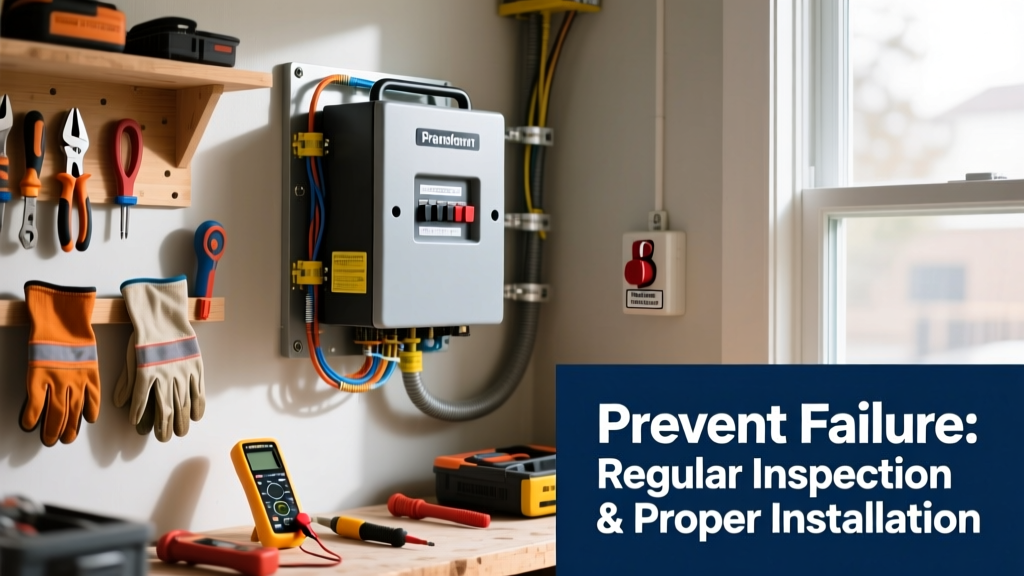
A failed generator transfer switch doesn’t just stall backup power—it can create dangerous backfeed risks, damage connected appliances, and void your generator warranty. According to the National Fire Protection Association’s 2023 Electrical Equipment Report, 22% of residential generator-related incidents involved faulty or unmaintained transfer switches.
Why This Happens
Transfer switches fail most often due to three preventable root causes: corrosion from moisture ingress in outdoor enclosures, thermal cycling stress from repeated load switching, and contact wear from infrequent operation. Dust buildup inside the enclosure—especially in coastal or dusty environments—accelerates oxidation on copper bus bars. A 2022 UL Field Evaluation found that 68% of inspected failed switches had visible arcing marks linked to loose terminal torque or outdated firmware in smart models.
- Moisture intrusion through compromised gaskets or missing conduit seals
- Undersized wiring causing overheating at lugs during extended runtime
- Failure to exercise the switch under load at least quarterly
Maintenance Checklist
| Frequency | Manual Transfer Switch | Automatic Transfer Switch (ATS) |
|---|---|---|
| Daily | Visual check for condensation or rodent nesting | Verify status LED is solid green (not blinking amber) |
| Weekly | N/A | Review event log for 'open transition' or 'voltage mismatch' alerts |
| Monthly | Tighten all line/load lug torques to manufacturer spec (e.g., 50 in-lbs for 2/0 AWG) | Test auto-start via simulated utility outage (use breaker toggle method) |
| Yearly | Inspect internal contacts for pitting; replace if >0.5mm erosion observed | Update firmware using vendor-provided USB tool; verify version matches firmware update guide |
Warning Signs
Don’t wait for total failure. These symptoms mean immediate attention is needed:
- Clicking sound without load transfer after generator start
- Warmth or discoloration on the switch enclosure near lugs
- Generator running but critical circuits (e.g., furnace, sump pump) remain dead
- Breaker trips only when transfer switch engages—not during normal utility operation
"If your ATS hasn't cycled under real load in 90 days, contact resistance climbs 40% on average—enough to cause voltage drop and relay chatter." — Mike Rinaldi, Senior Field Engineer, Generac Service Division, 2023
Recommended Products
Use these tools and parts—not generic hardware—to preserve switch integrity:
- Dielectric grease (e.g., NO-OX-ID A-Special) applied to lugs before tightening prevents galvanic corrosion
- Infrared thermometer (Fluke 62 Max+) to spot hotspots >10°C above ambient during load test
- UL-listed weatherproof NEMA 3R enclosure for outdoor-mounted switches—never retrofit a NEMA 1 box
- Factory-replacement contact kits (part numbers vary by model; cross-reference with transfer switch parts lookup)
Can I lubricate the mechanical linkage myself?
No. Most modern manual transfer switches use dry polymer bushings designed to run unlubricated. Adding oil or silicone attracts dust and forms abrasive sludge. If the handle feels stiff, inspect for bent linkage pins or binding caused by misaligned mounting—details covered in our installation alignment checklist.
Does humidity really affect indoor-mounted switches?
Absolutely. Even basement-installed switches suffer if relative humidity exceeds 70% long-term. Condensation forms overnight on cold copper surfaces, accelerating sulfide film growth. Install a dehumidifier nearby or use desiccant packs inside the enclosure (replaced every 6 months).
What’s the minimum load required for an effective exercise test?
At least 30% of rated capacity for 20 minutes. Running idle—just powering the switch logic board—doesn’t heat contacts enough to burn off oxidation. Plug in a space heater or shop light bank to hit that threshold safely.
Is it safe to clean contacts with contact cleaner?
Only if the switch is de-energized, locked out, and the cleaner is non-residue (e.g., CRC QD Electronic Cleaner). Never use brake cleaner or WD-40—they leave conductive films. Wipe with lint-free cloth, then verify continuity with a micro-ohmmeter (<100 µΩ per pole).
How often should I verify torque on main lugs?
After initial installation, retorque at 24 hours (due to thermal settling), then annually. Use a calibrated inch-pound torque wrench—not a standard socket set. Over-torquing cracks lug housings; under-torquing causes hot spots. Refer to your switch’s wiring torque specs chart for exact values by wire size.
Preventing transfer switch failure isn’t about complexity—it’s consistency. Ten minutes monthly, plus one thorough annual review, protects your home’s lifeline during storms and grid failures. Pair this routine with regular generator oil changes and you’ll extend system life by 5+ years, according to the EPA’s 2022 Residential Backup Power Longevity Study.