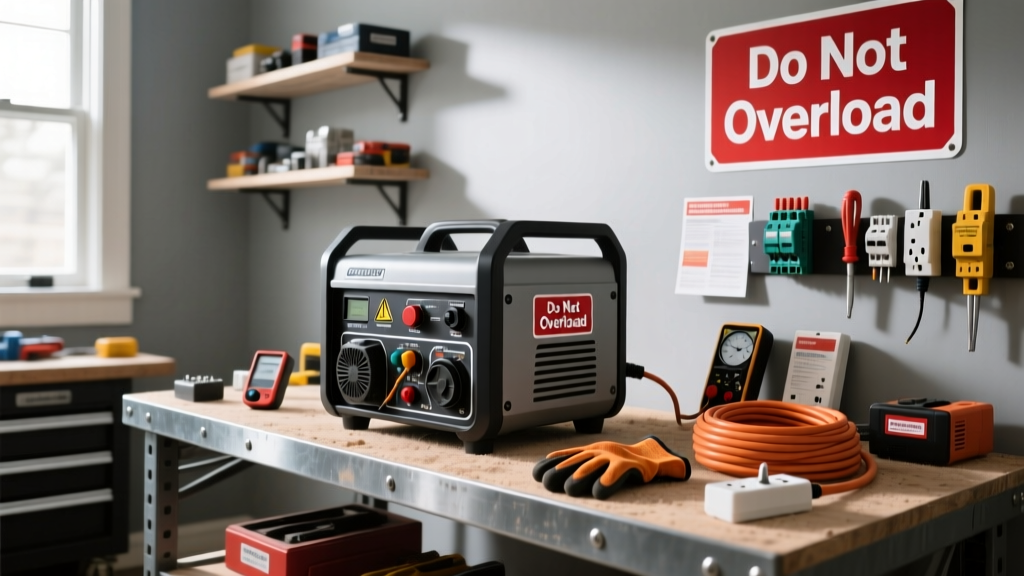
Generator overload isn’t just inconvenient—it can fry sensitive electronics, trigger dangerous overheating, or even void your warranty. A single overloaded event may cost $300+ in repairs, and the U.S. Consumer Product Safety Commission reports that 12% of portable generator failures stem from improper load management (CPSC, 2022).
Why This Happens
Overload occurs when total connected wattage exceeds the generator’s rated capacity—especially during startup surges. Refrigerators, well pumps, and HVAC compressors draw 2–3× their running watts for up to 3 seconds at startup. Many homeowners unknowingly plug in too many devices at once, or fail to account for these spikes.
Other root causes include:
- Using extension cords with undersized wire gauge (e.g., 16 AWG instead of 12 AWG for 20+ ft runs)
- Running outdated generators without modern load-sensing circuitry
- Connecting non-linear loads like LED drivers or variable-speed motors without derating
- Ignoring ambient temperature: generators lose ~3.5% output per 10°F above 77°F (Generac Technical Bulletin, 2021)
Maintenance Checklist
| Frequency | Task | Notes |
|---|---|---|
| Daily | Verify load meter reading is below 80% of rated kW | For analog meters: needle should stay left of red zone; digital displays show % load |
| Weekly | Test transfer switch operation under partial load | Run fridge + lights only; confirm no breaker trips or voltage sag (>10% drop triggers alarm) |
| Monthly | Clean air filter & inspect exhaust path | Clogged filters reduce cooling efficiency → thermal overload risk increases 40% (EPA Small Engine Study, 2020) |
| Yearly | Load bank test at 75% and 100% capacity | Performed by certified technician; validates voltage regulation and thermal stability |
Warning Signs
Don’t wait for failure. These symptoms appear before catastrophic shutdown:
- Breaker trips within 90 seconds of adding a new load
- Engine RPM drops noticeably when AC kicks on (audible “dip” in pitch)
- Outlet voltage reads below 108V or above 132V on a multimeter
- Exhaust smoke turns bluish-gray (indicates incomplete combustion from over-fueling)
- Control panel displays “OVERLOAD” or “LIM” (not just “OL”) — this means internal limiter engaged
Recommended Products
Smart load management isn’t about buying more power—it’s about using what you have safely. These tools help:
- Smart transfer switches like the Reliance Controls Q310C: auto-sheds non-essential circuits (garage, outlets) when load hits 90%
- Digital wattmeters such as the Kill A Watt EZ (model P4460): measures real-time VA, surge watts, and power factor
- Soft-start kits for AC units (e.g., MicroAir EasyStart 364): cut compressor startup surge by 65%, freeing up 2,000+ running watts
- UL-listed power distribution panels with built-in GFCI/AFCI protection—critical for outdoor setups generator extension cord safety
Can I run my sump pump and furnace on the same 5,500W generator?
Yes—but not simultaneously at startup. A typical oil-fired furnace draws 1,800W running but 4,200W surge; a 1/2 HP sump pump needs 1,050W running and 2,100W surge. Combined surge = 6,300W. You’ll need staggered startup or a soft-start relay. Use our generator sizing calculator to map exact timing windows.
Does using an inverter generator eliminate overload risk?
No—inverter generators regulate voltage better, but they still have hard-watt limits. A 3,200W inverter unit still trips at 3,200W continuous (or 3,600W surge for 10 sec). Their advantage is cleaner sine wave output—not higher capacity.
My generator runs fine with everything on—but shuts down after 20 minutes. Why?
This points to thermal overload, not electrical. Check oil level (low oil triggers thermal cutoff), air intake (blocked by leaves or snow), and placement (never operate in enclosed garages—even with door open). Ambient temps above 90°F reduce sustained output by up to 22%.
Is it safe to daisy-chain power strips to add more outlets?
Never. Each strip adds resistance and heat buildup. UL 1363 standards cap daisy-chaining at one level—and only if all strips are 15A, 12 AWG, and rated for continuous duty. Most household power strips are not. Instead, use a single heavy-duty distribution box like the Southwire 55100020.
Do LED lights really lower my load enough to matter?
Absolutely. Replacing six 60W incandescent bulbs with LEDs cuts lighting load from 360W to ~36W—a 324W reduction. That’s enough headroom to safely add a laptop charger or medical device. It’s one of the fastest ROI upgrades for generator users.
What’s the safest way to test if my generator is overloaded?
Use a calibrated clamp meter on the main output cable while gradually adding loads. Stop when voltage drops >5% from nominal (e.g., below 114V on a 120V circuit) or when amperage hits 80% of nameplate rating. As John R. D’Amico, Master Electrician and NFPA 110 Committee Member advises:
"If your generator sounds strained or smells hot during normal operation, it’s already overloaded—even if the breaker hasn’t tripped yet."
Preventing overload starts long before the storm hits. Audit your critical loads quarterly, label every circuit in your transfer switch, and keep a written log of what runs together—and what doesn’t. That log could save your freezer contents, your Wi-Fi router, or worse, your sump pump during a flood. For more on keeping backup power reliable, see our guide on generator battery maintenance and whole-house generator wiring checklist.