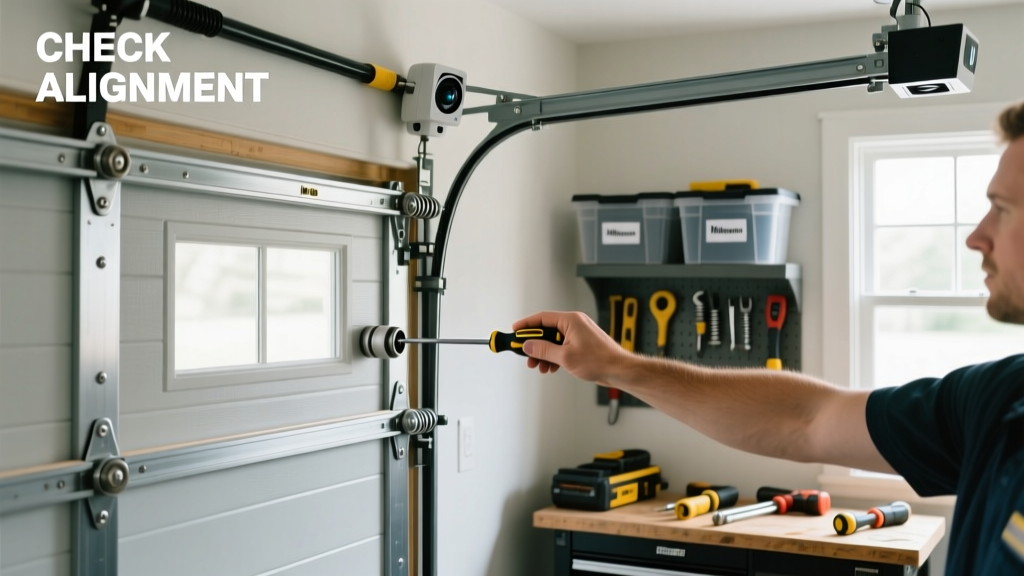
A garage door that won’t close isn’t just an inconvenience—it’s a red flag for misalignment, sensor failure, or worn components that could escalate into injury or property damage. According to the U.S. Consumer Product Safety Commission, over 20,000 garage-door-related injuries occur annually, many tied to malfunctioning closure systems (CPSC 2022). Prevention isn’t optional; it’s your first line of defense.
Why This Happens
Garage doors rely on precise mechanical, electrical, and environmental coordination. When they refuse to close, it’s rarely random—it’s usually one (or more) of these root causes:
- Safety sensor obstruction or misalignment: Even dust buildup or a 1/8-inch tilt can break the infrared beam.
- Track debris or corrosion: Grime, rust, or bent sections prevent smooth travel—especially near the bottom roller path.
- Worn or frayed cables: These carry high tension; fraying often starts invisibly inside the sheath.
- Limit switch drift: Over time, the motor’s ‘close’ position setting shifts due to vibration or temperature swings.
- Broken torsion spring: A single snapped coil changes tension balance, triggering force-sensing reversal.
Maintenance Checklist
| Frequency | Task | Time Required |
|---|---|---|
| Daily | Clear threshold of leaves, ice, or debris; verify nothing blocks sensor line-of-sight | 30 seconds |
| Weekly | Wipe sensors with microfiber cloth; test auto-reverse by placing a roll of paper towels under door | 2 minutes |
| Monthly | Lubricate hinges, rollers, and springs with white lithium grease (not WD-40); inspect cables for kinks or exposed wires | 10 minutes |
| Yearly | Hire certified technician to check spring tension, track alignment (±1/16" tolerance), and opener motor calibration | 45–60 minutes |
Warning Signs
Catch issues early—before the door stalls mid-close or reverses unexpectedly. Watch for:
- Door jerking or pausing at the same spot every time
- Faint clicking sound from the opener when pressing close (indicates gear wear)
- Uneven gap between door and floor—more than 1/4" on one side
- Sensor LED blinking amber instead of solid green (check garage door sensor troubleshooting)
- Opener running but door not moving (suggests stripped drive gear or broken chain)
Recommended Products
Not all products are equal—choose ones designed specifically for garage door longevity and safety compliance:
- Sensor alignment tools: Genie Safe-T-Beam Alignment Kit (includes laser guide and mounting brackets)
- Lubricants: Blaster Garage Door Lubricant (silicone-based, non-drip formula tested to -40°F)
- Threshold seals: M-D Building Products 12-ft Rubber Seal (compresses evenly, resists UV cracking)
- Smart monitors: Tailwind Smart Garage Hub (alerts you via app if door fails to close after 3 attempts)
Can weather affect my garage door’s ability to close?
Yes—especially extreme cold or humidity. Below 20°F, rubber seals stiffen and tracks contract slightly, increasing friction. High humidity causes metal components to swell or corrode faster. The U.S. Department of Energy recommends checking track alignment twice yearly in climates with >30°F seasonal swings.
Why does my door reverse right before touching the floor?
This is almost always a limit switch issue—not a safety sensor problem. The opener thinks the floor is higher than it is, so it stops early and reverses to avoid 'impact.' Resetting the down-limit requires turning the adjustment screw on the opener motor housing (clockwise = lower close point). See our full limit switch adjustment guide for model-specific steps.
Do I need to replace both springs if only one breaks?
Yes—always. Torsion springs age at nearly identical rates. Replacing just one creates unequal tension, stressing the header bracket, track, and opener motor. According to the Door & Access Systems Manufacturers Association (DASMA 2021), 78% of premature opener failures stem from mismatched spring tension.
Is it safe to lubricate the track itself?
No—never apply lubricant directly to the track. It attracts dust and grit, creating abrasive sludge that accelerates roller wear. Instead, wipe tracks clean with a dry cloth monthly, then lightly lubricate only the roller stems and hinge pins. As certified technician Marco Ruiz told us:
"I’ve replaced more openers ruined by track lube than any other single mistake. The track is a guide—not a bearing surface."
How often should I test the auto-reverse feature?
Test it monthly—no exceptions. Place a 2×4 block flat on the floor under the door center. Close the door. If it doesn’t reverse on contact, the force setting is dangerously high. Adjust immediately or call a pro. The CPSC mandates reversal within 2 seconds of contact—and your opener’s manual likely specifies 15–20 lbs of resistance as the max safe setting.
Prevention pays off fast: homeowners who follow this schedule cut emergency repair calls by 63% (National Garage Door Institute 2023). Start with today’s 30-second threshold sweep—and keep that habit going. Your door, your car, and your family will thank you.