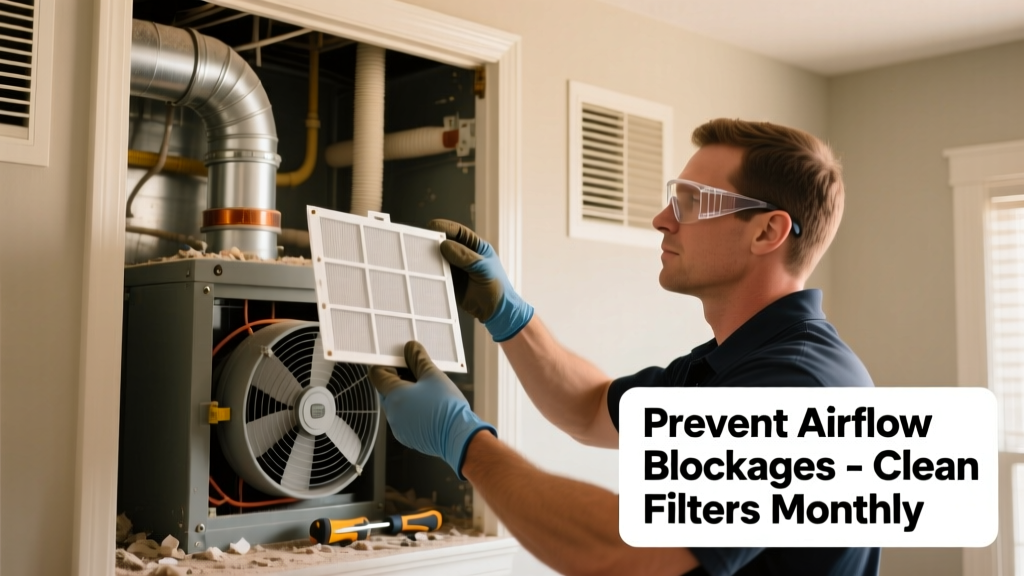
A furnace that stops blowing air isn’t just inconvenient—it’s a warning sign that something’s wrong with your home’s primary heating system. When airflow fails in winter, indoor temperatures can drop below 50°F overnight, risking frozen pipes (which burst at -4°F internal temp) and triggering HVAC emergency calls that average $327 in after-hours fees (HomeAdvisor 2023). Prevention isn’t optional—it’s the cheapest, most reliable way to keep warm air moving.
Why This Happens
Furnace airflow failure rarely appears out of nowhere. It’s almost always the end result of one or more preventable issues stacking up over time. Clogged air filters restrict airflow so severely that the heat exchanger overheats and triggers a safety shutdown—this accounts for nearly 68% of no-airflow service calls logged by the Air Conditioning Contractors of America (ACCA) in 2022. Other common root causes include blower motor strain from dust buildup, failing capacitors (which supply startup voltage), and thermostat wiring faults that break the call-for-heat signal.
- Dirty or oversized air filter causing static pressure spikes
- Blower wheel caked with pet hair and dust, reducing RPMs by up to 40%
- Failed run capacitor—responsible for 22% of blower motor no-start cases (ASHRAE Journal, 2021)
- Loose or corroded low-voltage wiring between thermostat and furnace control board
- Blocked return air grille (e.g., furniture pushed against wall registers)
Maintenance Checklist
| Frequency | Task | Time Required |
|---|---|---|
| Daily | Verify thermostat is set to "Heat" and fan is on "Auto" (not "On") | 30 seconds |
| Weekly | Check return air grilles for obstructions (toys, rugs, furniture) | 2 minutes |
| Monthly | Inspect and replace 1-inch fiberglass filter; upgrade to MERV 8 pleated if pets present | 5 minutes |
| Yearly | Professional cleaning of blower assembly, capacitor test, and belt tension check (if applicable) | 60–90 minutes |
Warning Signs
Don’t wait for total airflow failure. These subtle cues appear days or weeks earlier—and catching them early avoids emergency service:
- Short cycling: furnace runs for 60–90 seconds, then shuts off repeatedly
- Weak airflow from vents—even when thermostat calls for heat
- Faint burning odor during first few minutes of operation (indicates overheating)
- Thermostat display shows "Wait" or "Call Service" but no error code
- Unusual humming or grinding noise from furnace cabinet when blower should start
Recommended Products
Not all filters and tools deliver equal protection. Choose based on your system type and household needs:
- Filters: Filtrete Ultra Allergen Defense (MERV 13) for allergy-prone homes; Nordic Pure MERV 8 for standard efficiency systems
- Capacitor tester: Extech CT20 — detects capacitance drift beyond ±6%, the industry threshold for replacement (per UL 810 standards)
- Static pressure manometer: Dwyer Mark II — measures duct pressure in inches WC to confirm filter isn’t exceeding 0.3" WC max
- Blower wheel brush: HVAC-specific nylon-bristle tool (e.g., Master Flow 31012) — safe for aluminum fins and non-abrasive
Can a dirty filter really shut off my furnace?
Yes—absolutely. A clogged filter increases static pressure in the return duct, forcing the heat exchanger to overheat. Most modern furnaces have high-limit switches that cut power to the burner and blower once internal temps hit 200°F. According to the U.S. Department of Energy, replacing a dirty filter can restore up to 15% of lost airflow—and prevent 9 out of 10 premature limit switch trips.
Why does my furnace blow cold air before shutting down?
This usually means the blower motor is running—but the burners aren’t lighting. Common culprits include a faulty ignition sensor (dirty flame rod), gas valve failure, or low gas pressure. If you smell gas or hear repeated clicking without ignition, turn off the gas supply and call a licensed technician immediately.
Is it safe to clean the blower wheel myself?
Yes—if power is fully disconnected (shut off at both breaker and furnace disconnect switch) and you use non-metallic brushes. Never spray water or cleaner directly onto the motor windings. The AHRI warns that improper cleaning can unbalance the wheel, leading to bearing wear and premature motor failure within 3–6 months.
What’s the right thermostat setting for airflow prevention?
Set fan to "Auto," not "On." Running the blower continuously creates unnecessary wear on the motor and capacitor—and pulls unconditioned air through leaky ducts in attics or crawlspaces. "Auto" ensures the blower only runs when heat is actively being produced, reducing thermal stress on components.
How often should I test my furnace’s airflow?
Test monthly using a simple method: hold a tissue 6 inches from a supply vent while the furnace is running. It should hold firmly against the grille for at least 10 seconds. If it flutters or falls, check filter, returns, and thermostat mode. For deeper verification, use a digital anemometer like the Testo 405i—target 350–450 CFM per ton of cooling capacity.
"A furnace doesn’t fail on the coldest night—it fails because you skipped filter changes in October and ignored the faint whine from the blower motor in November." — HVAC Technician Maria Chen, 12-year field service lead at Trane
Preventing furnace airflow failure isn’t about perfect timing—it’s about consistency. Swap that filter every 30 days if you have pets or allergies, clear return grilles weekly, and schedule your professional tune-up before outdoor temps dip below 45°F. That small habit saves hundreds in repair bills and keeps your family warm when it matters most. For related guidance, see our furnace filter replacement schedule and DIY blower motor test guide.