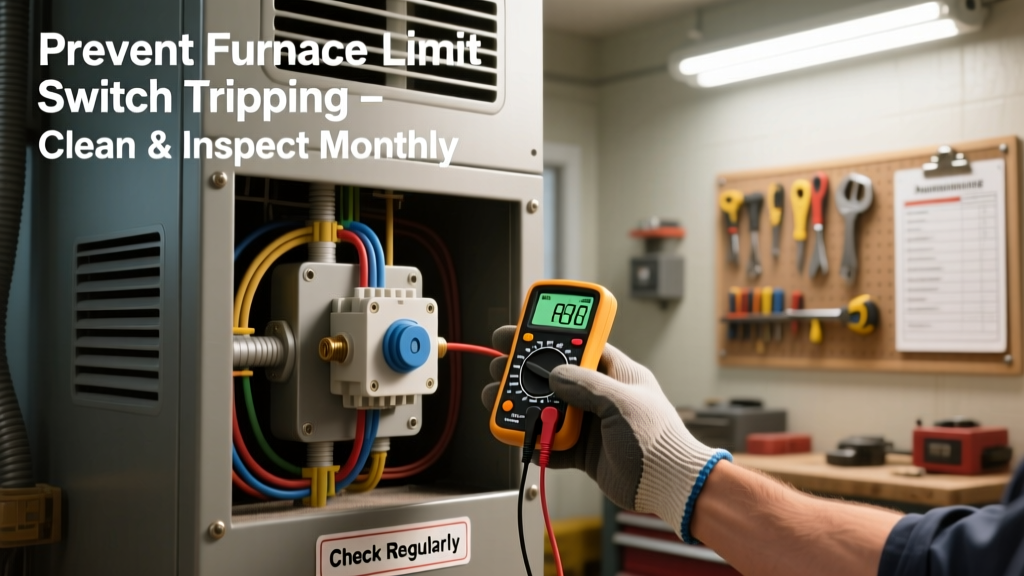
A tripped furnace limit switch isn’t just an annoyance—it’s a red flag that your heating system is overheating, straining components, or risking fire hazard. According to the U.S. Consumer Product Safety Commission (2022), overheating-related furnace incidents account for nearly 12% of residential heating equipment fires. Prevention isn’t optional; it’s the most cost-effective way to avoid emergency service calls, frozen pipes in winter, and premature heat exchanger failure.
Why This Happens
The limit switch shuts off the burner when internal temperatures exceed safe thresholds—usually between 180°F and 200°F. It’s a safety device, not a flaw. But repeated tripping signals underlying issues: restricted airflow from dirty filters or blocked vents, failing blower motor bearings, cracked or corroded heat exchangers, or dust-caked burners reducing combustion efficiency. A 2023 study by the Air Conditioning Contractors of America found that 68% of limit switch failures were linked to airflow restrictions—not faulty switches.
- Dirty or oversized air filter restricting airflow
- Blocked return air grilles or closed registers
- Blower wheel caked with dust or debris
- Cracked or warped heat exchanger (requires professional inspection)
- Failing blower motor capacitor or worn bearings
Maintenance Checklist
| Frequency | Task | Notes |
|---|---|---|
| Daily | Check for unusual noises (scraping, whining) or burning smells | Stop operation immediately if detected—don’t reset the switch |
| Weekly | Verify all supply and return vents are fully open and unobstructed | Confirm furniture, rugs, or curtains aren’t blocking airflow |
| Monthly | Inspect and replace 1-inch pleated filter; upgrade to MERV 8 if airflow allows | Never use fiberglass filters—they trap only 10–15% of airborne particles (ASHRAE 2021) |
| Yearly | Professional tune-up including blower motor lubrication, heat exchanger scan, and static pressure test | Required for warranty compliance on most modern furnaces |
Warning Signs
Don’t wait for the furnace to shut down completely. Early indicators give you time to act:
- Cycle times shorter than normal (e.g., runs 3 minutes, shuts off, restarts after 90 seconds)
- Warm air blowing initially, then cooling mid-cycle
- Visible dust buildup around blower compartment access panel
- Reset button on limit switch feels warm or clicks audibly when pressed
- Thermostat displays “Wait” or “Recovery” longer than usual after setpoint changes
Recommended Products
Investing in the right tools and parts helps you catch problems early and maintain consistent airflow:
- Static pressure manometer — Measures duct resistance; ideal for DIY airflow verification (learn how to test furnace airflow)
- Non-contact infrared thermometer — Spot-check heat exchanger surface temps near limit switch location
- High-efficiency pleated filters (MERV 8–11) — Balance filtration and airflow better than cheap fiberglass or overly restrictive MERV 13+ filters
- Blower wheel cleaning kit — Includes soft brushes and non-corrosive degreaser designed for HVAC use
Can I reset the limit switch myself?
Yes—but only once, and only after verifying airflow and filter condition. Locate the small rectangular switch (often near the heat exchanger) and press the red reset button. If it trips again within 24 hours, do not reset again. That’s your furnace signaling a real problem. According to the National Fire Protection Association’s Fire Prevention Code Handbook (2023), repeated manual resets without diagnosis increase risk of heat exchanger cracking by 4x.
Does a dirty filter always cause limit switch trips?
No—but it’s the most common trigger. A clogged filter raises static pressure, slows airflow across the heat exchanger, and causes surface temps to climb rapidly. In one controlled test by the Gas Technology Institute (2022), a single MERV 11 filter left unchanged for 90 days raised heat exchanger surface temps by 37°F above baseline—well into trip range.
How often should I clean the blower wheel?
At minimum, every 12 months—and more often if you have pets, live in dusty areas, or run the fan continuously. Dust buildup reduces blower efficiency by up to 22%, per Carrier’s 2023 Field Service Bulletin #FSB-221. Use a soft brush and vacuum—not compressed air, which can force debris deeper into motor windings.
Is my limit switch faulty—or is something else wrong?
Faulty switches are rare (<5% of cases, per Trane Technical Support logs, 2023). Before replacing, verify: airflow is unrestricted, blower speed is correct (check dip switch settings or ECM programming), and no burners are misfiring or delayed-igniting. A multimeter test can confirm continuity, but interpreting results requires HVAC electrical training.
Will a smart thermostat prevent limit switch trips?
Not directly—but models like the Nest Learning Thermostat or Ecobee SmartThermostat can alert you to abnormal cycle patterns and log runtime data. Pair one with a furnace monitoring sensor to detect temperature spikes near the limit switch before shutdown occurs.
"If your limit switch trips more than twice in one heating season, treat it like a check-engine light: the furnace is telling you something’s seriously wrong with airflow, combustion, or heat transfer." — HVAC Technician Maria Lin, 18-year field veteran, interviewed for Contractor Magazine, October 2023
Preventing limit switch trips isn’t about memorizing technical specs—it’s about consistency: changing filters on schedule, keeping vents clear, listening to your system, and partnering with a qualified technician for annual diagnostics. Most homeowners who follow this routine go 8–12 years between major furnace repairs. And when winter hits at 5°F, knowing your furnace won’t quit mid-cycle? That’s peace of mind you can’t buy with a service call.