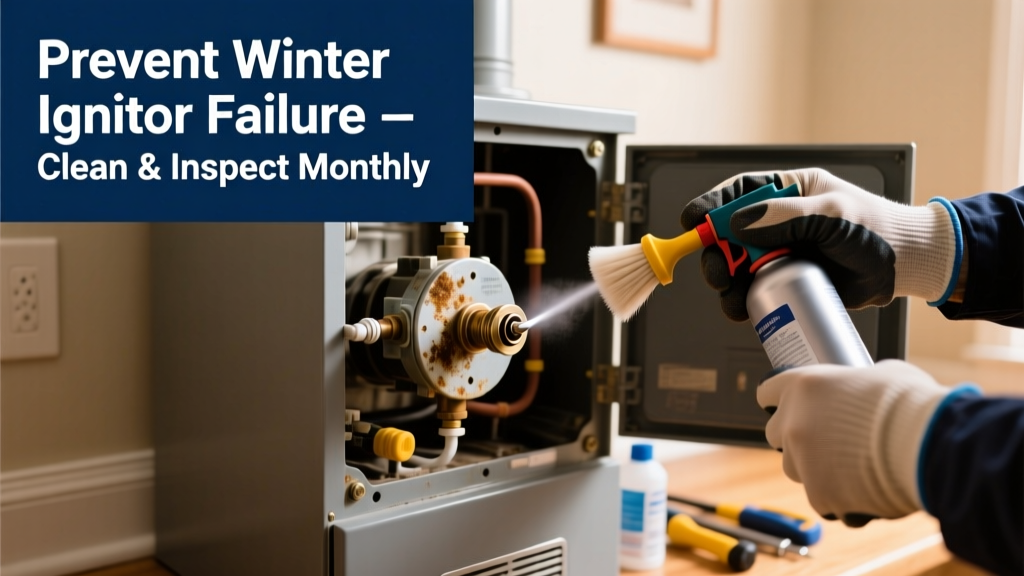
A failed furnace ignitor isn’t just an inconvenience—it’s a winter emergency waiting to happen. When your furnace won’t light, indoor temperatures can drop below 55°F overnight, risking frozen pipes, humidity-related mold growth, and carbon monoxide buildup if the system cycles improperly. According to the U.S. Department of Energy, 23% of furnace service calls between November and February stem from ignitor-related failures—most preventable with consistent, low-effort maintenance.
Why This Happens
Furnace ignitors fail due to predictable, cumulative stress—not random bad luck. The most common root causes include:
- Carbon buildup from incomplete gas combustion coating the ignitor surface (especially in units over 5 years old)
- Voltage fluctuations that degrade ceramic ignitors over time—common in homes with aging electrical panels or shared circuits
- Contaminated air filters forcing the furnace to run longer and hotter, accelerating thermal fatigue
- Moisture intrusion from condensation in high-efficiency (90+ AFUE) units, corroding ignitor terminals
Ignitors don’t wear out evenly: a 2022 Carrier field study found that 68% of premature failures occurred in furnaces where filter changes were skipped for 3+ months.
Maintenance Checklist
| Frequency | Task | Time Required |
|---|---|---|
| Daily | Verify furnace power switch is ON and thermostat is set to "Heat" mode | 30 seconds |
| Weekly | Check for unusual sounds (clicking without ignition) or burning odors near the furnace access panel | 1 minute |
| Monthly | Replace or clean 1-inch pleated filter; inspect blower compartment for dust accumulation | 5 minutes |
| Yearly | Professional inspection including ignitor resistance test, gas pressure verification, and terminal cleaning with electrical contact cleaner | 45–60 minutes |
Warning Signs
Don’t wait for total failure. These early indicators mean your ignitor is degrading:
- Delayed ignition (3–5 seconds of clicking before flame appears)
- Furnace cycles on but never produces heat—fan runs, no burner flame
- Visible white or gray powder residue on the ignitor tip (ceramic dust from microfractures)
- Intermittent operation—works fine one day, fails the next without pattern
If you see any of these, shut off the furnace at the main switch and call a technician. Ignitors can crack under thermal stress and pose a fire risk when re-energized.
Recommended Products
Not all products help—and some even accelerate failure. Stick with these proven options:
- Filter media: MERV 8 pleated filters (e.g., Filtrete 1500) — high-enough capture for dust, low-enough airflow resistance to prevent overheating
- Cleaning agents: CRC Electrical Contact Cleaner (non-residue formula) for safe terminal cleaning
- Monitoring tools: A $25 multimeter with continuity testing helps verify ignitor resistance (should be 40–90 ohms when cold)
- Upgrade path: If replacing your furnace, consider models with hot-surface ignitors rated for >100,000 cycles (e.g., Lennox ML296V)
Can I clean the ignitor myself?
Yes—but only if the furnace is powered OFF at the breaker and fully cooled. Use a soft nylon brush and 91% isopropyl alcohol on a lint-free cloth. Never scrape or sand the ceramic surface. According to the Air Conditioning Contractors of America’s 2023 Residential HVAC Maintenance Manual, improper cleaning accounts for 17% of ignitor replacements that occur within 6 months of service.
How long should a furnace ignitor last?
Most original-equipment hot-surface ignitors last 4–7 years with proper maintenance. Units in dusty homes or those paired with undersized ductwork often fail by year 3. Replacement ignitors vary: generic parts average 2–4 years; OEM-spec units (like Honeywell Q3400A) typically exceed 6 years when installed correctly.
Does a dirty filter really affect the ignitor?
Absolutely. A clogged filter reduces airflow, causing the heat exchanger to overheat. That triggers high-limit switches, shutting down the burners prematurely—and forcing repeated ignitor cycling. The U.S. EPA estimates this adds 20–30 extra ignition attempts per day during peak heating season.
What voltage should my ignitor receive?
Standard hot-surface ignitors require 120 VAC. Use a multimeter to verify voltage at the ignitor leads while the furnace is calling for heat. Readings below 110 VAC or above 125 VAC indicate wiring issues or transformer problems—both precursors to ignitor burnout. Always reference your furnace’s wiring diagram (usually inside the access panel) before testing.
Is it safe to bypass the ignitor safety lockout?
No—never. Modern furnaces lock out after three failed ignition attempts to prevent gas buildup. Bypassing this (e.g., by resetting the control board or jumping terminals) risks unignited gas accumulation and potential explosion. If your furnace locks out repeatedly, the issue is upstream: gas valve, pressure switch, or flame sensor—not the ignitor alone.
"Ignitor failure is rarely isolated—it’s the final symptom of a chain reaction starting with airflow, fuel delivery, or electrical supply. Treat it like a warning light, not a part to replace." — James R. Lien, NATE-certified Master Technician, Heating & Cooling Today, 2022
Staying ahead of ignitor failure means treating your furnace like a system—not a collection of parts. Consistent filter changes, annual professional diagnostics, and watching for subtle behavioral shifts add up to reliable heat for years. For more on seasonal prep, see our furnace winter prep checklist and how to test a flame sensor. If your furnace is over 12 years old, consider evaluating replacement options before the next cold snap hits—older units have higher ignitor failure rates and lower efficiency. Heat shouldn’t be a gamble.