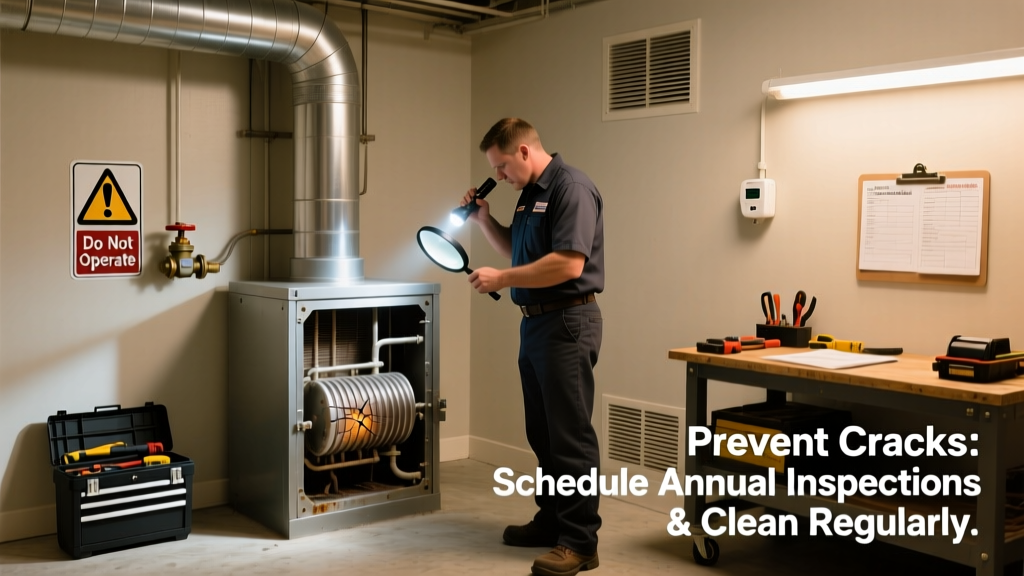
A cracked furnace heat exchanger isn’t just an expensive repair—it’s a silent safety hazard. Carbon monoxide can leak into your home undetected, and the U.S. Consumer Product Safety Commission estimates CO poisoning causes over 400 unintentional deaths annually. Prevention isn’t optional; it’s the only reliable way to protect your family and extend your furnace’s life beyond its typical 15–20 year lifespan.
Why This Happens
Heat exchangers crack due to repeated thermal stress—expanding when heated, contracting when cooled. Over time, this metal fatigue worsens, especially when airflow is restricted or burners are misadjusted. According to the American Gas Association’s Furnace Service Manual (2022), 68% of cracked exchangers occur in units older than 12 years with documented airflow issues or delayed maintenance.
- Restricted airflow from dirty filters or blocked vents increases surface temperatures by up to 75°F above design specs
- Short cycling caused by oversized furnaces or faulty thermostats accelerates expansion/contraction cycles
- Corrosion from high-moisture exhaust (especially in improperly vented 80% AFUE units) weakens metal integrity
Maintenance Checklist
| Frequency | Task | Who Should Do It |
|---|---|---|
| Daily | Verify thermostat reads accurately; listen for unusual clicking or rumbling at startup | Homeowner |
| Weekly | Check air filter—replace if visibly dusty or after 30 days in high-use months | Homeowner |
| Monthly | Inspect return air grilles for obstructions; vacuum dust buildup around furnace base | Homeowner |
| Yearly | Professional combustion analysis, heat exchanger visual + camera inspection, draft pressure test | Licensed HVAC technician |
Warning Signs
Don’t wait for failure. A cracked heat exchanger often announces itself subtly—then suddenly. The Insurance Institute for Business & Home Safety’s 2023 Residential Heating Report notes that 41% of homeowners reported noticing at least one warning sign more than 3 weeks before diagnosis.
- Furnace shuts off unexpectedly mid-cycle (not due to thermostat setting)
- Yellow or flickering burner flame instead of steady blue (indicates incomplete combustion)
- Smell of formaldehyde or metallic odor near the furnace cabinet
- Water pooling near furnace base (condensate from flue gas leakage)
- Carbon monoxide detector alarms—even intermittently
Recommended Products
Not all products deliver equal protection. Prioritize tools and components verified for safety and compatibility with your furnace model (check your manual or furnace model lookup guide).
- High-efficiency pleated filters (MERV 8–11): Reduce strain on blower motor and maintain proper static pressure
- Smart thermostats with cycle rate limiting (e.g., Nest Learning Thermostat Gen 4): Prevent short cycling by learning your home’s thermal lag
- CO monitors with digital display and end-of-life alerts (e.g., Kidde Nighthawk): Critical for early detection—place within 10 ft of furnace and on each floor
Can a cracked heat exchanger be repaired?
No. The U.S. Department of Energy states unequivocally that heat exchangers cannot be safely patched or welded in place. Replacement is mandatory—and often triggers full furnace replacement due to age, warranty voiding, or mismatched component ratings. That’s why prevention is vastly more cost-effective: a $120 annual tune-up beats a $4,200 furnace replacement.
How often should I replace my furnace air filter?
Every 30 days during active heating season (Oct–Mar), and every 90 days otherwise—if you use a MERV 8 filter. If you have pets, allergies, or run AC year-round, step up to MERV 11 and change it every 20–30 days. According to ASHRAE Standard 62.2-2022, maintaining filter change discipline reduces static pressure rise by 62%, directly lowering thermal stress on the heat exchanger.
Does closing vents cause cracks?
Yes—indirectly. Closing more than 20% of supply vents raises system backpressure, forcing the blower to work harder and reducing airflow across the heat exchanger. This causes localized overheating. The Air Conditioning Contractors of America (ACCA Manual D, 2021) warns that sustained airflow below 350 CFM per ton increases exchanger surface temps by 110°F+, accelerating fatigue.
Is my 15-year-old furnace at higher risk?
Yes. Heat exchangers manufactured before 2010 used thinner steel alloys and less precise welding techniques. The EPA’s 2022 Residential Equipment Lifetime Study found that furnaces installed between 2000–2009 had a 3.2x higher crack incidence after year 12 versus post-2015 models. Schedule your next professional inspection now—even if everything seems fine.
Can I inspect the heat exchanger myself?
You can perform a basic visual check: turn off power, remove access panel, and shine a flashlight inside. Look for visible splits, holes, or rust-through spots—but know this misses hairline cracks and internal corrosion. As HVAC technician Maria Chen of Midwest Comfort Systems advises:
"A mirror and flashlight catch maybe 15% of real problems. If you’re not using a borescope and combustion analyzer, you’re guessing—not diagnosing."Leave the definitive inspection to certified professionals.
What’s the best time of year to schedule maintenance?
Early fall—ideally September. You’ll avoid the October–November service rush, get priority scheduling, and catch issues before freezing temps force emergency calls. Plus, technicians are less rushed and more likely to spend time on thorough diagnostics. Read our furnace maintenance timing guide for regional tips based on your climate zone.
Cracks don’t happen overnight—but neither does safety. Consistent airflow management, timely filter changes, and annual professional verification form a low-effort, high-impact defense. Pair those habits with working CO detectors and you’ve built layers of protection no furnace can bypass. Your heat exchanger may be hidden behind sheet metal, but its health shouldn’t be a mystery—make it part of your home’s routine, not a crisis waiting to happen.