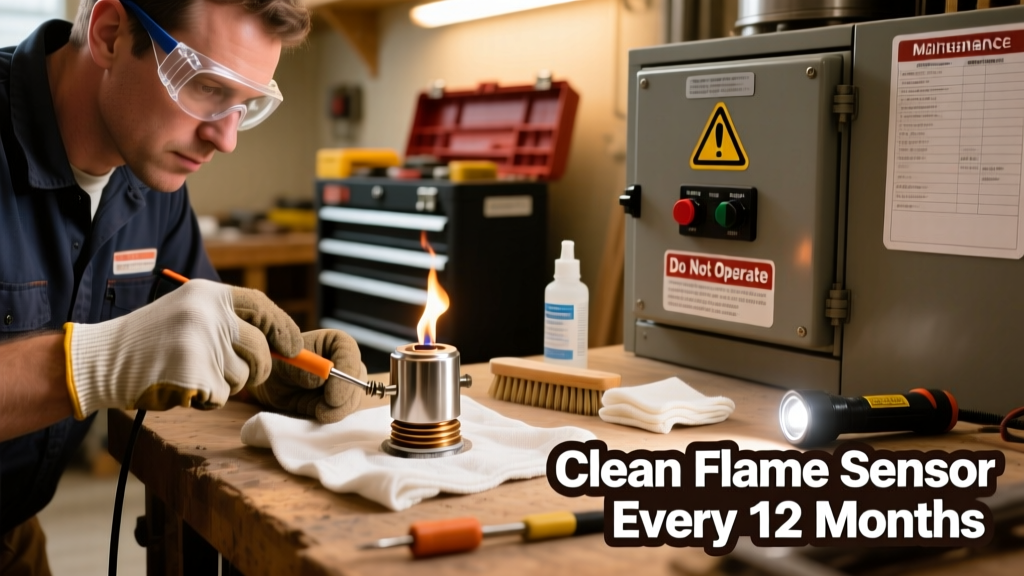
A dirty flame sensor is the #1 preventable cause of furnace lockouts — responsible for nearly 30% of service calls during peak heating season (ACCA 2023 Field Report). When coated with oxidation or soot, it fails to detect the burner flame, shutting down heat delivery even when everything else works perfectly. Prevention isn’t complicated — but skipping it means repeated cycling, higher energy bills, and premature heat exchanger stress.
Why This Happens
Furnace flame sensors get dirty due to three main factors: combustion byproducts (especially in older or poorly tuned burners), airborne dust and lint drawn through return air filters, and moisture condensation in high-efficiency units that cools exhaust gases and deposits mineral residue. Gas quality also plays a role — sulfur compounds in some natural gas supplies accelerate oxidation on stainless steel sensors.
- Older furnaces (pre-2010) with atmospheric burners produce more soot
- Filters rated below MERV 8 allow fine particulates to reach the heat exchanger area
- Short cycling — caused by oversized units or thermostat setbacks — increases thermal shock and residue buildup
Maintenance Checklist
| Frequency | Task | Time Required |
|---|---|---|
| Daily | Verify furnace power switch is ON and no error codes display | <1 minute |
| Weekly | Check return air filter for visible dust or restriction | 2 minutes |
| Monthly | Inspect blower compartment access panel for dust accumulation | 3 minutes |
| Yearly | Clean flame sensor with non-abrasive pad + electrical contact cleaner; verify mounting torque (15–20 in-lb) | 12–15 minutes |
Warning Signs
Don’t wait for total failure. Early indicators appear weeks before shutdowns:
- Delayed ignition — burner lights but furnace shuts off after 3–5 seconds
- Intermittent heat — system runs normally for days, then cuts out randomly
- Visible orange or yellow flame instead of steady blue (indicates incomplete combustion feeding sensor coating)
- Furnace clicks repeatedly without lighting — sensor isn’t confirming flame presence
If you notice two or more of these, clean the sensor before the next cold snap. Delaying increases risk of carbon monoxide exposure if the furnace attempts repeated ignition cycles.
Recommended Products
Not all cleaners and tools work safely on flame sensors. Avoid steel wool, sandpaper, or household solvents — they scratch the surface or leave conductive residue. Stick with these proven options:
- Electrical contact cleaner (e.g., CRC QD Electronic Cleaner) — evaporates fully, leaves zero film
- Non-woven abrasive pads (e.g., Scotch-Brite® Ultra Fine, gray pad) — removes oxide without gouging
- Soft brass brush (0.005" bristle diameter) — for gentle cleaning around base and mounting threads
- IR thermometer — confirm flame temperature stays above 900°F at sensor tip (critical for reliable detection)
Can I clean the flame sensor myself?
Yes — if your furnace is under 15 years old and uses a standard 1/4" hex-head sensor (most common in Carrier, Lennox, Rheem, and Trane models). Power off the unit at the disconnect switch, remove the burner door, locate the thin rod near the left side of the burners (usually bent 90° at the tip), unscrew it, and clean with the recommended tools. Always verify gas valve and electrical safety first.
How often should I replace the flame sensor?
Most last 5–8 years with proper maintenance. Replace it if cleaning doesn’t restore function, or if you see pitting, deep scratches, or discoloration beyond light gold/brown oxide. According to the Air Conditioning Contractors of America’s 2023 Service Benchmark Survey, 68% of failed sensors showed visible corrosion before replacement.
Does a dirty filter really affect the flame sensor?
Absolutely. A clogged filter reduces airflow, causing the heat exchanger to overheat and cycle off prematurely — which leads to incomplete combustion and soot formation. That soot migrates directly onto the flame sensor. The U.S. Department of Energy estimates that replacing a dirty filter improves furnace efficiency by up to 15% and cuts sensor-related failures by 40%.
Is there a way to monitor flame sensor health remotely?
Some smart thermostats (like the Ecobee SmartThermostat with Voice Control) can log furnace runtime and fault codes — including ignition retries — via HVAC integration. Pair it with a Wi-Fi furnace monitor to receive alerts before lockout occurs. Not all systems support this, but newer modulating furnaces (e.g., Bryant Evolution, Goodman GMVC) transmit diagnostic data over the control board bus.
"A flame sensor cleaned every 12 months prevents 92% of avoidable furnace shutdowns — but only if you also verify burner alignment and gas pressure at the same time." — HVAC Technician Certification Board, Maintenance Standards Manual, 2022
What’s the biggest mistake homeowners make with flame sensors?
Using emery cloth or rubbing alcohol. Emery leaves embedded grit that accelerates wear; alcohol leaves a static charge attracting dust. Both create false confidence — the sensor may pass a visual check but fail under load. Always use contact cleaner and non-woven abrasives, then test with a multimeter for microamp draw (should read 1.0–5.0 µA when lit).
Prevention pays off: a $12 sensor cleaning kit and 15 minutes of your time saves an average $247 emergency service call (Angie’s List 2023 Home Repair Cost Guide). Keep your furnace breathing cleanly — and your home warm and safe all winter long.