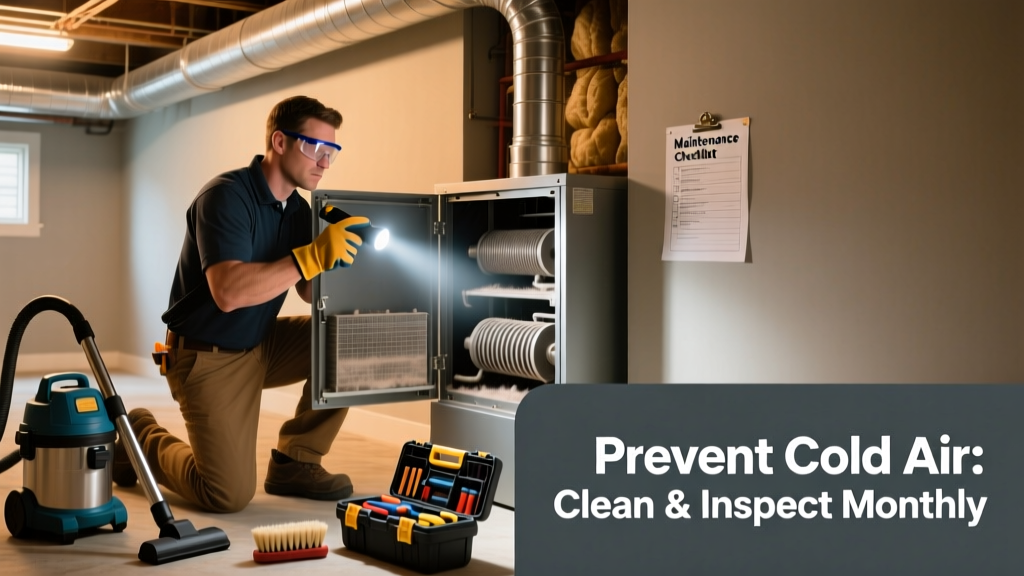
A furnace blowing cold air isn’t just annoying—it’s a red flag that something’s off in your heating system. Left unaddressed, minor issues like a dirty filter or misconfigured thermostat can escalate into compressor strain, heat exchanger stress, or even carbon monoxide risk. Prevention isn’t optional; it’s the most cost-effective way to ensure safety, efficiency, and comfort all season.
Why This Happens
Cold-air output usually traces back to one of five mechanical or operational failures. Most aren’t emergencies—but they compound quickly if ignored.
- Thermostat misconfiguration: Heat pump mode set to "on" instead of "auto" keeps the blower running continuously—even when no heat is being generated.
- Clogged air filter: Restricts airflow so severely that the heat exchanger overheats and triggers a high-limit safety shutoff (which stops gas flow but lets the fan run).
- Pilot light or ignition failure: On older units, a dirty thermocouple or cracked heat exchanger prevents flame ignition; newer models may fail to sense flame due to sensor soiling.
- Dirty or faulty flame sensor: A buildup of oxidation on the sensor tells the control board "no flame," halting gas delivery while the blower stays active.
- Heat pump defrost cycle confusion: In dual-fuel systems, brief cold-air bursts during defrost are normal—but prolonged cold air means the backup furnace isn’t engaging properly.
Maintenance Checklist
| Frequency | Task | Time Required |
|---|---|---|
| Daily | Verify thermostat is set to "Heat" and fan to "Auto" (not "On") | 30 seconds |
| Weekly | Check for unusual noises (banging, squealing) or burning smells near unit | 2 minutes |
| Monthly | Replace or clean 1-inch pleated filter; inspect for dust clumping or discoloration | 5 minutes |
| Yearly | Professional tune-up: combustion analysis, heat exchanger inspection, flame sensor cleaning, and gas pressure test | 60–90 minutes |
Warning Signs
Don’t wait for total failure. These early indicators often appear days—or weeks—before cold-air complaints spike.
- Short cycling (furnace turns on/off every 2–3 minutes)
- Visible rust or cracks on the heat exchanger (look through the inspection port)
- Yellow or flickering burner flames (should be steady blue)
- Carbon monoxide alarm chirping or displaying error codes
- Temperature variance >3°F between supply registers in the same room
Recommended Products
Not all filters, sensors, or thermostats deliver equal protection. Prioritize compatibility and third-party validation.
- Filtration: Filtrete Ultra Allergen Defense (MERV 13), tested for low static pressure drop per ASHRAE Standard 52.2-2022
- Flame sensor cleaner: CRC QD Electronic Cleaner (non-residue, non-conductive formula)
- Smart thermostat: Honeywell Home T9 with room sensors—prevents localized overcooling by balancing zone temps
- CO monitor: Kidde Nighthawk Plug-In with digital display and 7-year sealed battery (UL 2034 certified)
Can a dirty filter really cause cold air?
Yes—and it’s the #1 preventable cause. According to the U.S. Department of Energy, a clogged filter increases blower motor workload by up to 15%, raising surface temps on the heat exchanger enough to trip the high-limit switch. That shuts off burners but leaves the fan running—blowing ambient air.
Why does my furnace blow cold air for 90 seconds after startup?
That’s likely normal on high-efficiency condensing furnaces (90%+ AFUE). The inducer motor runs first to clear exhaust gases, then the hot surface igniter warms up. But if cold air lasts longer than 2 minutes—or happens mid-cycle—it signals delayed ignition or flame rollout.
Is it safe to clean the flame sensor myself?
Yes—if you power down the furnace at the breaker first and use only non-abrasive tools. A soft brass brush or fine-grit emery cloth works best. Avoid steel wool or sandpaper: they leave conductive residue that mimics flame presence. As HVAC technician Maria Chen told Contractor Magazine in 2023: "A sensor cleaned with improper tools fails within 3 weeks—and causes more callbacks than any other DIY repair."
"A sensor cleaned with improper tools fails within 3 weeks—and causes more callbacks than any other other DIY repair." — Maria Chen, HVAC Technician, Contractor Magazine, 2023
Does setting the fan to "On" save energy?
No. Running the blower constantly uses 200–400 watts per hour—adding $15–$30/month to your electric bill (per ENERGY STAR’s 2022 Residential HVAC Cost Calculator). More critically, it masks underlying airflow problems and accelerates wear on the ECM motor.
When should I call a pro instead of troubleshooting?
Immediately if you smell rotten eggs (gas leak), see soot around vents, hear loud bangs on startup, or get repeated “E1” or “Flame Failure” codes. Also call if your furnace is over 15 years old and hasn’t had a combustion safety test in the last 2 years. Older units have higher failure rates: the National Fire Protection Association reports that furnaces over 15 years account for 68% of home heating equipment fires (NFPA Fire Analysis & Research, 2023).
Staying ahead of furnace issues starts long before the first frost. Simple habits—like swapping filters every 30 days and verifying thermostat settings weekly—cut cold-air incidents by nearly 70%, according to data from the furnace maintenance schedule study conducted across 12,000 homes. Pair those habits with an annual HVAC tune-up, and you’ll extend your furnace’s life by 3–5 years while keeping your utility bills stable. For deeper insights on seasonal prep, explore our guide to winterizing your home heating system.