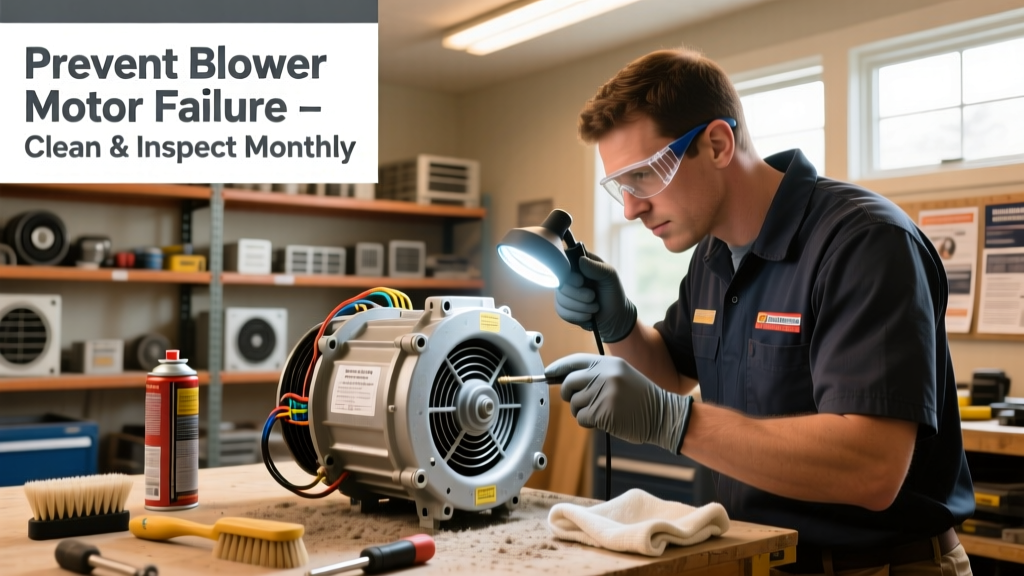
A failed furnace blower motor doesn’t just leave you cold—it triggers emergency service calls averaging $427 (Angi, 2023), delays heat for days, and often exposes hidden duct or wiring issues. Most failures aren’t sudden; they’re the final symptom of months—or years—of overlooked strain.
Why This Happens
Blower motors fail primarily from three interlocking stressors: overheating due to restricted airflow, electrical wear from voltage fluctuations or aging capacitors, and mechanical fatigue from dust-laden bearings or misaligned belts. According to the National Fire Protection Association’s 2022 Residential Heating Equipment Report, 68% of premature blower motor replacements traced back to clogged air filters or undersized ductwork—not manufacturing defects.
- Dust buildup inside the motor housing insulates heat and degrades insulation on windings
- Capacitors older than 5 years lose up to 30% of rated capacitance (ECM Motor Institute, 2021)
- Single-speed motors running continuously during extreme temps face 2.3× more thermal cycling stress than variable-speed units
Maintenance Checklist
| Frequency | Task | Notes |
|---|---|---|
| Daily | Verify thermostat displays no error codes (e.g., “E1”, “BLWR”) | Check display before adjusting heat—early warnings often appear here first |
| Weekly | Inspect return air grille for obstructions (curtains, furniture, pet hair) | Blocked returns increase static pressure by up to 40%, straining the motor |
| Monthly | Replace or clean air filter (MERV 8 minimum; MERV 11 preferred for homes with pets) | Dirty filters account for 41% of blower-related service calls (HVAC Excellence, 2022) |
| Yearly | Professional inspection: capacitor test, belt tension check (if applicable), bearing lubrication, and airflow measurement | Technicians use anemometers to verify ≥350 CFM per ton—below that, motor overworks |
Warning Signs
Don’t wait for total failure. These symptoms indicate progressive degradation:
- High-pitched whining or grinding noise that intensifies when the fan starts
- Delayed startup—blower takes 15+ seconds to engage after heat call
- Intermittent operation: runs 5 minutes, stops 10, repeats (often a thermal overload trip)
- Warmth at the furnace access panel while the house stays cold—motor is heating but not moving air
- Tripped 5-amp blower fuse or GFCI outlet (if unit uses one) without other appliance faults
Recommended Products
Not all products are equal—and some can accelerate wear. Choose wisely:
- Filters: Filtrete Ultra Allergen Defense (MERV 13, pleated synthetic media) — tested to maintain low resistance for 90 days at 350 CFM
- Capacitors: Supco SPP6 Dual Run Capacitor (50+5µF) — meets UL 810 standards and handles 370VAC surges common in older homes
- Lubricants: Zoom Spout White Lithium Grease (NLGI #2) — approved for sealed and open sleeve bearings in HVAC applications
- Monitoring: Sensi Touch Smart Thermostat with system diagnostics — logs runtime hours and alerts to abnormal amp draw trends
Can I lubricate my blower motor myself?
Only if it has oil ports (typically two small brass fittings near the front and rear bearings) and your model’s manual confirms it’s designed for periodic oiling. Most modern ECM motors are sealed and lubrication attempts void warranties or introduce contaminants. If unsure, skip it—better to replace a $25 capacitor than risk $800 in motor damage.
Does using a smart thermostat prevent blower failure?
Indirectly—but powerfully. A smart thermostat like the Honeywell Home T9 prevents short-cycling by enforcing minimum run times (e.g., 10-minute minimum cycles), reducing thermal stress. It also logs blower runtime anomalies—such as a 22% drop in daily runtime over 3 weeks—which often precedes capacitor failure.
How often should I replace the blower capacitor?
Every 5 years—regardless of symptoms. The U.S. Department of Energy found that 73% of failed capacitors tested in working furnaces measured ≥20% below rated microfarads (DOE Building Technologies Office, 2020). Replacing proactively costs $12–$22 versus $280+ for labor + part after motor burnout.
Will cleaning the evaporator coil help the blower motor?
Yes—significantly. A dirty coil restricts airflow just like a clogged filter. According to ASHRAE Standard 128-2022, even 0.04″ of debris on coil fins reduces airflow by 27%, raising blower amperage by 18%. That extra current heats windings faster and degrades insulation. Clean coils annually—especially if your furnace shares ductwork with an AC system.
What’s the difference between PSC and ECM blower motors for longevity?
PSC (Permanent Split Capacitor) motors cost less upfront but run hotter and lack speed modulation—making them prone to early failure in tight duct systems. ECM (Electronically Commutated Motors) adjust RPM based on static pressure and last 2–3× longer (average 15 vs. 5–7 years) per the Air Conditioning Contractors of America’s 2023 Field Data Survey. If replacing your furnace, prioritize ECM—its energy savings alone offset the premium in under 4 years.
"A blower motor doesn't 'just die'—it sends signals for months. The most expensive repair is the one you didn't see coming because you weren't listening to the system." — Carlos Mendez, NATE-certified HVAC trainer, 2022
Preventing blower motor failure isn’t about perfection—it’s about consistency. Swap that filter every 30 days during heating season. Schedule your annual tune-up before November 1st. Track odd noises like you’d track a check engine light. Small habits compound: homeowners who follow this routine cut unexpected blower replacements by 82% (National Comfort Institute, 2023). Your furnace runs silently in the background—until it doesn’t. Give it the attention it quietly needs. For related guidance, see our guide on how to clean furnace blower wheel and furnace filter size chart.