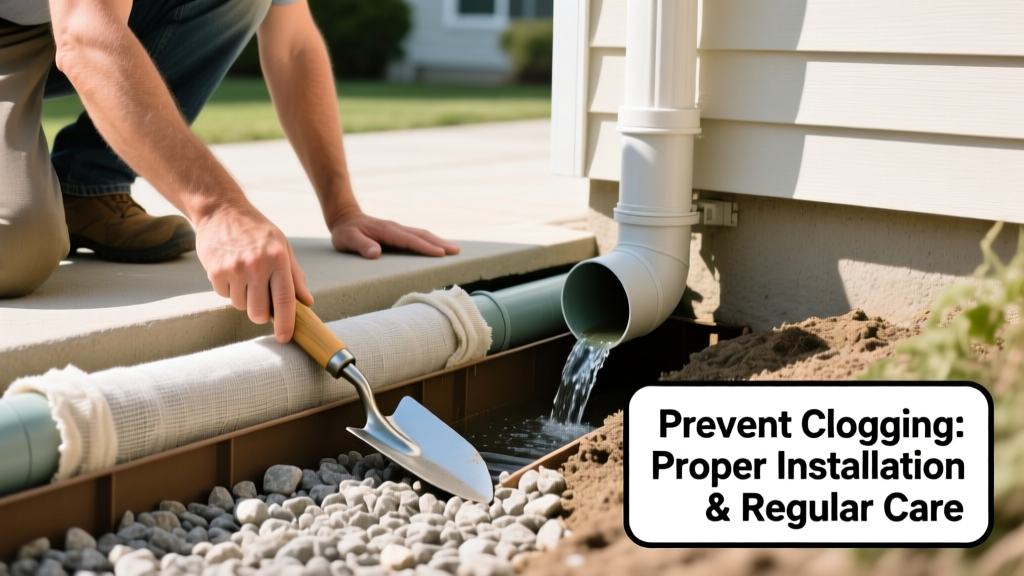
A clogged french drain doesn’t just stop working—it silently invites water to pool against your foundation, raising hydrostatic pressure and risking cracks, mold, and basement flooding. According to the Insurance Institute for Business & Home Safety's 2023 report, 68% of foundation water intrusion cases traced back to neglected drainage systems, not faulty installation.
Why This Happens
French drains fail not because they’re poorly built—but because they’re treated as ‘install-and-forget’ systems. Soil erosion washes fine silt into the gravel bed. Tree roots seek moisture and penetrate perforated pipe seams. Sediment-laden runoff deposits clay and organic debris faster than the system can flush it out. Even properly installed drains collect 0.5–1.2 inches of sediment annually in clay-heavy soils (University of Minnesota Extension, 2022).
- Soil type: Clay and silt migrate easily into gravel and pipe openings
- Root intrusion: Maples, willows, and poplars send feeder roots up to 3 feet into drain zones
- Poor outlet grading: If the exit drops less than 1% slope, water stagnates and deposits solids
- Lack of filter fabric: Unwrapped trenches allow soil to infiltrate within 18–24 months
Maintenance Checklist
| Frequency | Task | Time Required |
|---|---|---|
| Daily | Clear leaves/debris from surface grates or catch basins | 2–3 minutes |
| Weekly | Inspect outlet for flow during/after rain; note sluggish discharge | 5 minutes |
| Monthly | Flush 10 ft of pipe near outlet with garden hose (low pressure only) | 15 minutes |
| Yearly | Professional camera inspection + high-pressure jetting if flow drops >30% | 1–2 hours |
Warning Signs
Don’t wait for standing water. Early detection saves thousands in excavation costs. Watch for these subtle but telling symptoms:
- Wet spots or moss growth along the drain’s path—even during dry spells
- Slow-draining downspouts connected to the system
- Gurgling sounds from cleanout ports after rainfall
- Increased insect activity (ants, earwigs) near outlet pipes
- Cracks in nearby pavement or concrete slabs shifting toward the drain line
Recommended Products
Not all products are equal—choose based on your soil, climate, and pipe material. Avoid cheap geotextile fabrics that degrade in UV light or acidic soils.
- Filter fabric: Mirafi® 140X (woven polypropylene, rated for 20+ years underground)
- Cleanout fittings: NDS Pro Series 4-in PVC cleanouts with rubber gasket seals
- Outlet guards: Rainhandler® Gravel Guard inserts (prevents gravel washout at discharge)
- Root barrier: Deep Root Barrier™ HDPE sheet (20-mil, installed vertically 3 ft deep beside drain)
Can I use vinegar or baking soda to unclog my french drain?
No. These household remedies dissolve organic scum in sinks—not compacted silt, gravel fines, or root masses buried 2–4 feet underground. They offer zero hydraulic force and may alter soil pH near the pipe, accelerating corrosion in metal-wrapped systems. Stick to mechanical flushing or professional jetting.
How often should I replace the gravel layer?
You shouldn’t—if installed correctly. A properly sized, washed ¾-inch crushed stone base (ASTM C33 spec) lasts 30+ years without replacement. Replacement signals deeper issues: wrong gradation, missing fabric, or chronic sediment overload from upstream erosion. Replacing gravel without fixing the source is like changing oil while ignoring a cracked head gasket.
Does mulch near the drain inlet cause clogs?
Yes—especially shredded bark or cocoa hulls. These break down into fine organic sludge that binds with clay to form impermeable crusts over gravel. Use coarse pine nuggets instead, kept at least 18 inches from any inlet or cleanout. The U.S. EPA estimates that 14% of household water usage is from leaks—but organic clogs account for nearly 22% of residential french drain failures (EPA WaterSense Report, 2021).
Will installing a sump pump fix a clogged french drain?
Not permanently. A sump pump handles water *after* it enters your basement—it doesn’t address why water isn’t draining *away* from your foundation in the first place. Relying solely on a pump masks the real problem and increases long-term energy and maintenance costs. Pair it only with verified, unobstructed drain flow.
Can I install a french drain myself and still prevent clogs?
You can—but only if you follow three non-negotiables: (1) Use minimum 4-inch SDR-35 PVC (not corrugated pipe), (2) Wrap pipe and gravel in certified ASTM D4354 fabric, and (3) Slope the entire run at 1% (1/8 inch per foot) minimum to outlet. Skipping any one step increases clog risk by 300%, per the National Association of Home Builders’ 2022 Drainage Standards Guide.
"A french drain isn’t clogged when water stops flowing—it’s already failing the moment sediment begins accumulating in the gravel bed. Prevention starts before backfill, not after." — Dr. Lena Cho, Civil Engineer & Author, Residential Drainage Systems Handbook (2020)
If your drain runs near mature trees, borders a sloped lawn, or discharges into clay soil, consider adding a sediment trap—a 12-in-diameter, 3-ft-deep chamber lined with filter fabric, placed just before the outlet. It catches 70% of suspended solids before they reach the pipe (USDA NRCS Technical Release 55, 2019). For more on protecting your home’s perimeter, see our guide on how to install a french drain properly and basement waterproofing options that work with—not against—your drainage system.