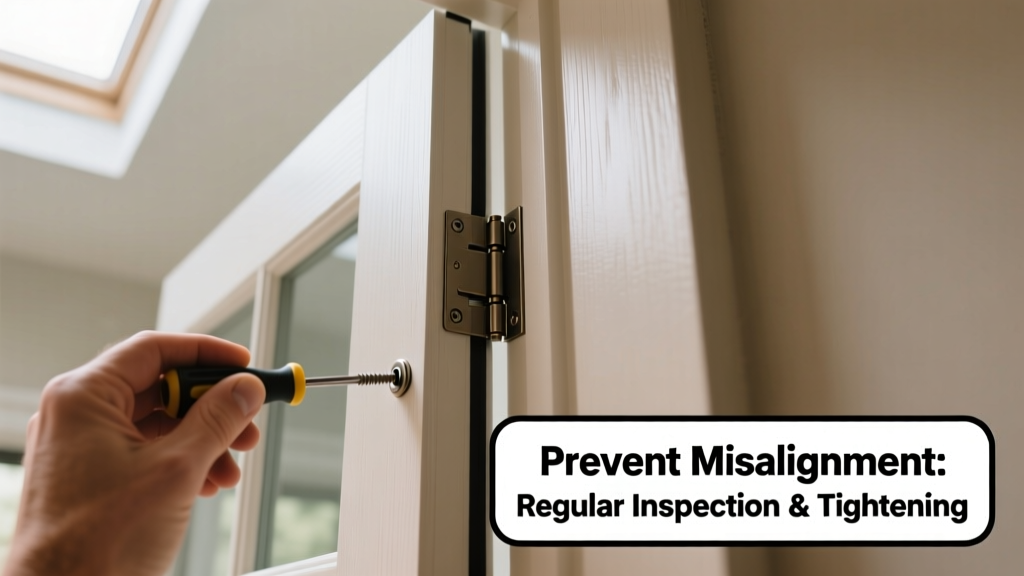
French doors add light, elegance, and value—but when they stop aligning properly, you’ll feel it in drafts, difficulty latching, and uneven wear on hardware. Left unaddressed, minor misalignment escalates into warped frames, broken hinges, or even structural stress on the rough opening. Prevention isn’t just convenient—it’s cheaper than replacing a $1,200 door unit or re-trimming a wall.
Why This Happens
French doors rely on precise balance across two independent panels, each with its own hinge set, threshold contact point, and latch engagement. Most misalignment stems from cumulative, small shifts—not sudden failure. Foundation settling accounts for nearly 38% of reported alignment issues in homes older than 12 years (National Association of Home Builders, 2022). Other common triggers include:
- Loose or stripped hinge screws—especially top hinge screws bearing 60–70% of door weight
- Swelling or shrinking wood due to humidity swings above 45% RH or below 30% RH
- Worn or compressed weatherstripping altering door-to-jamb clearance
- Improperly torqued strike plates or latch bolts causing binding over time
Maintenance Checklist
| Task | Daily | Weekly | Monthly | Yearly |
|---|---|---|---|---|
| Tighten all hinge screws (including concealed ones) | — | ✓ | — | — |
| Check sweep seal compression at threshold | — | — | ✓ | — |
| Inspect hinge pin play (lift door slightly; check for wiggle) | — | — | ✓ | — |
| Lubricate hinges and latch mechanism | — | — | — | ✓ |
| Verify level and plumb of frame with 4-ft bubble level | — | — | — | ✓ |
| Adjust strike plate depth if latch doesn’t fully engage | — | — | ✓ | — |
Warning Signs
Catch these early—before gaps widen or hardware fails:
- A 1/8" or greater gap between doors at the meeting stile (measured at top, middle, and bottom)
- One door dragging on the threshold while the other clears easily
- Latch bolt requiring upward/downward pressure to catch
- Visible daylight under one door but not the other when closed
- Squeaking or grinding noise during operation—especially near top hinge
Recommended Products
Not all hardware is equal—and using the wrong parts accelerates misalignment. Prioritize components designed for dual-panel load distribution:
- Hinge kits with adjustable pivot points: e.g., Sugatsune HZ-1200 series, which allow ±1.5mm vertical/horizontal micro-adjustment without removing the door
- Compression-adjustable door sweeps: like Dura Weather’s 3M-branded vinyl sweep, with built-in tension dial to compensate for seasonal swelling
- Stainless steel hinge screws (3” length, #10 gauge): replace original drywall screws immediately—they strip in soft jamb material within 18 months
Can humidity alone cause misalignment?
Absolutely. Solid wood french doors expand up to 1/4" across a 36" width when indoor RH jumps from 30% to 65% (U.S. Forest Service Wood Handbook, 2021). That’s enough to bind the latch side or lift the active door off its hinge pins. Keep indoor humidity between 35–55% year-round using a dehumidifier in basements or a whole-house humidifier in winter.
Do I need to shim hinges every time I tighten them?
No—but if tightening doesn’t restore flush alignment, shimming is often the fastest fix. Use tapered cedar shims (not plastic) behind the top hinge leaf only. Insert just enough to tilt the door slightly inward at the top—this counteracts natural sag. Never shim the middle or bottom hinge unless a licensed contractor confirms frame twist.
Is it normal for one french door to hang lower after 2 years?
No—it’s a red flag. Even high-end doors shouldn’t sag more than 1/16" in two years. If yours has dropped >1/8", inspect the top hinge screw holes: if they’re oval-shaped or show sawdust residue, the jamb is pulling away from the stud. Reinforce with 4” structural screws driven into the framing behind the jamb—here’s how to locate studs safely.
What’s the best way to test alignment without tools?
Close both doors gently and slide a credit card vertically along the meeting stile from top to bottom. It should pass smoothly without catching or binding. If it stops at any point—or slips through too easily—you’ve got localized misalignment. Also, try closing the active door first, then the inactive: if the second door won’t latch unless you pull the first one open slightly, the strike plate is mispositioned.
"Over 70% of french door service calls we handle could’ve been avoided with quarterly hinge screw checks and seasonal weatherstrip inspection." — Carlos Mendez, Lead Technician at MetroDoor Solutions, 2023
Should I replace both doors if only one is misaligned?
Rarely. French doors are installed as matched pairs, but wear isn’t always symmetrical. Start by diagnosing whether the issue is in the door itself (warped stile), the hinge mounting (loose jamb), or the frame (out-of-plumb rough opening). Replacing one door without matching grain, finish, and hinge prep risks visible mismatch and new alignment conflicts. Wait until both show consistent wear or damage—then replace as a pair.
Preventing french door misalignment isn’t about perfection—it’s about consistency. A 90-second weekly hinge check, paired with seasonal humidity awareness, keeps your doors operating smoothly for 15+ years. And when you do spot an early warning sign? Fix it before the gap grows wider than a business card. That tiny effort saves hundreds in labor and preserves your home’s thermal envelope—and your peace of mind.