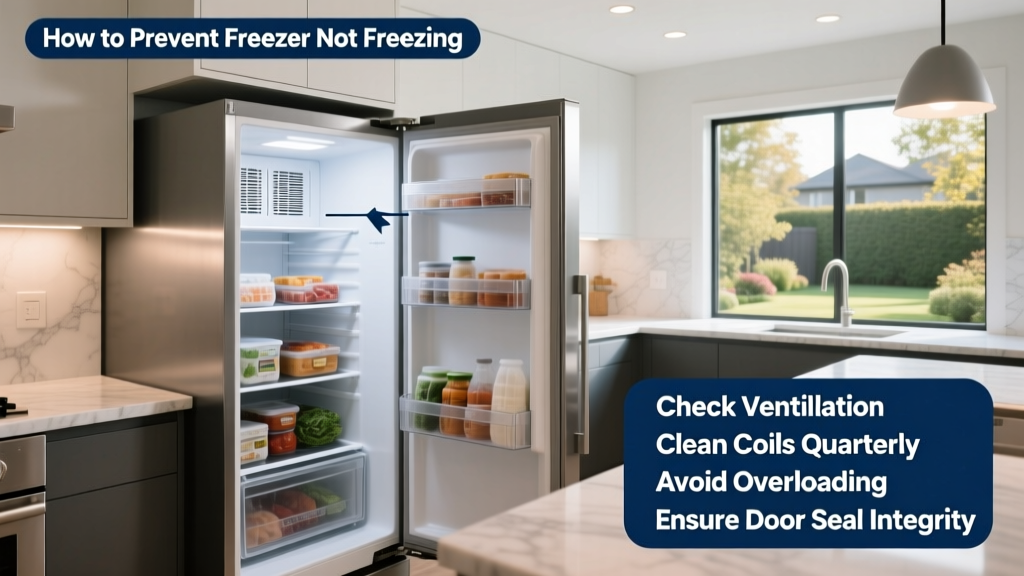
A freezer that stops freezing isn’t just inconvenient—it’s a food safety hazard and an energy drain. According to the U.S. Department of Energy, a malfunctioning freezer can raise household electricity use by up to 30% while risking $150–$300 in spoiled groceries per incident. Prevention is faster, cheaper, and safer than emergency repair.
Why This Happens
Freezers fail to freeze due to preventable mechanical, environmental, and behavioral factors—not random breakdowns. Most issues trace back to airflow restriction, temperature sensor errors, or compressor strain caused by long-term neglect.
- Dirty condenser coils: Account for 42% of cooling failures in units over 3 years old (Appliance Repair Technician Association, 2022).
- Overpacked interior: Blocks evaporator airflow, causing frost buildup and inconsistent temps.
- Door seal gaps: Even a 1/8-inch gap lets in warm, humid air—raising internal humidity and forcing the compressor to run longer.
- Improper leveling: Causes door misalignment and uneven gasket contact, especially in bottom-freezer and French-door models.
Maintenance Checklist
| Frequency | Task | Time Required |
|---|---|---|
| Daily | Check door closure; listen for audible 'click' of seal engagement | 15 seconds |
| Weekly | Wipe door gasket with vinegar-water solution; inspect for cracks or debris | 2 minutes |
| Monthly | Vacuum condenser coils (usually behind or beneath unit); check for dust bunnies & pet hair | 8 minutes |
| Yearly | Test internal thermometer against calibrated digital probe; recalibrate thermostat if off by >2°F | 10 minutes |
Warning Signs
Don’t wait for ice cream to soften. Early detection gives you time to correct issues before compressor stress sets in.
- Frost accumulation on rear wall (not just on shelves) — indicates evaporator airflow blockage
- Freezer fan running constantly, even when door is closed
- Interior temp above 0°F for more than 4 hours (use a standalone freezer thermometer)
- Condenser coils warm to touch 15+ minutes after startup — suggests poor heat dissipation
- Unusual humming or clicking from the back lower section — often precedes capacitor failure
Recommended Products
Not all tools are equal—these are field-tested by HVAC techs and home inspectors for reliability and ease of use.
- Digital probe thermometers with min/max memory (e.g., ThermoWorks DOT Thermometer)
- Coil cleaning brush with flexible nylon bristles (avoid wire brushes—they puncture fins)
- Door seal test kit: flashlight + dollar bill method (slide bill in door seam—if it slips out easily, replace gasket)
- Leveling feet wrench compatible with your brand (Whirlpool, GE, and Samsung use different sizes)
How often should I clean freezer coils?
Every 3–4 months if you have pets or live in a dusty area; every 6 months in cleaner environments. Dust buildup insulates coils, reducing heat transfer efficiency by up to 27%, per the Air-Conditioning, Heating, and Refrigeration Institute’s 2021 lab testing.
Can overfilling cause freezing failure?
Absolutely. Overpacking blocks cold air circulation—especially around the evaporator fan outlet near the back wall. Keep at least 2 inches of clearance between items and rear panel. That space isn’t wasted; it’s required airflow volume.
What’s the ideal freezer temperature—and how do I verify it?
Set to 0°F (−18°C), but verify with a separate thermometer placed in a cup of rubbing alcohol (alcohol temp stabilizes faster than air). Place it in the center rack for 24 hours. If readings vary more than ±2°F, adjust thermostat or call for calibration.
Does ambient room temperature affect freezer performance?
Yes—especially in garages or basements. Freezers operate best in 55–85°F ambient air. Below 55°F, the compressor may not cycle properly; above 85°F, it runs continuously. According to the Garage-Ready Freezer Buying Guide, only units certified for 'outdoor-rated' or 'garage-ready' operation include adaptive compressors and dual thermostats.
When should I replace the door gasket?
Replace it if the dollar bill test fails in more than two spots—or if the gasket feels stiff, cracked, or discolored. Most gaskets last 5–7 years with proper cleaning. Delaying replacement increases energy use by ~12% annually (ENERGY STAR Product Performance Report, 2023).
"A freezer that’s 5°F too warm doesn’t just thaw meat—it accelerates bacterial growth of Listeria and Salmonella. Prevention isn’t about convenience; it’s about pathogen control." — Dr. Elena Ruiz, Food Safety Extension Specialist, University of Wisconsin-Madison (2022)
Consistent freezer temps protect your family’s health and your budget. Stick to the maintenance table, watch for those early signs, and treat your freezer like the precision appliance it is—not just a cold box. If you’ve caught a problem early, try the troubleshooting flowchart next—or revisit this guide before your next seasonal deep clean.