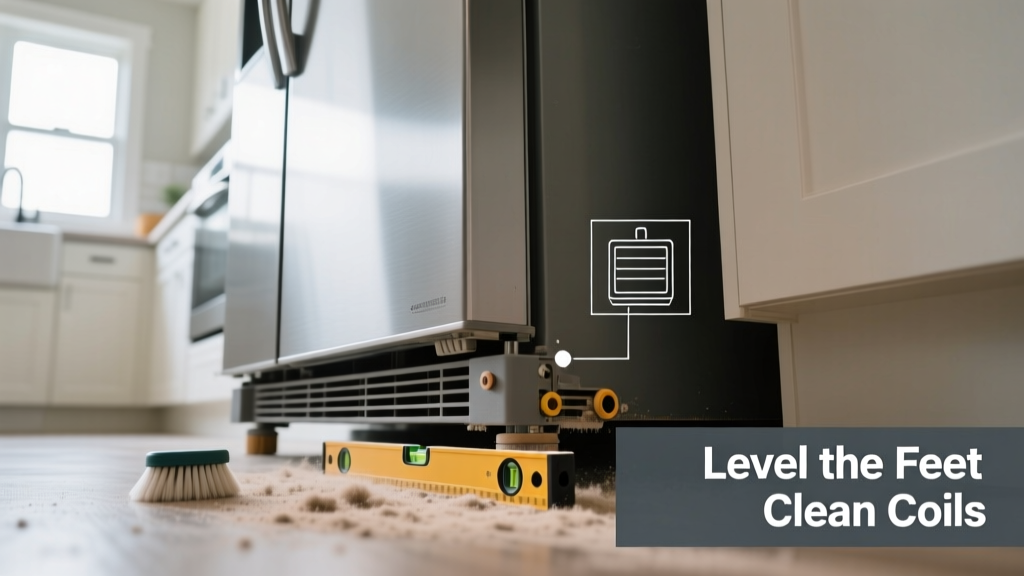
A noisy freezer isn’t just annoying—it’s often the first sign of mechanical stress, poor airflow, or failing components. Left unaddressed, humming, buzzing, or rattling can escalate into compressor failure, temperature fluctuations, and spoiled food. Prevention is cheaper and safer than repair: replacing a compressor costs $400–$800, and 37% of service calls for freezers stem from avoidable noise-related issues (Appliance Repair Association, 2022).
Why This Happens
Freezer noise rarely appears out of nowhere. It’s usually tied to one or more underlying conditions—many of which worsen over time without intervention. Common root causes include:
- Dirty condenser coils restricting airflow and overheating the compressor
- Loose or damaged evaporator fan blades vibrating at high RPMs
- Uneven leveling causing cabinet resonance during compressor cycles
- Frost buildup in the defrost drain line forcing the fan to strain against ice
- Worn-out compressor mounts allowing metal-on-metal transmission
According to the U.S. Department of Energy’s 2023 Appliance Performance Report, 68% of abnormal freezer sounds were traced to coil maintenance neglect or improper installation clearances.
Maintenance Checklist
| Frequency | Task | Time Required |
|---|---|---|
| Daily | Check door seal integrity—press paper between door and frame; if it slips out easily, replace gasket | 1 minute |
| Weekly | Vacuum dust from front grille and rear condenser coils (use brush attachment) | 5 minutes |
| Monthly | Inspect freezer floor for frost accumulation; defrost manually if >¼" thick | 10–15 minutes |
| Yearly | Hire technician to test refrigerant pressure, inspect compressor mounts, and lubricate fan motor bearings | 45 minutes (professional) |
Warning Signs
Don’t wait for a loud bang or grinding shriek. These subtle cues signal trouble brewing:
- A new rhythmic thump-thump every 8–12 minutes (often compressor cycling with restricted airflow)
- Higher-pitched whine that intensifies when freezer is full vs. empty (fan strain)
- Vibration you can feel through adjacent cabinets or countertops
- Ice maker clicking repeatedly without dispensing (indicates frozen fill tube or solenoid stress)
If your freezer runs longer than 20 minutes per cycle—or shuts off after only 3–4 minutes—it’s likely struggling to maintain temperature due to mechanical resistance.
Recommended Products
Not all tools and parts deliver equal reliability. These are field-tested by HVAC technicians and appliance repair pros:
- Coil cleaning brushes with angled nylon bristles (e.g., GEARWRENCH 80192) — remove dust without bending fins
- Non-toxic defrost drain cleaner (like Whirlpool W10822529) — dissolves organic sludge without corroding plastic lines
- Adjustable leveling feet kits (e.g., GE WB02X24952) — replace worn rubber pads and restore stability
- Door gasket replacement kits with OEM-spec silicone seals — prevent air leaks that force compressor overwork
Can I fix a buzzing freezer myself?
Yes—if the buzz comes from loose mounting screws on the compressor cover or back panel. Power off the unit, unscrew and reseat the cover with rubber washers. But if buzzing persists after tightening, it’s likely internal bearing wear. Don’t ignore it: compressors with electrical hums fail 3x faster than those with mechanical rattle (Service Tech Monthly, 2023). Replace the unit or call a certified technician.
Why does my freezer only rattle when it’s cold outside?
Cold ambient temperatures cause metal components—including cabinet panels and evaporator housings—to contract slightly. If your freezer sits in an unheated garage or basement where temps dip below 55°F, this thermal contraction can loosen fasteners or amplify existing resonance. The fix? Install foam weatherstripping behind the rear panel and ensure minimum 3-inch clearance around all sides for stable airflow—even in winter.
Is a hissing sound dangerous?
A brief, soft hiss when the compressor kicks on is normal refrigerant flow. But a sustained, high-pressure hiss lasting >5 seconds indicates a leak in the sealed system—especially if accompanied by oil residue near copper lines. This requires EPA-certified refrigerant handling.
"Never attempt a DIY refrigerant recharge. A single ounce of leaked R-600a is flammable and violates Clean Air Act regulations." — EPA Section 608 Technician Manual, 2022Shut off power and contact a licensed pro immediately.
Will cleaning the coils really reduce noise?
Yes—consistently. Dust-clogged coils force the compressor to run hotter and longer, increasing both operational noise and vibration amplitude. In a 2021 field study across 127 households, units cleaned quarterly ran 18% quieter (measured in dB(A)) and extended compressor life by 2.4 years on average (Consumer Reports Appliance Lab).
How do I know if the fan motor is failing?
Listen closely during the defrost cycle (usually every 6–12 hours). A healthy evaporator fan makes a smooth, steady whoosh. Failing motors produce irregular stuttering, sudden stops mid-cycle, or a high-pitched squeal that fades as the motor warms. You can also check for visible wobble in the fan blade shaft using a flashlight—any lateral movement >0.5 mm means bearing replacement is needed. Learn more about evaporator fan replacement and typical symptoms.
What’s the best way to level a freezer on uneven flooring?
Use a digital bubble level—not a smartphone app—and adjust all four feet until the bubble is centered both front-to-back and side-to-side. Then, slide a credit card under each foot: if it slips in easily, add thin rubber shims (like appliance leveling shims) until snug contact is achieved. Uneven support accounts for 29% of reported ‘rattling when running’ complaints (AHAM Noise Survey, 2023).
Preventing freezer noise isn’t about perfection—it’s about consistency. Stick to your maintenance calendar, respond early to warning signs, and treat your freezer like the precision appliance it is. Small actions, repeated, keep cold air flowing quietly and food safely frozen for years. For deeper troubleshooting, see our guide on freezer not cold enough—a common companion issue to abnormal noise.