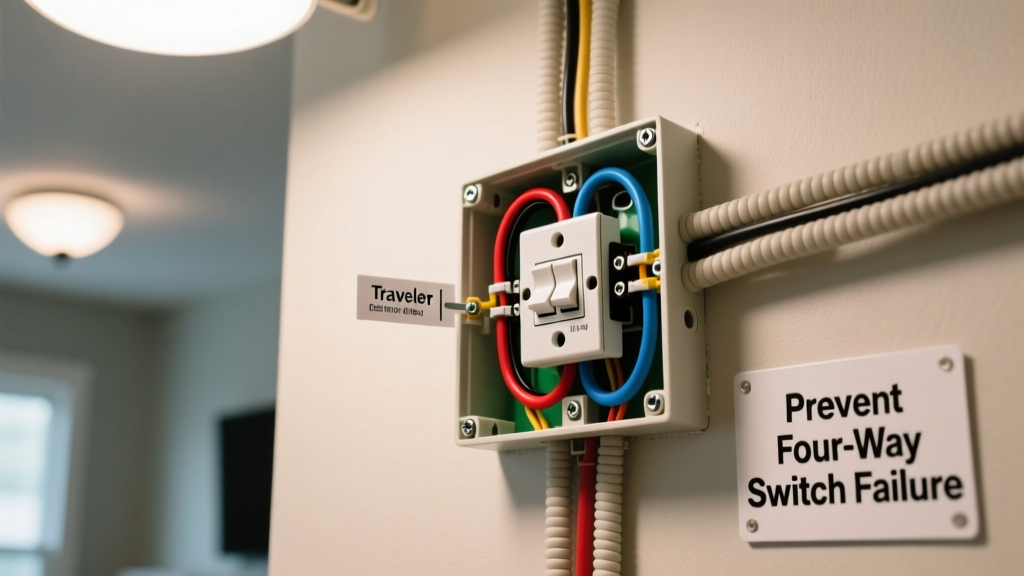
A four-way switch controls a single light or set of lights from three or more locations—common in hallways, stairwells, and large rooms. When one fails, the entire circuit goes dark, creating safety hazards and daily frustration. Unlike a single-pole switch, a four-way has two traveler wires and relies on precise coordination with two three-way switches—so small issues compound quickly.
Why This Happens
Four-way switches rarely fail catastrophically overnight. Most problems stem from cumulative wear or installation flaws:
- Loose wire connections at terminals—especially aluminum wiring or back-stabbed conductors—cause intermittent contact and arcing
- Oxidation on brass terminals (common in humid basements or garages) increases resistance over time
- Switches rated for 15A used on 20A circuits overheat, degrading internal contacts
- Vibration from nearby HVAC units or slamming doors loosens mounting screws and internal linkages
According to the National Fire Protection Association’s Electrical Equipment Fire Patterns (2022), 18% of residential arc-fault incidents involving lighting circuits originated at multi-way switch junctions—not outlets or fixtures.
Maintenance Checklist
| Frequency | Task | Tools Needed |
|---|---|---|
| Daily | Observe operation: does light respond consistently from all switch locations? | None |
| Weekly | Listen for faint buzzing or crackling near switch plates during use | None |
| Monthly | Check plate screws are tight; gently wiggle switch—no movement should occur | #1 Phillips screwdriver |
| Yearly | Power off circuit, remove cover, inspect terminals for corrosion or discoloration; retorque to 14 in-lb | Voltage tester, torque screwdriver, contact cleaner |
Warning Signs
Don’t wait for total failure. These symptoms mean action is needed within 72 hours:
- Light works from one location but not another—e.g., top of stairs works, bottom doesn’t
- Switch feels spongy, sticky, or requires extra force to toggle
- Faint warm spot on the switch plate (use infrared thermometer: >104°F/40°C is unsafe)
- Visible greenish powder or black soot around screw terminals
Recommended Products
Not all switches are equal—and generic replacements often worsen reliability. Prioritize these:
- Leviton Decora 4-Way Smart Switch (DW3CL-1BZ): UL-listed for 20A, with built-in surge protection and diagnostic LEDs
- Klein Tools 69108 Continuity Tester: Verifies traveler wire integrity without opening the box
- DeoxIT D5 Contact Cleaner: Removes oxidation without residue—tested safe on brass, copper, and silver-plated contacts
Can I replace a four-way switch myself?
Yes—if you’re comfortable turning off the correct breaker, verifying zero voltage with a non-contact tester, and labeling all four wires before disconnecting. But miswiring travelers (T1/T2) is the #1 cause of post-replacement failure. Always sketch the existing configuration first. If unsure, hire a licensed electrician—especially if your home was built before 1990 and uses knob-and-tube or cloth-insulated wiring.
How often should I replace four-way switches?
There’s no fixed lifespan, but most mechanical four-way switches last 25–30 years under normal use. However, homes with high-traffic stairwells (e.g., multi-family dwellings or homes with children) see failure rates climb after 12 years—per data from the Electrical Safety Foundation International’s Residential Switch Lifespan Study (2021). Replace proactively if you’ve had two or more repairs on the same circuit.
Why does only one position work?
This usually means one traveler wire has lost continuity—or a terminal screw inside the four-way is cracked. The switch has two internal poles; if either fails, only half the toggle positions complete the circuit. A multimeter test across the traveler terminals (with power OFF) should read near-zero ohms in both toggle positions. If it reads open in one position, the switch is defective.
Do LED bulbs affect four-way switch performance?
Yes—but indirectly. Low-wattage LED loads can cause ghost voltage or phantom switching in older switches with mechanical contacts. That’s why modern four-way switches like the Lutron Maestro series include minimum-load compensation. If flickering occurs only with LEDs, upgrade the switch—not the bulbs.
What’s the difference between a three-way and four-way switch?
A three-way switch has three terminals (common + two travelers) and starts/ends the circuit. A four-way sits between two three-ways and has four terminals—two input travelers and two output travelers. You can’t substitute one for the other. Confusing them causes immediate non-operation. For visual reference, see our wiring diagram comparison.
Should I install smart switches in multi-location setups?
You can—but only with compatible systems. Lutron Caseta and Leviton Decora Smart require a neutral wire and specific companion devices for four-way functionality. Avoid retrofitting single-pole smart switches into multi-location circuits—they’ll break the traveler path. Instead, use a smart master switch paired with mechanical smart-ready remotes designed for multi-way use.
"Most 'failed' four-way switches we troubleshoot aren't dead—they're just miswired or starved of torque. A properly tightened 14 in-lb connection lasts twice as long as one at 8 in-lb." — Master Electrician Maria Chen, NECA Certified Trainer, 2023
Prevention isn’t about replacing parts before they’re needed—it’s about respecting how precision-dependent multi-location switching really is. A loose screw, a corroded terminal, or a mislabeled traveler wire can shut down lighting for an entire floor. Stay ahead with monthly checks, yearly inspections, and the right tools. And when in doubt, consult a professional—especially before modifying circuits in older homes. Your stairwell lighting shouldn’t be a guessing game.