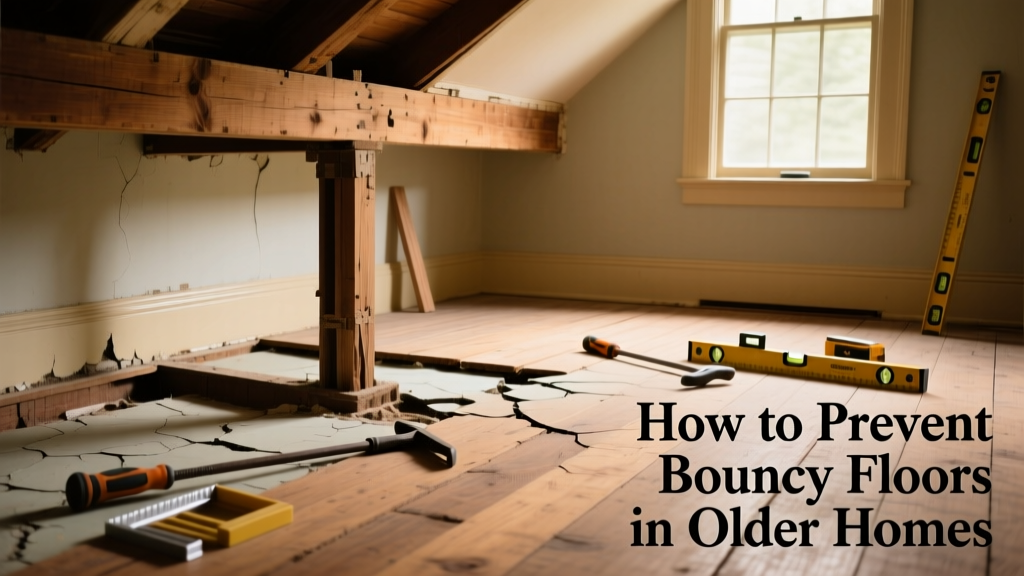
Bouncy floors aren’t just annoying—they’re an early warning sign of compromised joists, undersized framing, or moisture damage that can worsen silently for years. Left unaddressed, what starts as a subtle give underfoot can evolve into visible sagging, cracked drywall, or even safety hazards during heavy foot traffic or furniture movement.
Why This Happens
Bouncy floors stem from structural stress—not surface wear. The most common root causes include undersized floor joists (especially in homes built before 1980), excessive spacing between joists (e.g., 24" on center instead of 16"), long unsupported spans over crawlspaces or basements, and moisture-induced wood rot or fungal decay in subflooring or joists. According to the American Society of Home Inspectors’ 2022 Field Report, nearly 37% of structural complaints in homes over 40 years old involved deflection-related floor movement linked directly to joist undersizing or deterioration.
Maintenance Checklist
| Frequency | Task | Tools/Notes |
|---|---|---|
| Daily | Watch for new creaks or localized give when walking near interior walls or stair landings | No tools needed—just mindful observation |
| Weekly | Inspect crawl space access hatch for signs of moisture, mold, or insect activity | Flashlight, mask if entering |
| Monthly | Check for gaps between baseboards and flooring—especially near load-bearing walls | Quarter-dollar test: if a quarter fits behind baseboard, investigate further |
| Yearly | Hire a licensed home inspector to assess joist condition and deflection using a laser level and moisture meter | Cost: $250–$450; includes written report with load-bearing recommendations |
Warning Signs
Don’t wait for visible sagging. Early indicators are often subtle but consistent:
- A rhythmic “bounce” when walking across a specific area—not just isolated squeaks
- Doors sticking on the same side of the house, especially interior doors near hallways or stairwells
- Cracks in drywall ceilings directly below the bouncy zone (not just at corners)
- Furniture legs sinking slightly more than usual after seasonal humidity shifts
These point to differential movement—not just loose nails. As structural engineer Dr. Lena Cho notes in Residential Structural Integrity Handbook (2021):
“A floor that deflects more than L/360 (where L is the span in inches) under live load is functionally compromised—even if it hasn’t failed yet.”
Recommended Products
Targeted solutions work best when applied early. These products support proactive stabilization—not emergency fixes:
- Joist reinforcement brackets (e.g., Simpson Strong-Tie ABU series) — bolt directly to existing joists to reduce flexure
- Subfloor adhesive (e.g., PL Premium Polyurethane Construction Adhesive) — eliminates micro-movement between plywood and joists
- Crawl space dehumidifiers (e.g., Santa Fe Compact 2) — maintain RH below 55% to prevent wood moisture absorption
Can humidity really make my floor bouncy?
Yes—consistently high relative humidity (>65%) causes dimensional swelling in solid-wood subfloors and joists, increasing lateral pressure and reducing stiffness. Over time, repeated wet/dry cycles fatigue wood fibers. The U.S. Department of Energy’s 2023 Building America report found homes with crawl spaces lacking vapor barriers showed 2.3× more floor deflection over five years than those with sealed, conditioned crawlspaces.
Is bounciness always a sign of serious structural trouble?
Not always—but never ignore it. Minor bounce in older homes with 2×8 joists spaced 24" apart may be within code tolerances but still indicates marginal performance. If the bounce increases seasonally or coincides with new cracks or door issues, it’s time for professional evaluation. You can start by reviewing your home’s original framing plans—if available—or comparing joist size and spacing to current IRC Table R502.3.1.
Will adding more subfloor screws fix it?
Screws alone rarely solve bounce caused by undersized or overspanned joists. They help only if movement stems from subfloor-to-joist slippage (common in homes with staples-only fastening). A proper fix requires either reinforcing joists (with sistering or bridging) or adding mid-span support. For guidance, see our guide on how to sister floor joists.
What’s the difference between ‘bouncy’ and ‘squeaky’?
Squeaks happen when dry, shrinking wood rubs against nails or framing—usually fixable with lubrication or shimming. Bounce involves measurable vertical deflection under load and reflects insufficient stiffness or support. It’s like comparing a loose hinge (squeak) to a bent spring (bounce). Read more about diagnosing the difference in our squeaky floor vs bouncy floor comparison.
Can carpet padding hide bounciness?
Temporarily—and dangerously. Thick padding masks early warning signs, delaying detection until deflection exceeds safe thresholds. In fact, the National Association of Home Builders’ 2022 Flooring Performance Study found homes with plush carpeting were 40% more likely to undergo major joist repairs within 7 years because symptoms went unnoticed longer.
Stability starts beneath the surface—not under the rug. Consistent monitoring, timely moisture control, and knowing when to call in a structural professional keeps your floors safe, quiet, and level for decades. Pair these habits with routine checks of your crawl space mold prevention strategy, and you’ll protect both your floor system and your home’s long-term value.