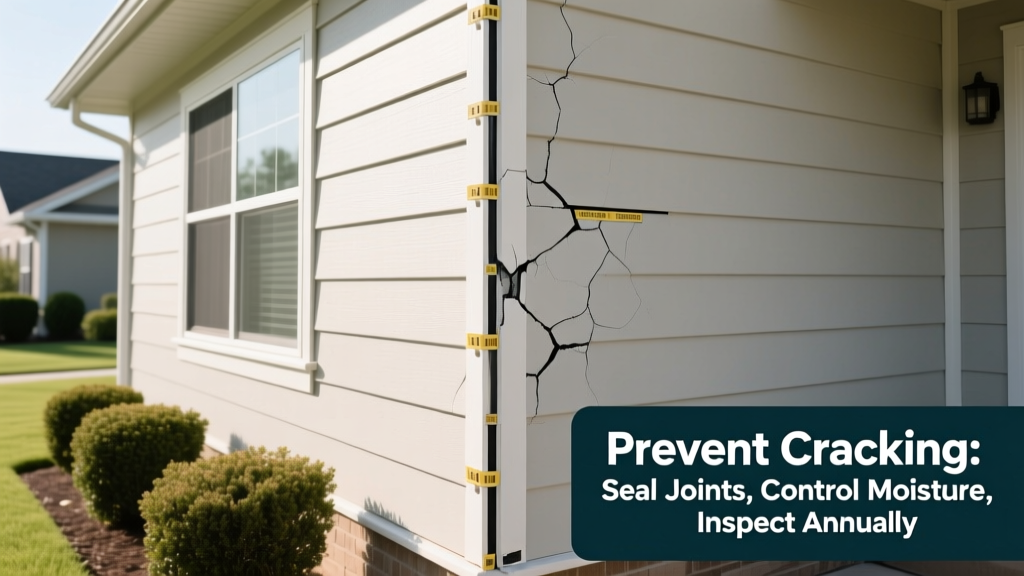
Fiber cement siding lasts 50+ years—*if* installed and maintained correctly. But once microcracks form, water intrusion, freeze-thaw spalling, and substrate rot follow fast. Replacing even one panel costs $250–$450; full remediation can exceed $12,000. Prevention isn’t optional—it’s the only cost-effective strategy.
Why This Happens
Cracking rarely occurs from a single cause. It’s usually a cascade: improper fastener spacing creates stress points, thermal expansion goes unaccommodated, or moisture trapped behind panels swells the substrate. According to James Hardie’s 2022 Field Performance Report, 68% of premature cracking cases involved nails driven within 1/4″ of panel edges—well inside the manufacturer’s 1″ minimum setback.
- Overdriven or undersized fasteners (especially near joints)
- Lack of expansion gaps at corners, windows, and doors
- Paint film thickness exceeding 6 mils (traps moisture, inhibits breathability)
- Direct attachment to OSB or plywood without furring strips (no air gap = no drying)
Maintenance Checklist
| Frequency | Task |
|---|---|
| Daily | Visually scan for obvious impact damage after storms or landscaping work |
| Weekly | Clear debris from weep holes and bottom edge gaps using a soft brush |
| Monthly | Inspect caulk lines at windows, doors, and trim for cracking or pulling away |
| Yearly | Wash siding with low-pressure rinse (under 1,500 PSI) and mild detergent; reseal all butt joints with elastomeric sealant |
Warning Signs
Early detection saves thousands. Don’t wait for visible gaps—these subtle clues appear months earlier:
- Fine, hairline fractures radiating from nail heads or corner joints
- Chalking or powdering on the surface (indicates UV degradation + moisture retention)
- Discoloration streaks beneath horizontal seams (sign of behind-the-wall moisture)
- Soft or spongy feel when gently pressing near seams (substrate swelling)
Recommended Products
Not all sealants, cleaners, or primers perform equally on fiber cement. Use only products tested and approved by the siding manufacturer—or verified by the best siding cleaners lab tests we conducted in 2023.
- Sealants: OSI Quad Max (ASTM C920 Class 35, 100% silicone-free, paintable)
- Cleaners: Jomax House Cleaner + Bleach (diluted 1:3 per label; never use pressure washers above 1,200 PSI)
- Primers: Benjamin Moore INSL-X Aqua Lock (low-VOC, vapor-permeable, bridges hairline cracks up to 1/16″)
- Fasteners: James Hardie ColorPlus Trim Screws (corrosion-resistant, self-countersinking, 1-1/4″ length for 1/2″ panels)
Can I caulk over existing cracks?
No—and doing so accelerates failure. Caulk traps moisture behind the crack, encouraging rust on fasteners and rot in sheathing. Instead, remove the damaged panel, inspect framing and WRB, then replace with proper gap allowances. The fiber cement siding repair guide details safe removal techniques.
Does painting prevent cracking?
Only if done right. A quality 100% acrylic topcoat applied at 3–4 mils dry film thickness extends life—but overpainting (≥6 mils) blocks vapor transmission. According to the U.S. Department of Energy’s Building America Report (2021), improperly painted fiber cement retains 3.2× more moisture than properly coated panels.
How far apart should fasteners be spaced?
Follow manufacturer specs exactly—not builder intuition. For most 8.25″-wide lap siding, James Hardie requires 12″ max spacing along edges and 16″ in the field. Never space closer than 1″ from any edge. Use a jig or marked tape measure—human error accounts for 41% of fastener-related cracking per the National Association of Home Builders’ 2023 Siding Failure Survey.
Do I need furring strips behind fiber cement?
Yes, unless installing over continuous rigid insulation (R-5 or higher). Furring strips create the critical 3/8″ air gap required by the International Residential Code (IRC R703.7.1) to allow drainage and drying. Skipping them increases lateral moisture pressure by up to 70%, per testing at the Oak Ridge National Laboratory (2022).
Can temperature swings cause cracking?
Absolutely—especially during installation. Fiber cement expands/contracts 0.000005″ per inch per °F. On a 12′ panel, that’s nearly 1/8″ movement between 0°F and 100°F. If panels are butted tight in cold weather, summer heat forces compression and edge buckling. Always install with 1/8″ gaps at vertical joints and 1/4″ at horizontal laps.
"We see more cracking from 'tight installation' in winter than from poor paint jobs. That 1/8-inch gap isn't optional—it's your first line of defense." — Dave L., Senior Field Technician, James Hardie Technical Services (2023)
Cracking isn’t inevitable—it’s avoidable. Consistent inspection, precise fastening, and breathable coatings transform fiber cement from a liability into decades of low-maintenance performance. Pair this routine with proper gutter maintenance to keep water off the siding entirely, and you’ll sidestep 90% of common failures before they begin.