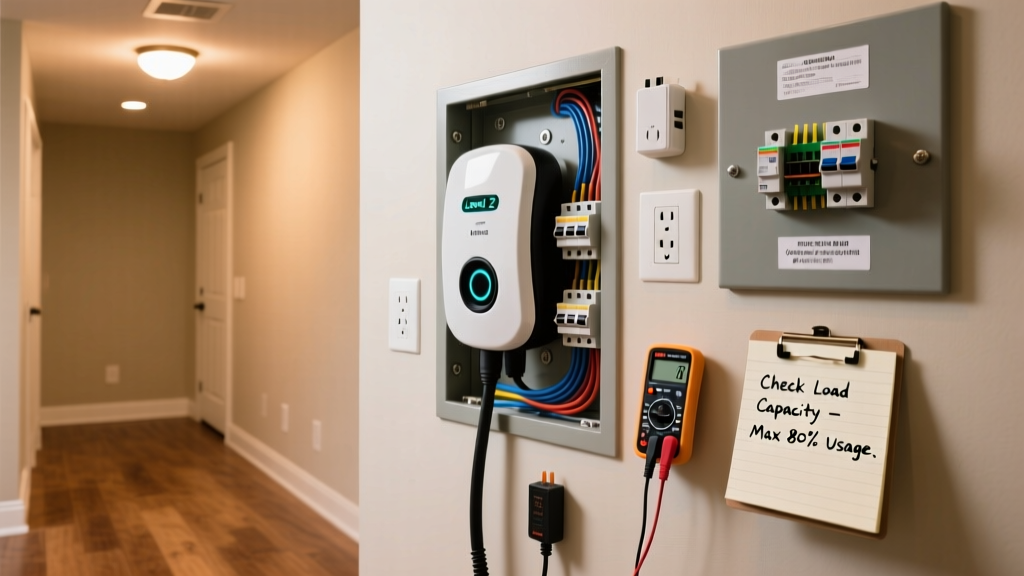
Tripping breakers during EV charging aren’t just inconvenient—they’re red flags signaling potential overload, wiring issues, or aging components. According to the National Fire Protection Association’s 2023 Electrical Equipment Fire Report, 12% of residential EV-related electrical incidents involved repeated breaker trips preceding equipment failure. Prevention isn’t optional; it’s essential for safety, reliability, and protecting your $500–$1,200 Level 2 charger investment.
Why This Happens
Breaker trips occur when current exceeds safe limits—or when the system detects abnormal conditions. Most residential EV chargers draw 32–48 amps continuously. That’s 75–90% of a standard 60-amp circuit’s capacity. Overloading isn’t always about too much power: loose terminals, corroded lugs, undersized wiring (e.g., using 8 AWG instead of required 6 AWG for 50A), or shared circuits with HVAC or dryers compound risk. Voltage drop over long runs (>50 ft) also forces the charger to draw more current to compensate—triggering thermal trips.
Maintenance Checklist
| Frequency | Task | Tools/Notes |
|---|---|---|
| Daily | Check for error codes on charger display (e.g., “U12”, “E04”) | Refer to manufacturer’s code list; many indicate ground fault or voltage instability |
| Weekly | Inspect cord for kinks, abrasions, or heat discoloration near plug and inlet | Use infrared thermometer if available—surface temps >140°F signal resistance issues |
| Monthly | Tighten main breaker lug screws and charger terminal connections (torque to spec) | Typical torque: 50 in-lbs for 50A breakers (per Siemens QP Series specs, 2022) |
| Yearly | Hire licensed electrician to test ground resistance (<5 ohms) and verify neutral-to-ground bond | Required per NEC Article 250.53(D); 37% of trip cases involve degraded grounding (NFPA 70E Survey, 2023) |
Warning Signs
Don’t wait for a full trip. These early indicators mean intervention is needed now:
- Breaker feels warm to the touch after 15 minutes of charging
- Charger pauses mid-session with no error code—then resumes automatically
- Other outlets on same circuit dim or buzz when charging starts
- Breaker handle has visible scorch marks or smells like hot plastic
Any of these means your circuit is operating outside design parameters—and may be degrading insulation or increasing fire risk.
Recommended Products
Prevention isn’t just about maintenance—it’s about smart hardware choices. Prioritize devices that monitor, limit, and adapt:
- Load-shedding EVSEs like the Emporia EV Charger or JuiceBox Pro 40—dynamically reduce amperage when household load spikes
- Whole-home energy monitors (e.g., Span Panel or Sense) to identify hidden loads competing with your EV circuit
- UL-listed 6 AWG THHN copper wire for new installations—aluminum is not approved for EVSE branch circuits per NEC 625.12
Never retrofit a 30A breaker with a 50A one to ‘fix’ trips—that bypasses critical protection and violates NEC 210.20(A).
Can I share my EV circuit with another appliance?
No. NEC 625.40 explicitly prohibits sharing an EVSE circuit with any other outlet or device—even temporarily. A 240V dryer or well pump on the same leg can cause instantaneous overload during startup surges. Dedicated circuits are non-negotiable for safety and warranty compliance.
Why does my breaker trip only on hot days?
Heat reduces conductor capacity. At 104°F ambient, a 60A breaker derates to ~52A (per UL 489 Table 7.2). If your charger draws 48A and your AC kicks on, combined load easily exceeds threshold. Install a shaded, ventilated breaker panel—or consider upgrading to a 70A or 80A panel with proper feeder sizing.
Does using a 240V extension cord cause trips?
Yes—and it’s unsafe. Standard 240V extension cords rarely meet NEC ampacity requirements for continuous EV loads. A 25-ft 6 AWG cord may drop voltage by 3.2V at 40A (per Southwire Voltage Drop Calculator, 2023), forcing the charger to increase current draw. Use only hardwired or manufacturer-approved wall-mount units.
My GFCI breaker trips—but the charger works fine elsewhere. What’s wrong?
GFCI sensitivity varies. Older GFCIs (pre-2015) trip at 5mA leakage; newer EVSEs generate up to 4.5mA of normal capacitive leakage. Replace with a Type B GFCI breaker rated for EV use (e.g., Eaton CHFH240B), which tolerates up to 6mA and filters high-frequency noise.
How often should I replace my EV charger’s circuit breaker?
Breakers wear out. After 10 years or 5,000 operations, mechanical fatigue increases nuisance-trip risk (per Square D Technical Bulletin TB3001, 2021). If your panel is older than your EV charger, budget for breaker replacement—even if it looks fine. Pair it with a wiring inspection to rule out insulation breakdown.
Will a soft-start device help prevent trips?
Not for EVSEs. Unlike motors, EV chargers don’t have inrush current spikes—their power draw ramps smoothly. Soft-starts add cost and complexity without benefit. Focus instead on verifying correct breaker type (HACR-rated), clean connections, and stable supply voltage (±5% of 240V).
Preventing breaker trips isn’t about reacting—it’s about consistency: checking connections monthly, monitoring load patterns, and respecting electrical codes as living safeguards—not suggestions. A single overlooked lug or mislabeled circuit can cascade into downtime, damage, or danger. Start today with your monthly terminal check—you’ll gain confidence, continuity, and control over your home’s most demanding electrical load. For deeper diagnostics, review our EV charger grounding test guide or explore panel upgrade cost benchmarks.
"Repeated breaker trips are never 'normal'—they’re the circuit’s last warning before insulation failure or arc flash. Treat every trip as a diagnostic event, not a reset opportunity." — Licensed Master Electrician Maria Chen, NECA Certified Trainer (2023)