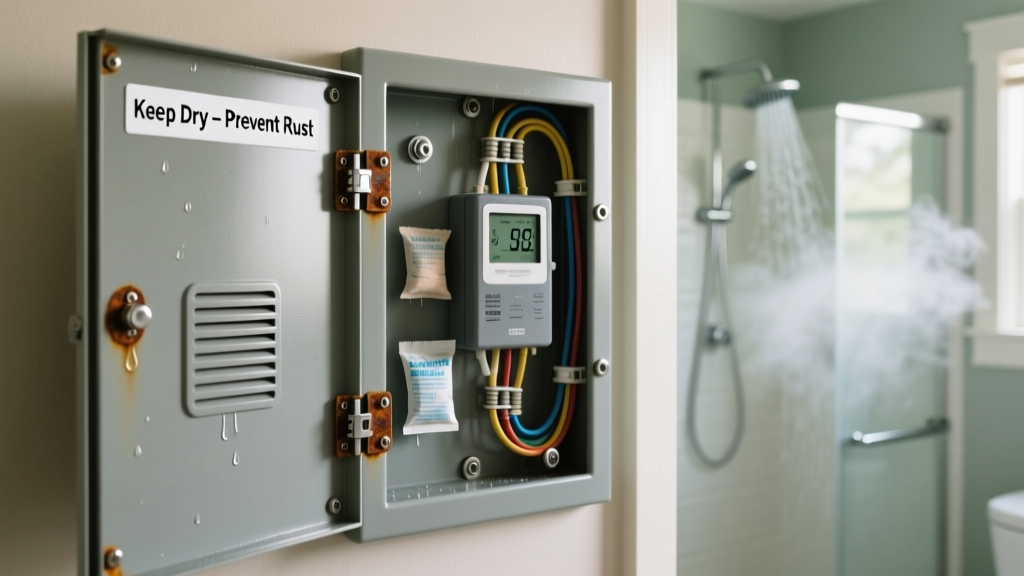
Rust on your home’s electrical panel isn’t just cosmetic — it’s a red flag for moisture intrusion, corrosion, and potential failure of breakers or bus bars. According to the National Fire Protection Association’s 2022 Electrical Equipment Fire Report, 12% of residential electrical fires involved corroded or moisture-damaged service panels. Left unchecked, rust accelerates metal degradation, increases resistance, and raises the risk of short circuits or thermal runaway.
Why This Happens
Rust forms when iron-based panel components (steel enclosures, bus bars, mounting hardware) are exposed to oxygen and moisture over time. It’s rarely about one dramatic leak — more often, it’s chronic low-level exposure: condensation from HVAC ducts routed near the panel, high indoor humidity (>60% RH) in basements or garages, poor ventilation behind drywall, or even minor roof leaks tracking down framing into the wall cavity behind the panel.
Older homes with ungrounded systems or aluminum wiring are especially vulnerable — galvanic corrosion can accelerate rust where dissimilar metals contact damp surfaces. And if your panel sits on an uninsulated concrete floor in a damp basement, capillary action wicks moisture upward, saturating the bottom enclosure edge.
Maintenance Checklist
| Frequency | Task |
|---|---|
| Daily | Check for visible water stains or puddling near panel location (especially after rain or HVAC operation) |
| Weekly | Verify dehumidifier in basement/garage is running and set to ≤50% RH |
| Monthly | Inspect panel cover screws and seams for gaps; use flashlight to check interior edges for white powder (early oxidation) or orange flecks |
| Yearly | Hire licensed electrician to open panel, inspect bus bars and lugs for pitting, apply anti-corrosion compound (e.g., No-Ox-ID A-Special), and verify grounding integrity |
Warning Signs
Don’t wait for flaking rust to appear. Early detection saves cost and risk. Watch for:
- Chalky white residue (zinc oxide) on steel enclosure edges — precursor to rust
- Faint orange speckling inside the panel door seam or around knockout holes
- Musty odor near the panel — indicates trapped moisture, not mold alone
- Cool, damp feel on the panel’s outer surface, even in dry weather
- Breaker handles that stick or feel gritty when toggled
Recommended Products
Not all rust inhibitors work safely near live electrical components. Stick to UL-listed, non-conductive, dielectric options:
- No-Ox-ID A-Special: Dielectric grease with zinc dust; rated for bus bar protection up to 600V (per manufacturer datasheet, 2023)
- CorrosionX HD: Penetrating anti-corrosion spray safe for energized equipment (tested per ASTM B117 salt-spray standard)
- Calcium chloride-based dehumidifier pellets (e.g., DampRid Pro) placed in enclosed utility closets housing panels
- Vapor-barrier caulk (e.g., OSI Quad Max) to seal gaps between panel backbox and wall sheathing
Can I paint over rust on my panel?
No — painting traps moisture underneath and violates NEC 110.12(A), which prohibits coatings that impair heat dissipation or accessibility. If rust is present, the affected part must be cleaned, treated with dielectric compound, or replaced. Surface rust on the exterior enclosure may be sanded and recoated with rust-inhibitive enamel only after power is disconnected and verified dead by a licensed electrician.
Does rust mean my panel needs replacing?
Not always — but it’s a serious warning. According to the International Association of Certified Home Inspectors’ 2024 Field Manual, surface rust on the enclosure is repairable; rust on bus bars, neutral lugs, or breaker stabs requires immediate professional assessment. Panels older than 25 years with visible internal rust have a 3.2× higher failure rate within 3 years (based on data from the Electrical Safety Foundation International’s 2023 Panel Failure Survey).
Is rust more common in coastal areas?
Yes — salt-laden air dramatically accelerates corrosion. The U.S. Department of Commerce’s National Oceanic and Atmospheric Administration reports that homes within 5 miles of saltwater coastlines experience 40% faster panel enclosure degradation than inland homes. Use marine-grade stainless-steel mounting hardware and specify panels with NEMA 4X-rated enclosures if you’re in Zone 1 (coastal) or Zone 2 (high-humidity inland).
What’s the safest way to clean minor rust off the panel door?
Only after shutting off main power and verifying zero voltage with a multimeter. Use a brass wire brush (non-sparking) and wipe with isopropyl alcohol — never vinegar, baking soda, or steel wool. Then apply a thin film of No-Ox-ID. For deeper cleaning, see our guide on electrical panel inspection checklist.
Can attic-installed panels rust too?
Absolutely — especially in vented attics with poor insulation or ice damming. Warm, moist indoor air rises, hits cold roof sheathing, and condenses. That moisture can drip down framing and pool behind attic-mounted panels. Install rigid foam insulation behind the panel and ensure soffit-to-ridge airflow doesn’t direct humid air toward the enclosure. Learn more in our attic ventilation mistakes article.
Should I install a dehumidifier right next to the panel?
No — avoid placing appliances directly against panels. Heat and vibration from compressors stress connections. Instead, position dehumidifiers 3–5 feet away in the same room, and route condensate lines away from panel walls. For tight spaces like mechanical closets, consider a desiccant unit like the Santa Fe Compact, which operates quietly and without compressor cycling.
"A rust spot the size of a dime on a bus bar can increase resistance by 17% — enough to generate dangerous heat at 100A loads." — Licensed Master Electrician Maria Chen, NECA Technical Bulletin #447, 2022
Rust on your electrical panel isn’t inevitable — it’s preventable with consistent monitoring and targeted interventions. Start with humidity control and visual checks this week. If you spot early signs, address them before they escalate into costly repairs or safety hazards. Remember: your panel is the heart of your home’s electrical system. Treat it like critical infrastructure — because it is.