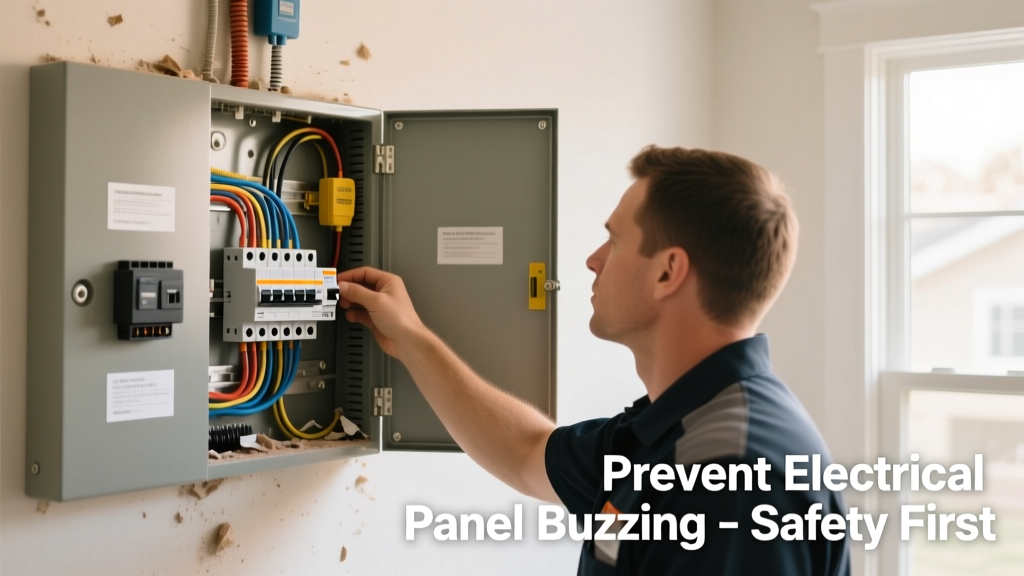
Electrical panel buzzing isn’t just annoying—it’s often the first audible warning of loose connections, overloaded circuits, or failing breakers. Left unaddressed, these issues can escalate into arcing, overheating, or even fire. The National Fire Protection Association reports that 13% of home structure fires between 2018–2022 originated from electrical distribution or lighting equipment—many with prior buzzing or humming as a red flag.
Why This Happens
Buzzing originates from physical vibration caused by electrical current interacting with magnetic fields or mechanical stress. Common root causes include:
- Loose terminal screws on breakers or bus bars (most frequent cause)
- Overloaded circuits drawing sustained current above rated capacity
- Worn or corroded breaker contacts losing proper tension
- Ground-fault or arc-fault conditions creating intermittent current surges
- Panel enclosure resonance amplifying normal transformer hum (especially in older panels)
According to the U.S. Consumer Product Safety Commission’s 2022 Electrical Hazard Report, 68% of panel-related incidents involved improper torque on connection points—often due to DIY installation or aging hardware.
Maintenance Checklist
| Frequency | Task | Tools/Notes |
|---|---|---|
| Daily | Visually scan panel for discoloration, scorch marks, or melted plastic | No tools needed; do during routine walkthroughs |
| Weekly | Listen for new or changing buzz/hum near panel (with doors closed and open) | Use quiet time—early morning or late evening—for best detection |
| Monthly | Check for warm breakers using non-contact infrared thermometer (safe threshold: ≤90°F surface temp) | Avoid touching—use IR thermometers rated for electrical use |
| Yearly | Professional torque verification of all main lugs and breaker terminals (per manufacturer specs) | Requires licensed electrician; torque values vary by brand (e.g., Square D QO: 50 in-lbs) |
Warning Signs
Don’t wait for loud buzzing to act. Subtle early warnings include:
- Faint, rhythmic humming that intensifies when large appliances cycle on (e.g., AC compressor or well pump)
- Breaker handles that feel warm to the touch—even slightly
- Flickering lights coinciding with panel noise
- Burning odor near the panel (distinct from dust-burn smell)
- Breakers tripping more frequently than usual without load changes
If you notice any of these, turn off non-essential circuits and contact a licensed electrician immediately. As master electrician Maria Chen notes in Residential Electrical Systems Handbook (2023): “A buzzing panel is never ‘just noise.’ It’s physics telling you something is vibrating under stress—and vibration means energy loss, heat buildup, and eventual failure.”
Recommended Products
These tools and components support long-term panel health—not quick fixes, but proven prevention aids:
- Torque screwdrivers calibrated to NEC-recommended values (e.g., Wiha 27100, preset at 50 in-lbs)
- Infrared thermometers with emissivity adjustment (Fluke 62 Max+ recommended for accuracy within ±1.5°C)
- Panel-mounted surge protection devices (e.g., Siemens FS140) to reduce transient-induced arcing
- Anti-oxidant compound (Noalox) for aluminum service entrance conductors to prevent corrosion-related resistance spikes
Can tightening breakers myself fix buzzing?
No—unless you’re a licensed electrician with torque calibration tools and panel-specific specs. Over-tightening can strip threads or crack breaker housings; under-tightening leaves dangerous resistance. Always verify torque values in the panel’s labeling or manufacturer documentation before adjusting. See our electrical panel safety checklist for safe inspection practices.
Is buzzing worse in summer? Why?
Yes—heat increases conductor resistance and expands metal components, loosening marginal connections. Humidity also accelerates oxidation on copper and aluminum lugs. The U.S. EPA estimates homes use 22% more electricity for cooling in July–August, increasing thermal stress on panels. That’s why monthly IR scans are especially critical June through September.
What’s the difference between normal hum and dangerous buzz?
Normal hum is low-frequency (<60 Hz), steady, and barely audible behind closed panel doors. Dangerous buzz is higher-pitched, irregular, or pulsing—and grows louder when loads change. If you hear it with the main breaker OFF, suspect utility-side issues (e.g., faulty transformer) and call your provider immediately.
Do AFCI/GFCI breakers buzz more than standard ones?
Not inherently—but their internal electronics can emit a faint, high-frequency whine (not buzz) under certain loads. This is harmless if consistent and quiet. A sudden onset or volume increase signals internal failure. Replace per manufacturer’s life expectancy: most AFCIs last 10–15 years (per Eaton Technical Bulletin TB-1127, 2021).
Should I replace an old panel just because it buzzes?
Not automatically—but if your panel is pre-1980 (e.g., Federal Pacific, Zinsco, or split-bus designs), buzzing may indicate obsolete, non-repairable components. These panels have documented failure rates up to 4× higher than modern equivalents (NFPA 921, 2022). Consult a licensed pro for a full assessment before assuming tightening will suffice.
Preventing panel buzzing starts with awareness—not waiting for the sound to get louder. Consistent visual checks, temperature monitoring, and professional torque verification every 12–18 months cut risk dramatically. Pair those habits with proper load management (avoid daisy-chaining high-wattage devices) and you’ll extend panel life by 10+ years. For deeper insight, explore our guide on identifying circuit overload signs and why breakers trip unexpectedly.