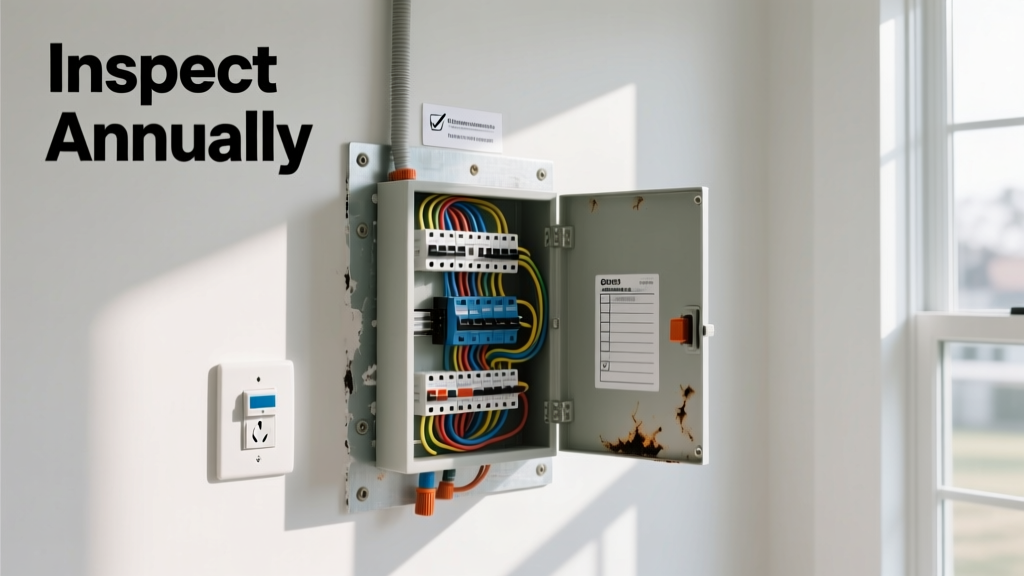
An electrical panel burn mark isn’t just cosmetic—it’s a red flag signaling arcing, overheating, or loose connections that could ignite a fire. According to the U.S. Fire Administration’s 2022 report, faulty wiring and panels cause over 34,000 home structure fires annually—nearly 10% of all residential fires. Ignoring early signs risks equipment failure, power loss, or worse: a thermal event inside your main service panel.
Why This Happens
Burn marks on breakers or bus bars almost always trace back to one or more of three root causes: loose terminal screws, corrosion from humidity or salt air, or sustained overloading beyond circuit ratings. Aluminum wiring—common in homes built between 1965–1973—expands and contracts more than copper, increasing the chance of connection loosening over time. Voltage spikes from lightning or utility switching can also carbonize insulation near terminals, leaving telltale black scorching.
- Loose breaker mounting screws (especially in older Square D QO or GE THQL panels)
- Moisture intrusion through cracked enclosures or missing knockouts
- Use of non-listed breakers (e.g., swapping a 20A for a 30A without load evaluation)
Maintenance Checklist
| Frequency | Task |
|---|---|
| Daily | Visually scan panel exterior for condensation, discoloration, or unusual warmth near cover |
| Weekly | Check for audible buzzing, sizzling, or ozone smell near panel location |
| Monthly | Tighten all accessible breaker terminal screws to manufacturer torque specs (typically 25–35 in-lbs) |
| Yearly | Hire a licensed electrician to perform infrared thermography scan and torque verification per NFPA 70B-2023 standards |
Warning Signs
Don’t wait for charring to appear. Early detection saves lives and dollars. Watch for:
- Faint gray or brown discoloration around breaker lugs—not just black soot
- Breaker handles that feel warm to the touch after normal use (not ambient heat)
- Small white powder (oxidized aluminum) near terminals in older homes
- Tripping breakers that reset but immediately trip again under same load
If you spot any of these, schedule a professional inspection before adding new loads like EV chargers or HVAC upgrades.
Recommended Products
Not all tools and materials are equal when protecting your panel. Prioritize UL-listed, NEC-compliant items designed for service-panel environments:
- Thermal imaging cameras (e.g., FLIR ONE Pro Gen 3): Detect hotspots as low as 2°C above ambient
- Breaker torque screwdrivers (e.g., Klein Tools 65202): Calibrated to ±3% accuracy for 20–40 in-lb range
- Anti-oxidant paste (Noalox or Burndy Alox): Required for aluminum-to-copper connections per NEC 110.14(A)
Can I tighten breakers myself?
Yes—but only if the panel is de-energized and you follow lockout/tagout procedures. Never tighten live terminals. Per the National Electrical Code Article 110.14(D), torque values must match manufacturer specs. Over-torquing cracks bus bar metal; under-torquing invites arcing. If unsure, learn how to safely shut off main power first—or call a pro.
Do AFCI/GFCI breakers reduce burn risk?
They help prevent downstream faults but don’t eliminate panel-level issues. An AFCI detects arc faults *after* the breaker, not internal bus bar arcing. GFCIs protect against ground leakage—not overheating. However, modern dual-function breakers (like Siemens QAF series) include enhanced thermal monitoring that alerts before catastrophic failure.
Is discoloration always dangerous?
No—but it’s never safe to ignore. Light tan oxidation on copper lugs may be benign aging; jet-black charring or blistered insulation means immediate shutdown. The Insurance Institute for Business & Home Safety’s 2023 Field Guide notes:
"Panel discoloration covering >15% of a breaker lug surface correlates with 87% likelihood of measurable resistance increase (>50 milliohms) during load testing."
How often should I replace my panel?
Most load centers last 25–40 years—but age alone isn’t the trigger. Replace if you see pitting on bus bars, brittle wire insulation, or if the panel lacks space for required AFCI/GFCI protection per current NEC editions. Panels manufactured before 1980 (especially Federal Pacific Stab-Lok or Zinsco) should be evaluated by a qualified inspector—many have documented failure rates exceeding 50% under load.
Does humidity really affect my panel?
Absolutely. In coastal or high-humidity climates, moisture accelerates corrosion on aluminum bus bars and steel mounting hardware. The U.S. EPA estimates indoor relative humidity above 60% increases metal oxidation rates by up to 300% over dry conditions. Install a small desiccant pack inside the panel enclosure (not touching conductors) and ensure outdoor-rated enclosures meet NEMA 3R or 4X specs.
Preventing burn marks starts long before smoke appears. Consistent visual checks, calibrated tightening, and timely expert evaluation turn a potential hazard into a managed system. For deeper insight, read our guide on signs of an overloaded electrical panel—it shares overlapping warning cues and helps prioritize upgrades. Stay proactive, not reactive.